




Resource Recycling
  • The Latest
  • Analysis
    • All
    • Certification Scorecard
    • Industry Announcements
    • Opinion
    SERI works to restore faith in certifications

    Building a defensible E-scrap evidence file

    tires

    The most important decision in tire recycling happens before the shredder

    Intel sign outside of company building.

    Intel’s CapEx tops $20B on server demand while PC volume shrinks

    Google sign on company building with blue sky and clouds above.

    Inside Alphabet’s Q2 results: More capital spending and cloud backlog

    Alpek closing Pennsylvania RPET plant

    Alpek seizing on war-related opportunity 

    Our top stories from March 2023

    Iron Mountain’s data center report: Strong on power, quiet on hardware

  • Conferences
    • Resource Recycling Conference
    • Plastics Recycling Conference
    • E-Scrap: The Longevity Conference
    • Textiles Recovery Summit
  • Publications
    • E-Scrap News
    • Plastics Recycling Update
    • Policy Now
    • Resource Recycling
    • Other Topics
      • All Topics
      • Brand Owners
      • Critical Minerals
      • Glass
      • Grant Watch / RFPs
      • Markets
      • Organics
      • Packaging
      • Research
      • Technology
      • Textiles
Subscribe
No Result
View All Result
Resource Recycling
  • The Latest
  • Analysis
    • All
    • Certification Scorecard
    • Industry Announcements
    • Opinion
    SERI works to restore faith in certifications

    Building a defensible E-scrap evidence file

    tires

    The most important decision in tire recycling happens before the shredder

    Intel sign outside of company building.

    Intel’s CapEx tops $20B on server demand while PC volume shrinks

    Google sign on company building with blue sky and clouds above.

    Inside Alphabet’s Q2 results: More capital spending and cloud backlog

    Alpek closing Pennsylvania RPET plant

    Alpek seizing on war-related opportunity 

    Our top stories from March 2023

    Iron Mountain’s data center report: Strong on power, quiet on hardware

  • Conferences
    • Resource Recycling Conference
    • Plastics Recycling Conference
    • E-Scrap: The Longevity Conference
    • Textiles Recovery Summit
  • Publications
    • E-Scrap News
    • Plastics Recycling Update
    • Policy Now
    • Resource Recycling
    • Other Topics
      • All Topics
      • Brand Owners
      • Critical Minerals
      • Glass
      • Grant Watch / RFPs
      • Markets
      • Organics
      • Packaging
      • Research
      • Technology
      • Textiles
Subscribe
No Result
View All Result
Resource Recycling
No Result
View All Result
Home E-Scrap

Report: Flame retardants tough to remove from skin

byJared Paben
December 20, 2018
in E-Scrap
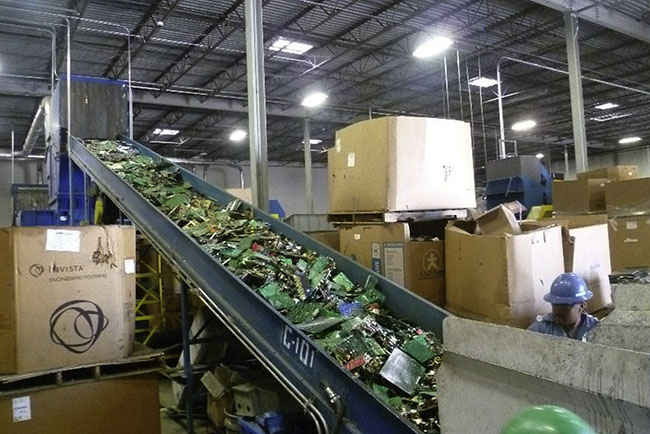
Materials and workers at an e-scrap facility.

Results of a new study suggest e-scrap workers must wipe their hands multiple times at the end of their shifts to remove toxic flame retardants.

The study was conducted by scientists at the National Institute for Occupational Safety and Health (NIOSH), Harvard T.H. Chan School of Public Health and the College of William & Mary. The resulting paper, titled “Field evaluation of sequential hand wipes for flame retardant exposure in an electronics recycling facility,” is slated to be published in the journal Chemosphere in March.

The study was conducted at an unnamed U.S. e-scrap facility that has both a manual disassembly department and a shredding and separation operation. Researchers tested isopropyl alcohol-soaked gauze and twill hand wipes used by 12 workers. The staff members wiped their hands three times sequentially before washing their hands at the end of the work day.

Broadly speaking, the study showed that while the first wiping generally removed the highest percentage of flame retardants on their hands, a large percentage – half or more – remained to be removed in subsequent wipings.

Even after the third wipe, some of the chemicals may remain on the skin. In particular, types of flame retardants that tend to combine with or dissolve in oils and fats required more passes to remove. That indicates several wipes may be needed to break down natural skin oils to remove the flame retardants. The researchers couldn’t definitively identify gauze or twill as the more effective material.

Some of the workers had worn gloves during their work shift, but researchers measured a lot of dust on their hands anyway.

Wipes used in research study.“This work is most interesting because all the dust we found on these workers’ hands was on a fairly small e-recycling facility with a small shredder,” said Diana Ceballos of the Harvard Chan School of Public Health. Ceballos was a co-author of the study. “[It provides] good motivation for firms to reduce shredding as much as possible and focus on the great refurbishing efforts happening nationwide, and to minimize shredding of plastics and other materials that are known to contain flame retardants.”

Harvard on Dec. 18 posted a news item about the research.

While much remains unknown about the human health impacts of flame retardants, studies point to a link between them and reproductive problems, low birth weight and length, delayed motor skills and decreased IQ. Different types of flame retardants have been, and continue to be, used throughout electronics components.

E-Scrap News has written about other recent studies exploring e-scrap workers’ flame retardant exposure. In one, Indiana University researchers examined a previously undetected flame retardant chemical in dust at an Ontario, Canada e-scrap facility. In another, NIOSH researchers studied exposure at an Ohio e-scrap facility and found flame retardants in workers’ urine and blood.

Photos from study.

 

Tags: Research
TweetShare
Jared Paben

Jared Paben

Related Posts

Penn State professor Maryam Shahri speaks at the PROP conference in Lancaster, Pennsylvania July 23, 2026.

How to get more people to recycle

byBrian Clark Howard
July 24, 2026

Harness the power of behavioral marketing, panelists said at the PROP conference in Pennsylvania.

Federal funds boost critical mineral research efforts

Federal funds boost critical mineral research efforts

byPaul Lane
July 16, 2026

A Midwest consortium plans to use the money to build up domestic mineral recovery and processing efforts.

Recycling council emphasizes importance of supply

Sorted: Why recycling isn’t a ‘scam’

byBrian Clark Howard
June 15, 2026

The sector has taken a beating in the press and in public perception, but recycling has many benefits.

Chemical recycling roundup: New plant, partnerships

Polystyrene’s circular future is already taking shape

byJustin Riney, Polystyrene Recycling Alliance
May 29, 2026

Justin Riney of the Polystyrene Recycling Alliance explores a study conducted with the Resource Recycling Systems consultancy.

What Netflix’s ‘Plastic Detox’ gets wrong – and right

byKeith Loria
April 23, 2026

Advocates are excited about the attention brought on plastics by the documentary, but scientists say more nuance is needed.

Hawaii trials asphalt made with plastic debris and nets

Hawaii trials asphalt made with plastic debris and nets

byScott Snowden
April 20, 2026

Researchers at Hawaii Pacific University test asphalt made with fishing nets and plastic debris, with early results showing no increase...

Load More
Next Post
Aerial view of Schupan's electronics recycling facility.

Michigan processor invests in HQ improvements

2026 Buyers’ Guide

Equipment, services and technology suppliers serving the recycling industry.

Browse the Guide

More Posts

Innovation. Partnership. Circular value.

Innovation. Partnership. Circular value.

August 1, 2026
SERI works to restore faith in certifications

Building a defensible E-scrap evidence file

August 6, 2026
Copper prices fall to lowest point since spring

EMR recycling plant to reopen in NJ after fire, legal battle

July 21, 2026
RecyClass hits 500 EU recyclability evals

RecyClass hits 500 EU recyclability evals

July 21, 2026
Cascade Asset Management sees higher sales volumes

Sorted: Restoring mineral supplies, one junk drawer at a time

July 20, 2026
What the NAND flash crunch means for remarketing, refurbishment and residual values

Telamon acquires ITAD consultancy Retire-IT

July 9, 2026
Tech giant pens detailed ‘plastic-free packaging’ guide

What Google’s latest report means for ITAD

July 8, 2026
Canada EV battery reuse pilot to start

Canada EV battery reuse pilot to start

July 8, 2026
Battery fire risk isn’t going away. Insurance is responding

Battery fire risk isn’t going away. Insurance is responding

February 24, 2026

Our top stories from October 2021

November 3, 2021
Load More

About & Publications

About Us

Staff

Archive

Magazine

Work With Us

Advertise
Jobs
Contact
Terms and Privacy

Newsletter

Get the latest recycling news and analysis delivered to your inbox every week. Stay ahead on industry trends, policy updates, and insights from programs, processors, and innovators.

Subscribe

Welcome Back!

Login to your account below

Forgotten Password?

Retrieve your password

Please enter your username or email address to reset your password.

Log In

Add New Playlist

No Result
View All Result
  • The Latest
  • Analysis
  • Recycling
  • E-Scrap
  • Plastics
  • Policy Now
  • Conferences
    • E-Scrap Conference
    • Plastics Recycling Conference
    • Resource Recycling Conference
    • Textiles Recovery Summit
  • Magazine
  • About Us
  • Advertise
  • Archive
  • Jobs
  • Staff
Subscribe
This website uses cookies. By continuing to use this website you are giving consent to cookies being used. Visit our Privacy and Cookie Policy.