




Resource Recycling
  • The Latest
  • Analysis
    • All
    • Certification Scorecard
    • Industry Announcements
    • Opinion
    NJ’s PCR delay risks making its own excuse permanently true

    NJ’s PCR delay risks making its own excuse permanently true

    E-scrap magnet recycling company scales up

    Why only some rare-earth sources are economically viable

    e-Stewards to develop an ITAD-specific standard

    Certification scorecard — week of Sept. 21

    Who should pay for lithium-ion battery fire damage?

    America’s critical-materials buildout has a feedstock problem

    Certification scorecard – week of Sept. 14

  • Conferences
    • Resource Recycling Conference
    • Plastics Recycling Conference
    • E-Scrap: The Longevity Conference
    • Textiles Recovery Summit
  • Publications
    • E-Scrap News
    • Plastics Recycling Update
    • Policy Now
    • Resource Recycling
    • Other Topics
      • All Topics
      • Brand Owners
      • Critical Minerals
      • Glass
      • Grant Watch / RFPs
      • Markets
      • Organics
      • Packaging
      • Research
      • Technology
      • Textiles
Subscribe
No Result
View All Result
Resource Recycling
  • The Latest
  • Analysis
    • All
    • Certification Scorecard
    • Industry Announcements
    • Opinion
    NJ’s PCR delay risks making its own excuse permanently true

    NJ’s PCR delay risks making its own excuse permanently true

    E-scrap magnet recycling company scales up

    Why only some rare-earth sources are economically viable

    e-Stewards to develop an ITAD-specific standard

    Certification scorecard — week of Sept. 21

    Who should pay for lithium-ion battery fire damage?

    America’s critical-materials buildout has a feedstock problem

    Certification scorecard – week of Sept. 14

  • Conferences
    • Resource Recycling Conference
    • Plastics Recycling Conference
    • E-Scrap: The Longevity Conference
    • Textiles Recovery Summit
  • Publications
    • E-Scrap News
    • Plastics Recycling Update
    • Policy Now
    • Resource Recycling
    • Other Topics
      • All Topics
      • Brand Owners
      • Critical Minerals
      • Glass
      • Grant Watch / RFPs
      • Markets
      • Organics
      • Packaging
      • Research
      • Technology
      • Textiles
Subscribe
No Result
View All Result
Resource Recycling
No Result
View All Result
Home Plastics

Equipment Spotlight: Separate black PS from black ABS

byJared Paben
April 28, 2017
in Plastics
Equipment Spotlight: Separate black PS from black ABS

Electronics and appliances present an attractive source for reclaimed plastics, but technical challenges can often inhibit recovery. Many of the e-plastics are black, which can make separation by polymer difficult.

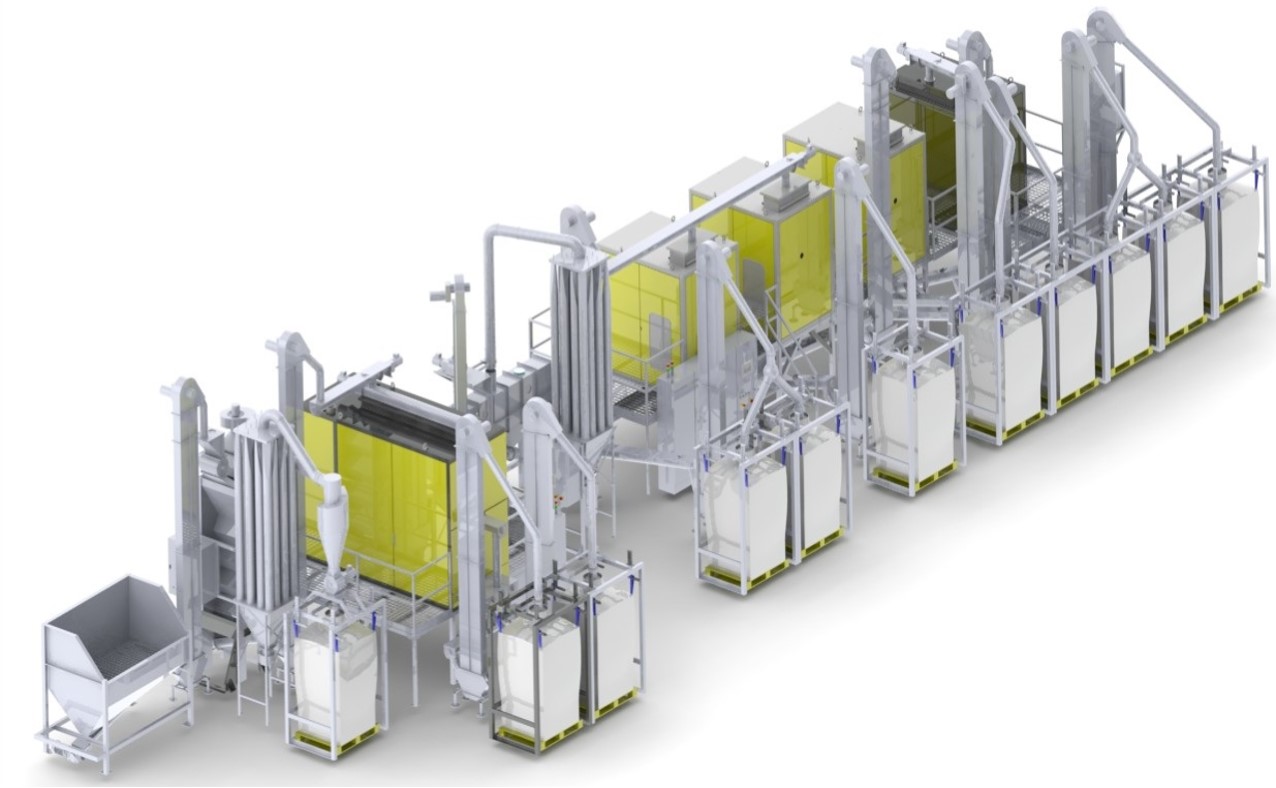
Germany-based company Hamos supplies a sorting line for plastics reclaimers looking to sort black plastics from other black plastics in those end-of-life devices.

The system is capable of removing a variety of contaminants, including rubber, wood, silicone, dirt and more, while also recovering separate black PS and black ABS stream, according to Hamos.

“Even completely black-colored fractions can be separated at the lowest sorting costs with purities of PS and ABS of better (than) 98.5 percent, something that other separation systems cannot do,” said Rainer Koehnlechner, managing director of Hamos.

The first step in Hamos’ full separation line involves pretreatment of the material, which includes screening by size, de-dusting, removal of heavy materials and the elimination of metals.

After that, float-sink techniques are used. Using a salt solution, the tank is able to sink plastics containing flame retardants to the bottom for removal, while allowing non-flame retardant PE, PS, ABS and PP/PP20 (polypropylene 20 percent talc-filled) to float. Then, using the float-sink process with freshwater, PE and PP float while PS, ABS and PP20 sink to the bottom.

The final pre-treatment step involves granulation, reducing plastics to less than 10 millimeters in size, and drying of material. The equipment will dry plastics but leave wood wet, which aids in removal of wood in the next step: electrostatic separation targeted at plastics.

Each of the company’s EKS electrostatic separators can sort up to 1,650 pound per hour of material, separating black plastics from other black plastics. Via the use of triboelectric charging, the equipment can separate PS from ABS and PP20. According to Hamos, it can achieve purities of 98.5 percent in the resulting PS stream and 99 percent in ABS stream.

The company says the sorting technologies can be used to recover plastics from a printer or a toner cartridge, for example. The e-plastics would go through the line, generating streams of PS and ABS regrind that can then be extruded and compounded and sold back to an electronics manufacturer for use in new products. The use of recycled content helps the manufacturer qualify for EPEAT ratings, a recognition of a product’s comparably lighter environmental impact. That, in turn, helps them sell products.

The company is using its technology in a demonstration plant in Germany. That plant is run by Hamos’ sister company, Wersag, which reclaims and sells PS, ABS and PP regrind from end-of-life electronics and appliances streams.

“Our know-how in WEEE (waste electrical and electronic equipment) plastic separation is based upon the experience with our own plant,” Koehnlechner said.

He noted other potential separation applications for the EKS electrostatic separators. For example, he said it would be used to eliminate PVC from PET flakes in post-consumer bottle recycling, or it can separate polyolefin mixtures into clean streams of HDPE and PP.

Koehnlechner said Hamos can provide full e-plastics lines or single EKS electrostatic separators.


 

SDS Logistics

Tags: E-PlasticsEquipmentEuropeHard-to-Recycle MaterialsPSTechnology
TweetShare
Jared Paben

Jared Paben

Related Posts

Cutting healthcare plastics could save $18B

Report provides path to reduce medical e-scrap

byPaul Lane
September 25, 2026

The European report found that circularity in medical devices is possible through several potential initiatives.

E-scrap magnet recycling company scales up

Why only some rare-earth sources are economically viable

byDavid Daoud
September 24, 2026

Rare-earth recycling economics depend on several factors, and there is no single price or date that makes the process pencil...

Study assesses environmental cost of excess data storage

BAN paper says AI e-scrap estimates are low

byPaul Lane
September 17, 2026

The advocacy group said current estimates on the scrap resulting from data centers don’t account for the full picture of...

Google Pixel 6 phone

Google makes repairability part of design ethos

byBrian Clark Howard
September 16, 2026

The tech titan supports the right-to-repair movement in several key ways.

Canada Plastics Pact reports 2024 progress

Trade tensions shift global mineral partnerships 

byPaul Lane
September 15, 2026

Canada is seeking new trade partners amid worsening US relations, while South Korea is trying to tap into deep Asian...

CommanderAI launches searchable hauler database

Inside the Circle: Put AI to work for the people who do the work

byBill Shireman
September 14, 2026

There is more than one way to use AI, and some ways are more valuable than others.

Load More
Next Post

In other news: May 2, 2017

2026 Buyers’ Guide

Equipment, services and technology suppliers serving the recycling industry.

Browse the Guide

More Posts

Recyclers reeling from NJ PCR extension

Recyclers reeling from NJ PCR extension

September 23, 2026
Oregon state capitol building with state flag and blue sky.

NAW appeals Oregon EPR ruling

September 25, 2026
Bin to Better gets students involved in reuse, recycling

Bin to Better gets students involved in reuse, recycling

September 24, 2026
Calif. Governor Gavin Newsom at podium.

Newsom signs battery EPR expansion, vetoes SB 54 fund bill

September 24, 2026

Who should pay for lithium-ion battery fire damage?

September 21, 2026
Bipartisan reps introduce bill on recycling claims

House passes bill to ease lithium-ion battery storage rules

September 24, 2026
Analysis: Undersupply of PCR is ‘stifling’ brand goals

US lawmakers urge protection of domestic RPET

September 25, 2026
US packaging is evolving. The recycling system isn’t ready

US packaging is evolving. The recycling system isn’t ready

September 16, 2026
Industry announcements for January 2026

Industry announcements for September 2026

August 31, 2026
Bridge Green, Hartree partner on mineral processing deal

Bridge Green, Hartree partner on mineral processing deal

September 21, 2026
Load More

About & Publications

About Us

Staff

Archive

Magazines

Work With Us

Advertise
Jobs
Contact
Terms and Privacy

Newsletters

Get the latest recycling news and analysis delivered to your inbox every week. Stay ahead on industry trends, policy updates, and insights from programs, processors, and innovators.

Subscribe

Welcome Back!

Login to your account below

Forgotten Password?

Retrieve your password

Please enter your username or email address to reset your password.

Log In

Add New Playlist

No Result
View All Result
  • The Latest
  • Analysis
  • Recycling
  • E-Scrap
  • Plastics
  • Policy Now
  • Conferences
    • E-Scrap Conference
    • Plastics Recycling Conference
    • Resource Recycling Conference
    • Textiles Recovery Summit
  • Magazines
  • About Us
  • Advertise
  • Archive
  • Jobs
  • Staff
Subscribe
This website uses cookies. By continuing to use this website you are giving consent to cookies being used. Visit our Privacy and Cookie Policy.