


This story originally appeared in the Winter 2021 issue of Plastics Recycling Update. Subscribe today for access to all print content.
One doesn’t need to look too far to understand just how pervasive flexible packaging has become. Just take a walk down any aisle in the grocery store.
The growing use of flexible formats makes sense from a brand owner perspective. Typically made from plastics, flexible packaging offers many benefits – convenience, shelf appeal, and extending product shelf life.
Brand owners and others are also increasingly pointing out the sustainability component. And it’s not just about there being less material use; there can also be a decrease in food waste with pouches and other single-serving-size flexible formats.
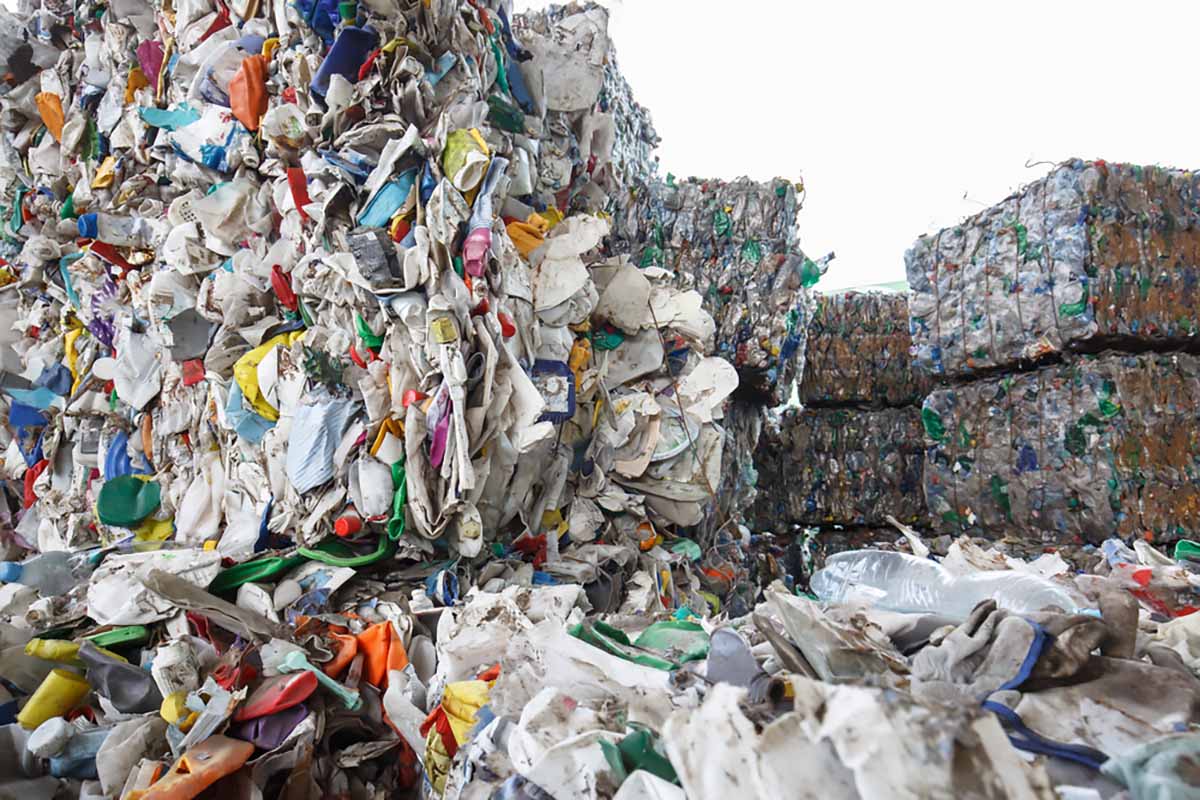
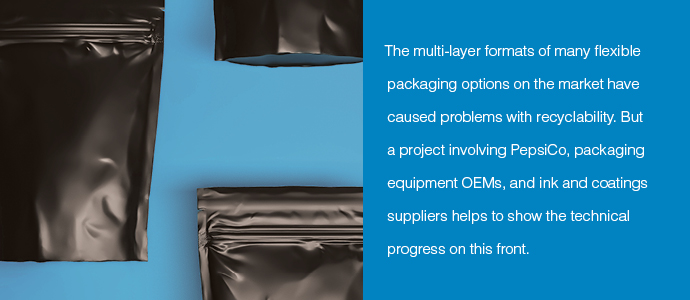
However, as readers of this publication know well, the downside of flexible packaging has been its lack of recyclability. Since many of these products have often been engineered using multi-layered film structures with high-barrier materials, recyclability has been a challenge.
But this is changing, thanks to technological innovations, the willingness of brand owners to embrace new ways of doing things, and in large part, collaboration between brand owners, packaging manufacturers and their suppliers.
This article will lay out one case study in which technical work on adhesives, inks and other components is helping to create flexibles that do not require multiple layers of material. This work represents a significant step forward on recyclability.
Collaboration is key
Last year, PepsiCo was honored as one of RadTech’s 2020 Emerging Technology Award winners for its work in exploring electron beam curing as a fast, clean and energy-efficient way to process inks, coatings and adhesives in flexible packaging operations. (RadTech is a trade association representing companies that develop ultraviolet and electron beam technologies.)
It was through its association with RadTech that a PepsiCo project management and execution specialist for packaging materials and processes met with experts from Energy Sciences, Inc. (ESI), ink manufacturer Wikoff Color Corporation and others to develop a flexible packaging manufacturing process that vastly improves the packaging’s recyclability.
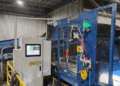
Massachusetts-based ESI is a wholly owned subsidiary of Iwasakie Electric Japan. ESI manufactures custom electron beam (EB) curing equipment, and the company has emerged as a key player in improving the recyclability of flexible packaging for snacks – such a PepsiCo’s chips and popcorn brands.
UV and EB curing refers to a special way in which coatings, inks, adhesives, composites and other materials may be cured (dried), replacing traditional methods that typically use more energy and can create harmful emissions.
In effect, the ultraviolet light spectrum in a UV lamp and the focused electrons in EB interact with specially formulated chemistries to cure material – typically quicker and using less energy, which in turn results in lower costs when compared with alternative methods.
While both UV and EB curing methods are effective, EB curing has emerged as the process of choice for packaging safety and durability-conscious food product brand owners looking to maximize both safety and sustainability.
“At ESI, applications in packaging take up the lion’s share of EB curing equipment installations,” said Im Rangwalla, senior process engineer at ESI.
Rangwalla added that a process called flexography, or “flexo,” is used most often for flexible packaging printing and converting. Innovations in this area are now opening new doors to recyclability for flexibles.
Historically, because conventional solvent or water-based inks were used, flexo-printed packaging was done by putting one color down and drying it off. Then, additional colors would be applied on top of each other with interstation thermal drying, followed by overhead drying from a tunnel thermal dryer to ensure there were no retained solvents in the ink.
But EB curing is opening up new pathways.
“For EB flexo printing,” Rangwalla said, “the process is inline with no interstation thermal drying. The colors are applied on top of each other, including an overprint varnish, all wet-on-wet and cured with one EB unit at the end, replacing a thermal overhead dryer.”
How does this affect recyclability? In short, it helps packaging developers move away from the multi-layered constructions that have been so problematic in the materials recovery stream because different layers would consist of different types of plastics with different melting points.
With EB curing, one has two options. “Mono-layer structures use EB flexo inks and [overprint varnish] to replace a laminate, thus making it one layer,” explained Rangwalla. “Or, a mono-material structure using MDO or BOPE film is laminated to a similar PE-based sealant film. EB, in this case, is used to cure the EB flexo inks as well as crosslink the PE film to provide the higher temperature resistance required for the package-filling processes.”
Either mono-material approach results in packaging that can be recycled much easier than the multi-layer structures in use today. In addition, Rangwalla pointed out, the use of EB curing provides much lower total energy and very low levels of volatile organic compounds, which can help manufacturers meet goals and mandates around carbon footprint reductions.
“Throughout the world, the biggest brands have mandates in place requiring a certain amount of structures be recyclable,” said Rangwalla. “When it comes to flexible packaging recycling, the future looks very promising.”
Ink innovation
While ESI brings its EB curing expertise to the table, Wikoff Color is helping to make more recyclable flexible packaging with the development of a flexographic ink system that cures via EB technology.
Wikoff Color has licensed an ink innovation with the goal of bringing to a wide market a more environmentally friendly ink system.
“We have been working closely with multiple key partners including EB curing experts ESI, as well as [central impression] flexo press manufacturers,” said Evan Benbow, vice president product technology and solutions for Wikoff Color Corporation. “Through collaboration, we discovered that together we could greatly improve the recyclability of flexible packaging. Our collective involvement with RadTech went a long way toward this achievement and helping brand owners meet their sustainable packaging goals.”
This new ink system from Wikoff allows converters to print thinner ink films while producing sharp dots and high definition. In addition, EB flexo technology utilizing these inks can eliminate the need for lamination while helping to reduce the overall film structure, effectively reducing the number of passes needed.
Also, these inks will not cure until passing through the EB unit – the ink can stay on press for hours or days, maximizing production by minimizing interruption to clean the press between shifts and print jobs.
“One of the unique features of these inks is that [they offer] a surface print option for flexible packaging,” Benbow explained. “If you compare to laminations, these inks offer a number of benefits in regards to sustainability. Immediately, we can begin lightweighting structures by removing the outer layer of PE typically used to protect the inks and replacing the PE with an OPV. We can also achieve the deinking of plastic structures now that the ink is no longer hidden in a lamination.”
This process enables higher value recycled plastic since the colorants are removed. Deinking also enables the supply chain to develop mono-material structures.
Benefits for all involved
Through their association with RadTech, both ESI and Wikoff came together to help PepsiCo. Here, they were able to learn in detail the brand owner’s sustainability goals, and worked together to find a solution that benefits all involved, as well as the wider recycling system.
Steve Katz is a freelance writer focused on helping companies in the package printing industry share their news and tell their stories. He can be contacted at stevekatz716@gmail.com.