



Resource Recycling
  • The Latest
  • Analysis
    • All
    • Certification Scorecard
    • Industry Announcements
    • Opinion

    ITAD is moving past its adolescent phase: beyond end-of-life

    Rainforest

    Inside the Circle: What the rainforest can teach us about EPR

    Closeup of a printed circuitboard

    Hardware demand puts new focus on parts harvesting

    Rare look inside the world’s largest plastics recycler

    Mass balance matters: Why different rules can lead to different outcomes 

    Certification Scorecard — Week of June 1, 2026

    IT asset disposition and electronics recycling: Now and then

    $60 billion in AI servers will create an ITAD challenge

  • Conferences
    • Resource Recycling Conference
    • Plastics Recycling Conference
    • E-Scrap: The Longevity Conference
    • Textiles Recovery Summit
  • Publications
    • E-Scrap News
    • Plastics Recycling Update
    • Policy Now
    • Resource Recycling
    • Other Topics
      • All Topics
      • Brand Owners
      • Critical Minerals
      • Glass
      • Grant Watch / RFPs
      • Markets
      • Organics
      • Packaging
      • Research
      • Technology
      • Textiles
Subscribe
No Result
View All Result
Resource Recycling
  • The Latest
  • Analysis
    • All
    • Certification Scorecard
    • Industry Announcements
    • Opinion

    ITAD is moving past its adolescent phase: beyond end-of-life

    Rainforest

    Inside the Circle: What the rainforest can teach us about EPR

    Closeup of a printed circuitboard

    Hardware demand puts new focus on parts harvesting

    Rare look inside the world’s largest plastics recycler

    Mass balance matters: Why different rules can lead to different outcomes 

    Certification Scorecard — Week of June 1, 2026

    IT asset disposition and electronics recycling: Now and then

    $60 billion in AI servers will create an ITAD challenge

  • Conferences
    • Resource Recycling Conference
    • Plastics Recycling Conference
    • E-Scrap: The Longevity Conference
    • Textiles Recovery Summit
  • Publications
    • E-Scrap News
    • Plastics Recycling Update
    • Policy Now
    • Resource Recycling
    • Other Topics
      • All Topics
      • Brand Owners
      • Critical Minerals
      • Glass
      • Grant Watch / RFPs
      • Markets
      • Organics
      • Packaging
      • Research
      • Technology
      • Textiles
Subscribe
No Result
View All Result
Resource Recycling
No Result
View All Result
Home Plastics

APR gives recyclability thumbs up to PP additive

byJared Paben
September 5, 2019
in Plastics
APR gives recyclability thumbs up to PP additive
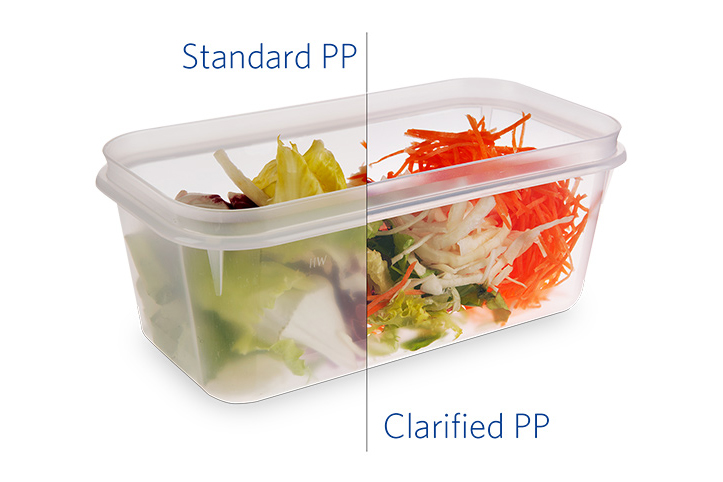
Photo provided by Milliken shows the results of the use of Millad NX 8000 clarifier.

A market-dominating polypropylene clarifier has undergone testing to prove that it neither complicates the plastics recycling process nor harms the finished product.

The Association of Plastic Recyclers (APR) on July 29 issued a letter confirming the Millad NX 8000 PP clarifier line meets or exceeds APR guidance for recycling-friendly products. The additive is produced by global company Milliken.

Milliken’s additives are used in plastic scrap coming in the doors of recycling facilities, and they are also used by reclaimers to boost the quality of their products. A member of APR, Milliken announced in May that its DeltaMax Performance Modifier is being used by reclaimer Aaron Industries to produce a new high melt flow recycled PP compound.

Milliken has also signed an exclusive supply agreement for PureCycle Technologies’ PP recycling facility in southern Ohio. The plant, which is under development, will utilize Procter & Gamble’s technology for removing colors, odors and other contaminants from post-consumer material.

The NX 8000 family of additives accounts for about 80% of the world’s clarified PP market, according to Milliken. During a July 23 APR webinar, Scott Trenor, senior polymer scientist at Milliken Chemical, talked about the additives and the testing that took place to ensure they are compatible with plastics recycling processes and markets. (Disclosure: APR owns Resource Recycling, Inc., the publisher of Plastics Recycling Update.)

How the clarifier works

A semicrystalline polymer, PP has crystals that are large enough to diffract light, which creates a hazy appearance, Trenor explained. The NX 8000 provides a clearer natural PP, allowing the plastic to compete with other materials such as PET, PS and even glass in some applications, Trenor said.

When PP is injected into a mold, nucleation of the crystals begins. The crystals will typically start growing around dust particles, talc, calcium carbonate or other non-PP materials in the mold, Trenor said. They grow at roughly equal rates, but because they start forming at different times, some of them end up being large enough to diffract light, creating the haze.

One approach is to add what’s called a particulate nucleator (Milliken’s line is called Hyperform). Essentially, the additive introduces small particles into the plastic, each of which births a crystal. The crystals end up being smaller and more uniform in size than if the additives weren’t used.

Instead of particles, however, the NX 8000 introduces a three-dimensional web in the plastic. The crystals grow off the surface of the web, providing a higher number of crystals, Trenor explained.

“The crystals that grow stay quite small, they don’t diffract light and you get a much clearer system,” he said. “And you’re able to control that and control the amount of haze and clarity that you have.”

As an example, when 500 parts per million of NX 8000 is used in a 35 melt flow random copolymer PP, the haze drops to 40% (0% is clear and 100% is opaque on the scale). At 1,000 parts per million, haze is 25%, and at 4,000 parts per million, the haze is around 5%.

Trenor said NX 8000 also yields substantial benefits to molders: It reduces molding temperatures and cycle times, decreasing energy costs and boosting production speeds. He cited one example of a company using 12 melt flow PP to injection mold drinking cups.

“Just with changing the clarifier [to NX 8000], they were able to lower their molding temperatures from 245 degrees celsius down to about 100. And that reduced cycle times, the amount of time it took them to mold the individual cups, from a little over 32 seconds down to just below 30,” Trenor said. “And just that decrease in cycle and decrease in temperature reduced their costs of production by about $50 per ton of polypropylene processed.”

At left is a control PP without the NX 8000 clarifier additive, and at right is a PP with 4,000 parts per million of NX 8000. | Courtesy of Milliken.

Testing the recycling impacts

When it came time for testing, Milliken, which is headquartered in Spartanburg, S.C., produced a 12-melt-flow random copolymer PP to use as a control and a random copolymer PP with 4,000 parts per million of NX 8000 for testing. Both batches contained a fairly standard stabilizer package, Trenor said. They were both compounded on an 18-millimeter twin-screw extruder at about 30 kilograms per hour. The plastics were cooled in room temperature water before they were strand cut.

For third-party testing, the samples were shipped to independent testing and R&D lab Plastics Forming Enterprises (PFE), which is located in Amherst, N.H. PFE mixed the control resin and the NX 8000-containing resin to create three blends: 100% control, 25% additive and 75% control, and 50% additive and 50% control.

PFE noted the plastics with NX 8000 additive all floated, so they wouldn’t inhibit proper sorting in a float-sink tank, Trenor said. PFE also melted, filtered and pelletized the plastics, testing the processing impacts and the pellets. According to Trenor’s presentation, the samples with NX 8000 were on par with the control resin in terms of melt temperature, extruder pressure, melt flow, density, volatiles content, and more.

PFE then molded strips and tested those. It found their properties were fairly constant in terms of tensile strength, izod and color, Trenor said. The exception was increased flexural modulus in the samples with higher amounts of NX 8000. That is a standard outcome with the use of nucleators and clarifiers, he said.

After examining the test results, an APR review committee approved issuing Milliken a letter confirming the clarifier meets APR Critical Guidance Protocol. Companies that receive recognition use generally use the letters to help market their products.

Milliken sees a strong future for NX 8000, which has been on the market since 2007. In March, the company announced it will build the largest clarifier plant in its history in Blacksburg, S.C. Scheduled to begin operations in 2020, the facility will boost Milliken’s NX 8000 production capacity by 50%.

“We plan to stick with this product for a while,” Trenor said during the webinar.

To receive the latest news and analysis about plastics recycling technologies, sign up now for our free monthly Plastics Recycling Update: Technology Edition e-newsletter.

 

Tags: Industry GroupsPPTechnology
TweetShare
Jared Paben

Jared Paben

Related Posts

GP Recycling offers on-ramp for smaller recyclers

GP Recycling offers on-ramp for smaller recyclers

byAntoinette Smith
June 9, 2026

The company's hubbIT platform is a way for smaller generators to sell plastic, glass and metal bottles to the brokerage,...

DOE commits federal funds toward critical minerals

ABTC wins DOE appeal for Tonopah Flats lithium refinery project

byStefanie Valentic
June 8, 2026

ABTC has won back a DOE grant that was among hundreds terminated last fall.

House resolution aims to make recyclability central to product design

NY EPR bill fails to advance after third try

byStefanie Valentic
June 8, 2026

This marks the third session in which the bill cleared the Senate only to stall in the Assembly.

Closeup of a printed circuitboard

Hardware demand puts new focus on parts harvesting

byDavid Daoud
June 5, 2026

Several key electronics parts are seeing tight supplies, potentially making for opportunities for the ITAD sector.

IT asset disposition and electronics recycling: Now and then

$60 billion in AI servers will create an ITAD challenge

byDavid Daoud
June 3, 2026

An AI growth boom suggests that a large number of devices will reach end-of-life around 2029-2031.

The independent ITAD at a crossroads

DMD acquires ITAD firm Lifespan, outlines acquisition strategy

byDavid Daoud
June 2, 2026

DMD Systems Recovery is expanding through acquisitions, starting with a business bought from Bluum Technology.

Load More
Next Post

Our top stories from August 2019

More Posts

House resolution aims to make recyclability central to product design

NY EPR bill fails to advance after third try

June 8, 2026
CalRecycle withdraws proposed regs for SB 54

Oceana, NRDC, CAW sue CalRecycle over SB 54 regs

June 5, 2026
GP Recycling offers on-ramp for smaller recyclers

GP Recycling offers on-ramp for smaller recyclers

June 9, 2026
Rainforest

Inside the Circle: What the rainforest can teach us about EPR

June 8, 2026
Rare look inside the world’s largest plastics recycler

Mass balance matters: Why different rules can lead to different outcomes 

June 5, 2026

Three-bill package aims to revamp Michigan’s bottle return system

June 9, 2026
Circular Materials to supply PlasCred chem recycling plant

Circular Materials to supply PlasCred chem recycling plant

June 4, 2026
How electronics legislation fared this legislative season

NY sends repairability labeling bill to governor

June 8, 2026
Recycling industry addresses Beyond Plastics report

Recycling industry addresses Beyond Plastics report

May 26, 2026
Industry announcements for January 2026

Industry announcements for June 2026

June 1, 2026
Load More

About & Publications

About Us

Staff

Archive

Magazine

Work With Us

Advertise
Jobs
Contact
Terms and Privacy

Newsletter

Get the latest recycling news and analysis delivered to your inbox every week. Stay ahead on industry trends, policy updates, and insights from programs, processors, and innovators.

Subscribe

Welcome Back!

Login to your account below

Forgotten Password?

Retrieve your password

Please enter your username or email address to reset your password.

Log In

Add New Playlist

No Result
View All Result
  • The Latest
  • Analysis
  • Recycling
  • E-Scrap
  • Plastics
  • Policy Now
  • Conferences
    • E-Scrap Conference
    • Plastics Recycling Conference
    • Resource Recycling Conference
    • Textiles Recovery Summit
  • Magazine
  • About Us
  • Advertise
  • Archive
  • Jobs
  • Staff
Subscribe
This website uses cookies. By continuing to use this website you are giving consent to cookies being used. Visit our Privacy and Cookie Policy.