



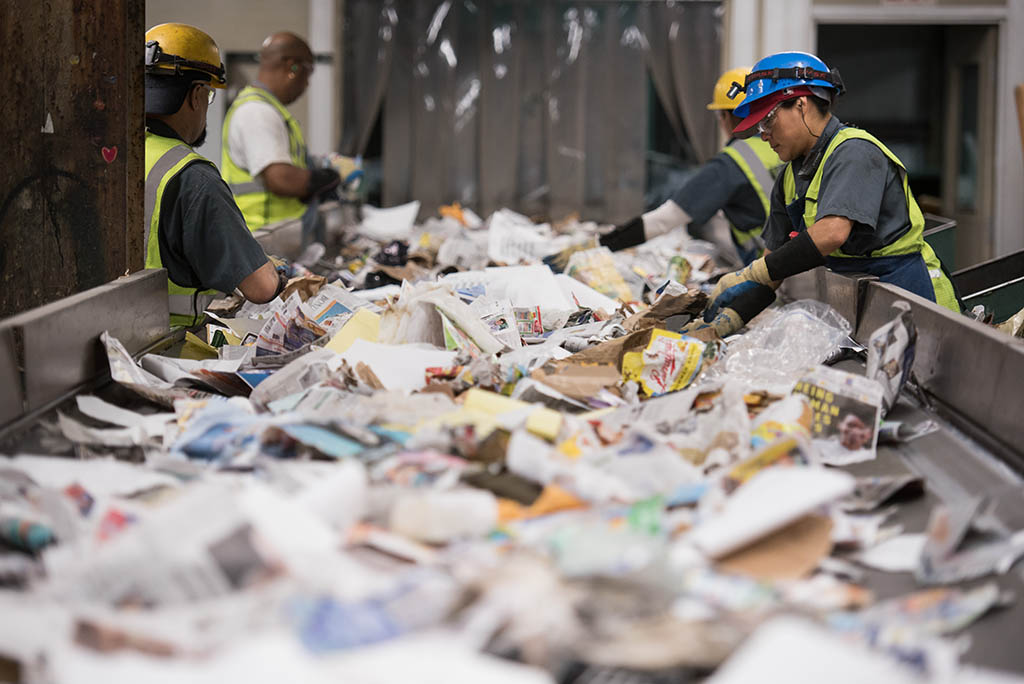
As the coronavirus continues to spread, recycling facilities are increasing distance between employees, sanitizing common areas and, in at least one case, halting the practice of punching in and out on a time clock.
MRFs, largely exempt from state shutdown orders, typically already had important personal protective equipment (PPE) protocols in place. But processing executives note they have nonetheless needed to adjust staffing and procedures on the line.
“I think for us, first and foremost, we want to make sure we protect the health and safety of our employees, and we’re willing to do whatever we need to do to make sure employees are safe,” said Bill Keegan, president of Minnesota-based Dem-Con Companies.
MRFs have some advantages
Although large swaths of Des Moines, Iowa appear as a “ghost town,” the Mid-America Recycling MRF is humming along as normal, company president Mick Barry told Resource Recycling.
In fact, some policies the company had in place prior to the pandemic are lessening the impact.
Mid-America, which employs more than 40 people, previously repositioned workers on the sorting line so they are all at least two arms’ lengths apart. The change was made for efficiency, Barry said. If sorters are too close to each other, they run the risk of grabbing the same item or bumping into each other while picking materials off the line.
“We already had social distancing without knowing that was the term,” Barry said.
Beyond spacing workers, Barry pointed to existing personal protective equipment (PPE) protocols as a benefit MRFs have in managing employee exposure to coronavirus. Workers already wear masks, goggles, puncture-proof gloves and more, he noted.
“They’re geared up for every contagion known to man coming in with the single-stream, because of the contamination levels coming from homes,” he said.
Still, Mid-America has enacted some new procedures, including additional disinfecting throughout the facility at the beginning of every day. The company has also reworked its break room, moving tables and chairs to create more distance between people. Supervisors monitor the break room to make sure social distance is in place.
When the pandemic reached Iowa, Mid-America contacted its medical supply company, brought all employees down into a meeting room – with adequate distancing – and had a discussion about new practices that would take effect.
Barry said it was important to bring in an outside expert to talk about the virus. That type of person will have more of an impact than if it was a boss reminding employees to wash their hands, he said.
Making changes ‘wherever we can’
Up in Minnesota, Dem-Con Companies has made a number of operational shifts to continue operating amid the coronavirus crisis. As in Iowa, recycling companies are considered “essential” operations in Minnesota.
Dem-Con has added social distancing measures that have required staffing changes, explained company president Bill Keegan. On the container-sorting line, the company has spaced workers out more than they were previously. This has meant reducing the number of manual sorters on that line from 10 to five.
The company also has a simple testing protocol in place to ensure social distancing: Employees on the sort line have to be able to hold out their arms and not touch anyone else with outstretched arms.
Further, the company has opened additional break room capacity and staggered break schedules to encourage social distancing. Employees are also asked to wash their hands more than usual.
Dem-Con has a cleaning crew come in twice per day – working after each shift – and it focuses on the areas of frequent use, including bathrooms, microwaves, door handles and more. The company stopped use of refrigerators, instead requiring employees to use their own coolers for food. Also, the facility stopped using a time clock for employees to punch in and out.
All staff meetings, including managerial, have all been moved outside to the parking lot to allow more room between people.
“With that social distancing, we’ve seen operational impacts,” Keegan said.
For instance, with fewer sorters, the container line is achieving lower throughput. And the sorting line is seeing higher residue in the end product because, with half the sorters, “we’re just not getting everything,” Keegan said. “We’re sending more recyclables to landfill, essentially.”
In the past, Dem-Con saw 8% to 10% residue, and it’s a few points higher now, Keegan said.
The company’s labor force has also had challenges stemming from the statewide stay-at-home order. The state enacted a tiered list of essential services, and recycling facilities fell into a category in which it was optional for schools to provide free childcare based on local needs. That created initial hurdles for employees, but local schools then agreed to provide daycare for waste and recycling workers.
“That has helped us a lot,” Keegan said.
The company has also lost some employees over concerns about coronavirus exposure. Keegan said the company is continually monitoring guidance from the CDC, which currently says COVID-19 spreads through contact with people, rather than contact with recyclables.
Dem-Con plans to continue operating under its current protocol unless that guidance changes.
“We wouldn’t be operating if we didn’t feel employees were safe,” Keegan said.
Additional company policies
Larger MRF operators around the country are making similar adjustments.
Republic Services says it is “continuing to work closely with public health experts and other advisors, as well as following guidance from the CDC and adhering to OSHA guidelines regarding the safe handling of waste and recycling.” The company has made several operational changes, including suspending bulk waste pickup in part so drivers don’t need to exit their vehicles to handle materials.
Waste Management is “providing necessary cleaning supplies and [is] increasing our vigilance in sanitizing our equipment,” the company wrote. “Additional cleaning protocols have been put in place to ensure that all facilities remain safe and limit the potential risk of spreading COVID-19.” The company is advising workers to stay home from work if they have any COVID-19 symptoms.
Casella Waste Systems, meanwhile, published an April 1 update to investors, describing its approach in responding to the coronavirus. Casella is following CDC social distance recommendations, increasing cleaning at its facilities, providing appropriate protective gear, enhancing communication, and developing new internal resources and policies.
Sims Municipal Recycling, which takes in much of the municipal recycling collected curbside in New York City, says it is “following the guidelines and recommendations made by the various authorities, including health, hygiene and social distancing at each of our sites. Restricting the spread of the virus is an issue we take very seriously, and we have the necessary safety and security processes and technology in place to mitigate the impact on our employees and customers.”