


Resource Recycling
  • The Latest
  • Analysis
    • All
    • Certification Scorecard
    • Industry Announcements
    • Opinion

    Certification scorecard for the week of March 9, 2026

    Diversion Dynamics: Secondhand exports slow down fast fashion

    Certification scorecard for the week of March 2, 2026

    Industry announcements for January 2026

    Industry Announcements for March 2026

    HP receives ocean plastics certification

    HP Inc. earnings point to memory inflation challenge

    Certification scorecard for the week of Feb. 23, 2026

    Umicore highlights strength in recycling, catalysis

    Apto, Tusaar partner on rare earths recovery

    Apto, Tusaar partner on rare earths recovery

    Certification scorecard for the week of Feb. 16, 2026

  • Conferences
  • Publications

    Other Topics

    Textiles
    Organics
    Packaging
    Glass
    Brand Owners

    Metals
    Technology
    Research
    Markets
    Grant Watch

    All Topics

Subscribe
No Result
View All Result
Resource Recycling
  • The Latest
  • Analysis
    • All
    • Certification Scorecard
    • Industry Announcements
    • Opinion

    Certification scorecard for the week of March 9, 2026

    Diversion Dynamics: Secondhand exports slow down fast fashion

    Certification scorecard for the week of March 2, 2026

    Industry announcements for January 2026

    Industry Announcements for March 2026

    HP receives ocean plastics certification

    HP Inc. earnings point to memory inflation challenge

    Certification scorecard for the week of Feb. 23, 2026

    Umicore highlights strength in recycling, catalysis

    Apto, Tusaar partner on rare earths recovery

    Apto, Tusaar partner on rare earths recovery

    Certification scorecard for the week of Feb. 16, 2026

  • Conferences
  • Publications

    Other Topics

    Textiles
    Organics
    Packaging
    Glass
    Brand Owners

    Metals
    Technology
    Research
    Markets
    Grant Watch

    All Topics

Subscribe
No Result
View All Result
Resource Recycling
No Result
View All Result
Home Recycling

A new approach to sorting containers at MRFs

byJared Paben
July 26, 2022
in Recycling
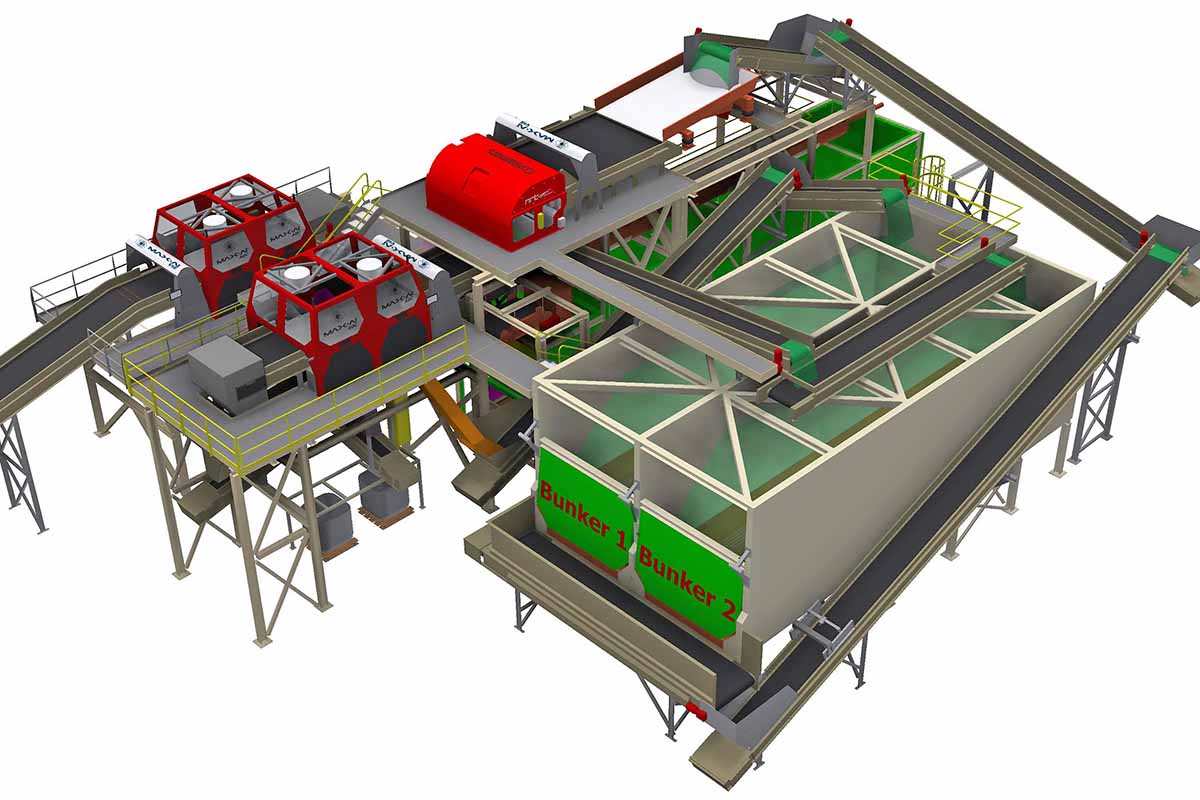
An automated sorting system uses AI to continuously reprogram itself to remove different materials. | Courtesy of BHS

An autonomous system developed by Bulk Handling Systems is really more of a sorting loop than a sorting line.

The recycling equipment manufacturer has sold the first of its container sorting loops to a large waste management company’s Canadian MRF. The system is expected to come on-line at the unnamed facility in the third or fourth quarter of this year.

“The concept … is this system has a volume of material that it’s basically able to continuously process and extract the different valuable commodities from that stream of material, until it’s basically extracted everything,” said Thomas Brooks, chief technology officer for Eugene, Ore.-based Bulk Handling Systems (BHS).

The system, which is currently set up to serve as a single-stream MRF’s container line, uses temporary storage bunkers and conveyors laid out in loops to carry mixed containers through the same AI-powered optical sorter and robotic unit multiple times. With each pass, the computer can automatically reprogram the equipment to pull out a different commodity, until the PET, natural HDPE, color HDPE, PP and aluminum cans have all been removed. Or the system can target one valuable commodity during multiple passes, to ensure high capture rates.

With the circular layout, the robotic and optical sorter can do the work of several units, without the need for human QC, according to BHS.

Around and around it goes

Brooks, who is based at BHS’ optical sorter and robotics facility in Nashville, Tenn., explained that the mixed containers first pass under an AQC-2 dual-arm robot, which pulls out fiber and other contaminants. This robot’s visioning system also analyzes the composition of the stream, gathering data that allows the autonomous system to decide how to best sort the material.

After passing through the first QC robot, the mixed containers then enter a temporary storage bunker. When the bunker is full, the computer releases the material from the bunker and a conveyor carries it to an optical sorter equipped with an AI visioning system and near-infrared detection. If the optical sorter is programmed to remove PET, for example, then the ejected PET goes to another AQC-2 dual-arm robot to further clean the PET stream. After that, the clean PET goes into a bunker (or bunkers, depending on how much material the computer sees in the stream and how many bunkers it decides to allocate for the plastic), before baling.

In this scenario, the mixed containers that weren’t ejected by the optical sorter – essentially everything other than PET – are conveyed back to the temporary storage bunker, before the computer releases them for another pass through the sorting equipment. If, for example, the value of PET is particularly high and the MRF operator wants to ensure all of it is captured, the computer could give the optical sorter another pass to pull out any PET that was missed on the first try. Or the system could move on to the next most plentiful commodity in the stream.

The first system sold to the Canadian MRF is located in a province with a bottle deposit program. As a result, the second AQC-2 robot won’t just be pulling contaminants out; it will also separate deposit containers, Brooks said.

The system can sort 6.5 tons per hour, and because no human sorters are needed, it can run almost 24/7, with only one or two hours a day needed for maintenance, Brooks said.

“The beauty of this is it’s set up to run continuously, independent of what your manpower resources are,” he said.

Building blocks to autonomy

Brooks said the system was only made possible by technological advances over the years. “We had to put together a bunch of building blocks to get here,” he said.

Key steps were the development of the MAX-AI robotic system, which uses a visioning system to identify materials by appearance; BHS’ Total Intelligence Platform, which uses sensors and software to provide real-time data on MRF performance; and the pairing of the AI-powered visioning system with optical sorters.

As opposed to a line, the loop approach also allows for a much smaller footprint, in the range of one-sixth or one-fifth the size of a linear system, Brooks said. That makes it ideal for urban facilities without much available space.

Brooks noted that the system would also work for smaller municipalities that have too much material to sort manually – especially with difficult labor markets – but not enough to justify buying half a dozen optical sorters and robots.

In terms of cost, BHS has initially priced the system at only slightly more than what it would cost to buy each of the pieces of equipment separately, he said. The slightly higher price – in the range of 2-3% – is a recognition of the value of an autonomous system, he explained.

BHS didn’t jack up the price because “we really view this as kind of an enabler that we see going forward, not only for our company but really just trying to drive an initiative toward recycling and recovery,” he said.

BHS has a patent covering how the system gathers data and decides how to move and sort material – essentially the humanless decision-making process. This first container loop is a jumping off point for other systems with autonomous control, Brooks said.

“I have this dream of a lights-out facility, where material is brought in, it’s all processed, processed material is run out the back, and you have one or two maintenance personnel that are running the whole thing,” Brooks said. “Some people tell me that’s a little bit of a pipe dream, and I’m OK with that.”

A version of this story appeared in Plastics Recycling Update on July 19.
Tags: MRFsTechnology
TweetShare
Jared Paben

Jared Paben

Related Posts

Machinex debuts organics co-collection system

Coastal partners with Machinex on four Florida MRF projects

byStefanie Valentic
March 10, 2026

Coastal Waste & Recycling is accelerating its MRF upgrade strategy as it partners with Machinex on four projects.

AI servers reshape ITAD sector, recyclers brace for new wave

byScott Snowden
March 9, 2026

The coming retirement of AI data center hardware could reshape IT asset recovery, as recyclers prepare for complex servers packed...

CommanderAI launches searchable hauler database

CommanderAI launches searchable hauler database

byAntoinette Smith
March 4, 2026

The new tool provides a "matchmaking service" for waste haulers and generators, to help streamline demand sourcing and potentially increase...

RCI, CurbWaste partner on waste management software 

RCI, CurbWaste partner on waste management software 

byPaul Lane
February 24, 2026

CurbWaste now provides the operational management and data platform for the Recycling Certification Institute, which works to improve transparency in...

WM opens new $90m MRF in south Florida 

WM opens new $90m MRF in south Florida 

byAntoinette Smith
February 23, 2026

The new facility is expected to process the most volume of recyclables in the hauler's MRF network.

The electronics recycling industry is undergoing a transformation from labor-intensive manual operations to highly automated, AI-driven facilities that use advanced robotics, cleaner chemistry and digital tracking systems to extract critical materials.

The cyber-physical MRF: AI and robotics reshape e-waste recovery

byDavid Daoud
February 12, 2026

The electronics recycling industry is entering a new phase of technological acceleration. Advances in artificial intelligence, robotics, advanced chemistry, and...

Load More
Next Post

Publishing and events firm buys Waste Dive parent for $389M

More Posts

How rising fuel and memory prices are impacting ITAD’s margins

How rising fuel and memory prices are impacting ITAD’s margins

March 10, 2026
ERI sues Revivn alleging raid on staff and trade secrets

ERI sues Revivn alleging raid on staff and trade secrets

March 10, 2026

Mint, HP close loop on recycled copper

March 3, 2026
Panelists: Textile recycling requires more automation

Panelists: Textile recycling requires more automation

March 3, 2026
Greenway now takes e-scrap from Midwest businesses

Greenway now takes e-scrap from Midwest businesses

March 11, 2026
RecycleDat! collects nearly 197,000 cans at Mardi Gras

RecycleDat! collects nearly 197,000 cans at Mardi Gras

March 9, 2026
K-Cup recycling comes to Ontario Blue Boxes

K-Cup recycling comes to Ontario Blue Boxes

March 2, 2026
UN trade data, tools aim to shape plastics treaty talks

UN trade data, tools aim to shape plastics treaty talks

February 17, 2026

Blue Whale scales up battery recycling in OK

January 26, 2026
New Comstock site to feed Nevada solar panel recycling

New Comstock site to feed Nevada solar panel recycling

January 13, 2026
Load More

About & Publications

About Us

Staff

Archive

Magazine

Work With Us

Advertise
Jobs
Contact
Terms and Privacy

Newsletter

Get the latest recycling news and analysis delivered to your inbox every week. Stay ahead on industry trends, policy updates, and insights from programs, processors, and innovators.

Subscribe

Welcome Back!

Login to your account below

Forgotten Password?

Retrieve your password

Please enter your username or email address to reset your password.

Log In

Add New Playlist

No Result
View All Result
  • The Latest
  • Analysis
  • Recycling
  • E-Scrap
  • Plastics
  • Policy Now
  • Conferences
    • E-Scrap Conference
    • Plastics Recycling Conference
    • Resource Recycling Conference
    • Textiles Recovery Summit
  • Magazine
  • About Us
  • Advertise
  • Archive
  • Jobs
  • Staff
Subscribe
This website uses cookies. By continuing to use this website you are giving consent to cookies being used. Visit our Privacy and Cookie Policy.