





Resource Recycling
  • The Latest
  • Analysis
    • All
    • Certification Scorecard
    • Industry Announcements
    • Opinion

    Certification scorecard – Week of March 23, 2026

    Certification Scorecard – Week of March 16, 2026

    Groups identify recovered plastics users in the Northeast

    Bale pricing for recycled plastics diverges

    Why global ITAD is stranded in the Gulf

    Why global ITAD is stranded in the Gulf

    Certification scorecard for the week of March 9, 2026

    Diversion Dynamics: Secondhand exports slow down fast fashion

    Certification scorecard for the week of March 2, 2026

    Industry announcements for January 2026

    Industry Announcements for March 2026

    HP receives ocean plastics certification

    HP Inc. earnings point to memory inflation challenge

  • Conferences
  • Publications

    Other Topics

    Textiles
    Organics
    Packaging
    Glass
    Brand Owners

    Metals
    Technology
    Research
    Markets
    Grant Watch

    All Topics

Subscribe
No Result
View All Result
Resource Recycling
  • The Latest
  • Analysis
    • All
    • Certification Scorecard
    • Industry Announcements
    • Opinion

    Certification scorecard – Week of March 23, 2026

    Certification Scorecard – Week of March 16, 2026

    Groups identify recovered plastics users in the Northeast

    Bale pricing for recycled plastics diverges

    Why global ITAD is stranded in the Gulf

    Why global ITAD is stranded in the Gulf

    Certification scorecard for the week of March 9, 2026

    Diversion Dynamics: Secondhand exports slow down fast fashion

    Certification scorecard for the week of March 2, 2026

    Industry announcements for January 2026

    Industry Announcements for March 2026

    HP receives ocean plastics certification

    HP Inc. earnings point to memory inflation challenge

  • Conferences
  • Publications

    Other Topics

    Textiles
    Organics
    Packaging
    Glass
    Brand Owners

    Metals
    Technology
    Research
    Markets
    Grant Watch

    All Topics

Subscribe
No Result
View All Result
Resource Recycling
No Result
View All Result
Home Recycling

Detailing the shift to EPR in three Canadian provinces

Bobby ElliottbyBobby Elliott
June 28, 2016
in Recycling

“It’s been a resounding success,” said Robert Costanzo, engineering and operations manager for Surrey, British Columbia.

Detailing the development and the rollout of extended producer responsibility (EPR) systems in three Canadian provinces, webinar speakers made the case that the EPR approach has led to higher diversion rates and increased access to recycling services.

In EPR systems, brand owners are mandated to fund and/or manage recovery systems for the products they put in on the market in a given jurisdiction.

The recent webinar was hosted by the Product Stewardship Institute, a nonprofit group that advocates for producer responsibility policies.

Adapting to the new order

Systems currently in place in British Columbia, Ontario and Quebec were discussed during the webinar. British Columbia and Quebec call on producers to fund all program costs, and Ontario, until recently, has required municipalities and producers to split costs.

According to Claudia Marsales, a senior manager in Markham, Ontario, a city with about 300,000 residents, the infusion of producer funding into the province’s extensive curbside recycling system has been critical.

“It really was seamless. It is a funding model to help cover the costs and make the service more efficient,” Marsales said.

She said a wide range of materials are collected in Ontario and the province has attained a 60 percent diversion rate. That’s been made possible by a unique funding structure established by the Waste Diversion Act of 2002 that calls on municipalities and producers to split the costs of the program.

“It was a good model on both sides,” Marsales said.

Nicolas Boiselle, a waste management advisor for the Quebec Ministry of Sustainable Development, told listeners that the province has also achieved a residential diversion rate north of 60 percent. The province has had an EPR law in place since 2005 that is intended to cover all costs of running municipal programs for printed paper and packaging.

“It was somewhat easy to integrate existing services and infrastructure,” Boiselle said.

All three province speakers noted the impact of EPR programs on existing programs and infrastructure was minimal. While the funding structure changed, most communities continued running programs as usual.

Program funding questions

Still, representatives from the provinces also noted some kinks need to be worked out to ensure programs continue to thrive.

Marsales noted Ontario’s current system “is not perfect.” While municipalities and producers have been called on to split the cost of municipal recycling program, that hasn’t always occurred.  Brand owners last week were notified they would have to increase funding for the program in 2017.

According to Marsales, municipalities have ended up paying more than their share since the province introduced its hybrid EPR program and under recently passed legislation, brand owners will be expected to pay 100 percent of the costs. “Now it’s really time to move on,” she said of the new legislation.

Costanza from Surrey, who spoke glowingly of working with brand owners in British Columbia, also said municipalities aren’t always reimbursed fully for the costs of running their programs. British Columbia transitioned to a full EPR program for printed paper and packaging in 2014.

He said Surrey, which has a population of over 460,000 residents, receives about $4.5 million a year to run its program. That sum is not quite enough, he noted.

“It didn’t cover 100 percent of our costs, but it did cover most of our costs,” Costanza said.

To help solve similar challenges in Quebec, the government there is exploring a handful of options to improve program funding and performance.

While the program is intended to cover 100 percent of the net costs of municipal programs, Boiselle noted it isn’t. In addition, there are no performance standards under the law in Quebec to ensure diversion rates keep climbing.

Currently, Quebec is evaluating some adjustments to the program, including an approach that would call on producers to take over sorting and processing contracting and oversight.

“We’re talking about a full EPR system, where producers would be responsible for managing the program from A to Z,” Boiselle noted.

He said Quebec is still “evaluating the advantages and disadvantages of these approaches.”

Tags: EPRLocal ProgramsNorth AmericaPolicy Now
TweetShare
Bobby Elliott

Bobby Elliott

Bobby Elliott worked with Resource Recycling, Inc. from 2013 to 2021.

Related Posts

Quebec PRO reflects on first year of packaging EPR

byAntoinette Smith
March 30, 2026

The province's all-packaging collection approach has simplified messaging while providing lessons for the PRO as well as for industry.

Rural effort targets vapes as battery fire risk grows

byScott Snowden
March 24, 2026

A Wisconsin firefighter is building a rural vape collection service as discarded devices with lithium-ion batteries continue to raise fire...

ag plastics field

Ag industry holds potential for recycling feedstock

byStefanie Valentic
March 24, 2026

With less than 15% of US agricultural plastics currently being recycled, insiders say the gap between what's possible and what's...

New Providence carts underpin recycling campaign

New Providence carts underpin recycling campaign

byBrian Clark Howard
March 23, 2026

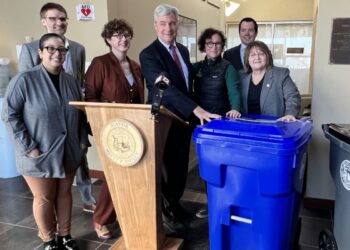
With grant assistance, the Rhode Island capital is providing about 55,000 new collection carts to help boost its recycling rate,...

Traceability tools add recycled material trust

Industry coalition seeks injunction against California’s SB 343

byStefanie Valentic
March 19, 2026

A coalition of packaging producers, farmers, restaurants and grocers has filed a class action lawsuit seeking to block enforcement of...

EPR expanding beyond packaging into tougher waste streams

EPR expanding beyond packaging into tougher waste streams

byScott Snowden
March 19, 2026

Proposals beyond packaging include boat wrap, hazardous products and oil containers, though infrastructure gaps and unclear producer rules remain, panelists...

Load More
Next Post

California recycling and composting rate drops

More Posts

Quebec PRO reflects on first year of packaging EPR

March 30, 2026
Groups identify recovered plastics users in the Northeast

Bale pricing for recycled plastics diverges

March 17, 2026
Unilever shifting focus to flexibles targets

Unilever shifting focus to flexibles targets

March 23, 2026

Report pegs fire losses at $2.5b in US and Canada recycling industry

March 27, 2026

Ball Corp. US recycled aluminum content drops

March 26, 2026
E-commerce packaging market set for steady global growth

E-commerce packaging market set for steady global growth

March 26, 2026
#ESC2025 Speaker Spotlight: Matthew Young

From bootstrap to boom: EVR poised for growth after capital injection

March 26, 2026
L-R: Koichiro Nishimura, CEO of ERI Japan and Manager, ITOCHU; John Shegerian, Chairman & CEO of ERI; and Daisuke Inoue, Deputy General Manager, ITOCHU, celebrate the announcement of ERI Japan.

ERI enters Japan through joint venture with Itochu

March 24, 2026
Women in Circularity: Lisa Puckett

Women in Circularity: Lisa Puckett

March 30, 2026
War-driven fuel costs compound recycling woes

War-driven fuel costs compound recycling woes

March 16, 2026
Load More

About & Publications

About Us

Staff

Archive

Magazine

Work With Us

Advertise
Jobs
Contact
Terms and Privacy

Newsletter

Get the latest recycling news and analysis delivered to your inbox every week. Stay ahead on industry trends, policy updates, and insights from programs, processors, and innovators.

Subscribe

Welcome Back!

Login to your account below

Forgotten Password?

Retrieve your password

Please enter your username or email address to reset your password.

Log In

Add New Playlist

No Result
View All Result
  • The Latest
  • Analysis
  • Recycling
  • E-Scrap
  • Plastics
  • Policy Now
  • Conferences
    • E-Scrap Conference
    • Plastics Recycling Conference
    • Resource Recycling Conference
    • Textiles Recovery Summit
  • Magazine
  • About Us
  • Advertise
  • Archive
  • Jobs
  • Staff
Subscribe
This website uses cookies. By continuing to use this website you are giving consent to cookies being used. Visit our Privacy and Cookie Policy.