Resource Recycling
  • The Latest
  • Analysis
    • All
    • Certification Scorecard
    • Industry Announcements
    • Opinion
    NJ’s PCR delay risks making its own excuse permanently true

    NJ’s PCR delay risks making its own excuse permanently true

    E-scrap magnet recycling company scales up

    Why only some rare-earth sources are economically viable

    e-Stewards to develop an ITAD-specific standard

    Certification scorecard — week of Sept. 21

    Who should pay for lithium-ion battery fire damage?

    America’s critical-materials buildout has a feedstock problem

    Certification scorecard – week of Sept. 14

  • Conferences
    • Resource Recycling Conference
    • Plastics Recycling Conference
    • E-Scrap: The Longevity Conference
    • Textiles Recovery Summit
  • Publications
    • E-Scrap News
    • Plastics Recycling Update
    • Policy Now
    • Resource Recycling
    • Other Topics
      • All Topics
      • Brand Owners
      • Critical Minerals
      • Glass
      • Grant Watch / RFPs
      • Markets
      • Organics
      • Packaging
      • Research
      • Technology
      • Textiles
Subscribe
No Result
View All Result
Resource Recycling
No Result
View All Result
Home E-Scrap

ERI enters Japan through joint venture with Itochu

byDavid Daoud
March 24, 2026
in E-Scrap
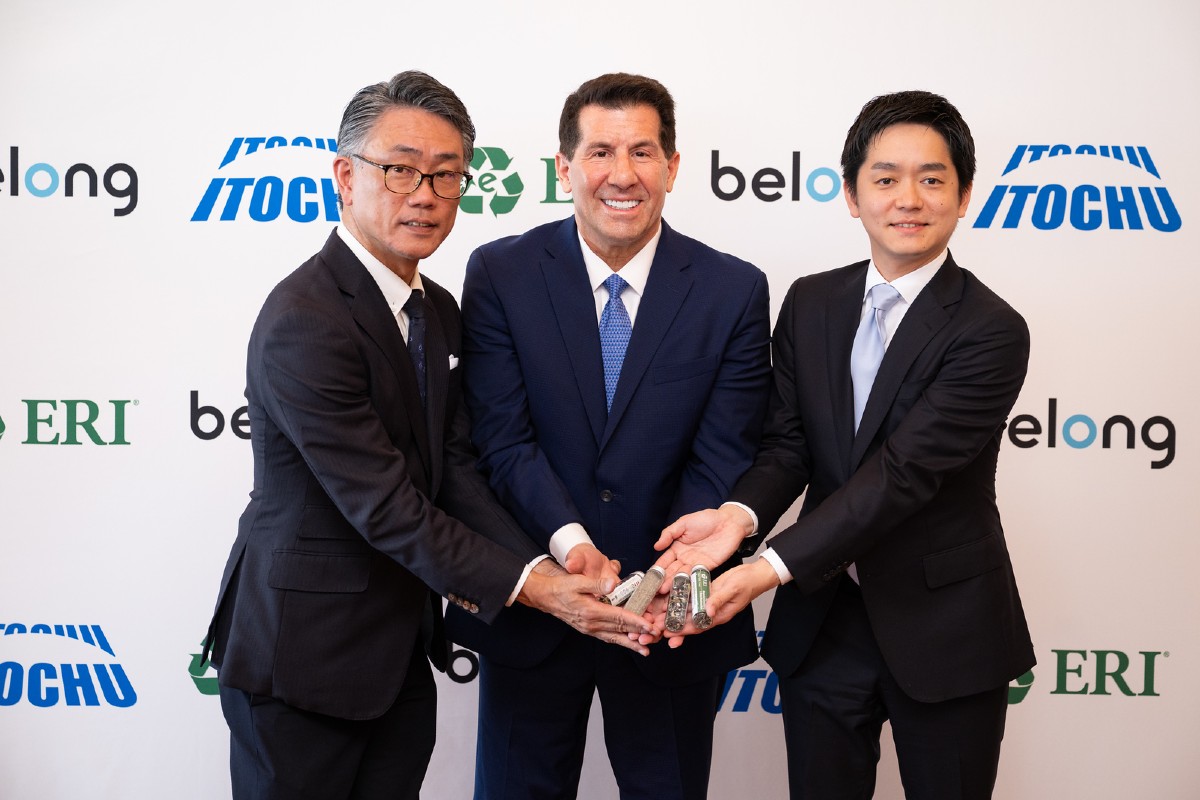
L-R: Koichiro Nishimura, CEO of ERI Japan and Manager, ITOCHU; John Shegerian, Chairman & CEO of ERI; and Daisuke Inoue, Deputy General Manager, ITOCHU, celebrate the announcement of ERI Japan.

From left, Koichiro Nishimura, CEO of ERI Japan and Manager, ITOCHU; John Shegerian, Chairman & CEO of ERI; and Daisuke Inoue, Deputy General Manager, ITOCHU, celebrate the announcement of ERI Japan. ERI announced another expansion this week into India. | Photo courtesy ERI

US-based electronics recycler and IT asset disposition (ITAD) provider ERI has formed a 50-50 joint venture with Itochu Corporation to launch operations in Japan, the companies announced March 24.

The new entity, ERI Japan, represents ERI’s first owned and branded operation outside the United States. Itochu’s investment is being made through its wholly owned subsidiary Belong Inc., according to the announcement. Koichiro Nishimura, CEO of Belong, has been named CEO of ERI Japan.

The partners said the venture will combine ERI’s processing, data destruction and materials recovery capabilities with Itochu’s domestic and international trading networks. Operations are expected to begin later in 2026.

Entry into a tightly regulated, high-volume market

Japan is one of the world’s largest generators of electronic waste, producing an estimated 2.6 million metric tons in 2022, according to data from the Global E-waste Monitor, a collaborative publication of the United Nations Institute for Training and Research, the International Telecommunication Union, and the International Solid Waste Association. The country has established one of the more structured regulatory frameworks for electronics recycling, including the Home Appliance Recycling Law and Small Waste Electrical and Electronic Equipment Recycling Act.

Despite this framework, Japan’s recycling rate for electronic devices is only around 20%, Nishimura noted in a statement, adding that “recovering and recycling Japan’s ‘urban mines’ is crucial to reducing environmental impact and promoting sustainability.”

Japan’s combination of high device density, strict environmental standards, and mature manufacturing base makes it a strategic entry point for companies seeking to deploy more advanced circular processing technologies.

Strategic alignment between trading and processing capabilities

Itochu, one of Japan’s largest sogo shosha trading houses, reported revenue of approximately ¥14.7 trillion, roughly $98 billion, for the fiscal year ending March 2025. The company has broad exposure across technology distribution, consumer electronics, and global commodities markets.

The joint venture structure suggests a model where Itochu provides upstream sourcing and downstream market access, while ERI contributes processing infrastructure and ITAD capabilities. Itochu also plans to acquire a stake in ERI itself, though details of that investment were not disclosed.

ERI said it has processed more than 2.5 billion pounds of electronic waste in the United States and operates eight facilities nationwide. The company provides services including secure data destruction, remarketing, recycling, logistics and compliance management.

The company has also invested in automation technologies, including AI-assisted image recognition sorting and robotic systems for post-shredding separation, which are expected to be deployed in the Japanese operation.

Cross-border circularity and supply chain implications

The launch comes at a time when global supply chains for secondary materials, particularly metals recovered from electronics, are under pressure from both geopolitical disruptions and rising demand linked to electrification and digital infrastructure.

Japan remains a major consumer of refined metals and components, but has limited domestic natural resources, increasing the strategic value of urban mining and electronics recycling.

By establishing a local processing presence, ERI and Itochu are positioning the venture to retain material flows within Japan while potentially linking recovered outputs to broader global markets through Itochu’s trading network.

ERI CEO John Shegerian said the work “will be done in a radically transparent, end-to-end closed loop manner where materials will be kept out of landfills, responsibly recycled, and put back into the circular economy to produce new products in Japan.”

First international foothold for ERI

ERI has previously operated through audited ITAD and recycling partners in over 140 countries but had not established an owned facility outside the U.S. prior to this announcement.

The move reflects a broader trend among ITAD and electronics recycling firms seeking to expand beyond domestic markets, particularly in regions with strong regulatory drivers and high-value material streams.

Daisuke Inoue, Itochu’s deputy general manager, said the partnership aims to “enhance the overall sophistication of the IT equipment lifecycle in Japan” by combining Belong’s reuse and distribution capabilities with ERI’s recycling technologies and traceability.

ERI Japan is expected to begin operations later this year.

Tags: Electronics
TweetShare
David Daoud

David Daoud

David Daoud is a contributor to Resource Recycling and E-Scrap News, covering IT asset disposition, electronics recycling, and circular IT governance. He is the founder of and current Principal Analyst at Compliance Standards LLC, where he conducts independent research and advisory work on ITAD markets, sustainability and ESG compliance, data security, and lifecycle risk management. Daoud has analyzed enterprise IT trends since the late 1990s and was among the first analysts to examine ITAD as a distinct market segment during his time at IDC. He advises operators, OEMs, and investment teams on regulatory, technology, and market developments affecting the electronics lifecycle.

Related Posts

Cutting healthcare plastics could save $18B

Report provides path to reduce medical e-scrap

byPaul Lane
September 25, 2026

The European report found that circularity in medical devices is possible through several potential initiatives.

Bin to Better gets students involved in reuse, recycling

Bin to Better gets students involved in reuse, recycling

byPaul Lane
September 24, 2026

E-scrap among three focus areas for student-run, California-based environmental advocacy group.

E-scrap magnet recycling company scales up

Why only some rare-earth sources are economically viable

byDavid Daoud
September 24, 2026

Rare-earth recycling economics depend on several factors, and there is no single price or date that makes the process pencil...

Who should pay for lithium-ion battery fire damage?

byDavid Daoud
September 21, 2026

Fires continue to be a major threat to the recycling industry, even as states explore new policy solutions.

America’s critical-materials buildout has a feedstock problem

byDavid Daoud
September 18, 2026

As the US invests in critical-minerals capacity will facilities have enough material to process?

Google Pixel 6 phone

Google makes repairability part of design ethos

byBrian Clark Howard
September 16, 2026

The tech titan supports the right-to-repair movement in several key ways.

Load More
Next Post

Rural effort targets vapes as battery fire risk grows

2026 Buyers’ Guide

Equipment, services and technology suppliers serving the recycling industry.

Browse the Guide

More Posts

IT asset disposition and electronics recycling: Now and then

Data center evolution creates ITAD opportunity

August 7, 2026
Ten e-scrap projects receive federal prize funds

Recycling rates for rare earths could double by 2040

July 17, 2026

In other news: May 2, 2016

May 2, 2016
The electronics recycling industry is undergoing a transformation from labor-intensive manual operations to highly automated, AI-driven facilities that use advanced robotics, cleaner chemistry and digital tracking systems to extract critical materials.

The cyber-physical MRF: AI and robotics reshape e-waste recovery

February 12, 2026
Data erasure firm expands wearable device capabilities

What Apple’s latest earnings mean for ITAD

August 3, 2026
Google sign on company building with blue sky and clouds above.

Inside Alphabet’s Q2 results: More capital spending and cloud backlog

July 28, 2026
Our top stories from March 2023

Iron Mountain’s data center report: Strong on power, quiet on hardware

July 24, 2026
Scrap copper for recycling

Seed funding bolsters build of new copper facility

June 11, 2026
Closeup of a printed circuitboard

Hardware demand puts new focus on parts harvesting

June 5, 2026
Blancco’s software flags possible data security loophole

Blancco’s software flags possible data security loophole

November 7, 2024
Load More

About & Publications

About Us

Staff

Archive

Magazines

Work With Us

Advertise
Jobs
Contact
Terms and Privacy

Newsletters

Get the latest recycling news and analysis delivered to your inbox every week. Stay ahead on industry trends, policy updates, and insights from programs, processors, and innovators.

Subscribe

Welcome Back!

Login to your account below

Forgotten Password?

Retrieve your password

Please enter your username or email address to reset your password.

Log In

Add New Playlist

No Result
View All Result
  • The Latest
  • Analysis
  • Recycling
  • E-Scrap
  • Plastics
  • Policy Now
  • Conferences
    • E-Scrap Conference
    • Plastics Recycling Conference
    • Resource Recycling Conference
    • Textiles Recovery Summit
  • Magazines
  • About Us
  • Advertise
  • Archive
  • Jobs
  • Staff
Subscribe
This website uses cookies. By continuing to use this website you are giving consent to cookies being used. Visit our Privacy and Cookie Policy.