





Resource Recycling
  • The Latest
  • Analysis
    • All
    • Certification Scorecard
    • Industry Announcements
    • Opinion
    NJ’s PCR delay risks making its own excuse permanently true

    NJ’s PCR delay risks making its own excuse permanently true

    E-scrap magnet recycling company scales up

    Why only some rare-earth sources are economically viable

    e-Stewards to develop an ITAD-specific standard

    Certification scorecard — week of Sept. 21

    Who should pay for lithium-ion battery fire damage?

    America’s critical-materials buildout has a feedstock problem

    Certification scorecard – week of Sept. 14

  • Conferences
    • Resource Recycling Conference
    • Plastics Recycling Conference
    • E-Scrap: The Longevity Conference
    • Textiles Recovery Summit
  • Publications
    • E-Scrap News
    • Plastics Recycling Update
    • Policy Now
    • Resource Recycling
    • Other Topics
      • All Topics
      • Brand Owners
      • Critical Minerals
      • Glass
      • Grant Watch / RFPs
      • Markets
      • Organics
      • Packaging
      • Research
      • Technology
      • Textiles
Subscribe
No Result
View All Result
Resource Recycling
  • The Latest
  • Analysis
    • All
    • Certification Scorecard
    • Industry Announcements
    • Opinion
    NJ’s PCR delay risks making its own excuse permanently true

    NJ’s PCR delay risks making its own excuse permanently true

    E-scrap magnet recycling company scales up

    Why only some rare-earth sources are economically viable

    e-Stewards to develop an ITAD-specific standard

    Certification scorecard — week of Sept. 21

    Who should pay for lithium-ion battery fire damage?

    America’s critical-materials buildout has a feedstock problem

    Certification scorecard – week of Sept. 14

  • Conferences
    • Resource Recycling Conference
    • Plastics Recycling Conference
    • E-Scrap: The Longevity Conference
    • Textiles Recovery Summit
  • Publications
    • E-Scrap News
    • Plastics Recycling Update
    • Policy Now
    • Resource Recycling
    • Other Topics
      • All Topics
      • Brand Owners
      • Critical Minerals
      • Glass
      • Grant Watch / RFPs
      • Markets
      • Organics
      • Packaging
      • Research
      • Technology
      • Textiles
Subscribe
No Result
View All Result
Resource Recycling
No Result
View All Result
Home Recycling

Smart bins target contamination at street level

Marissa HeffernanbyMarissa Heffernan
January 2, 2024
in Recycling
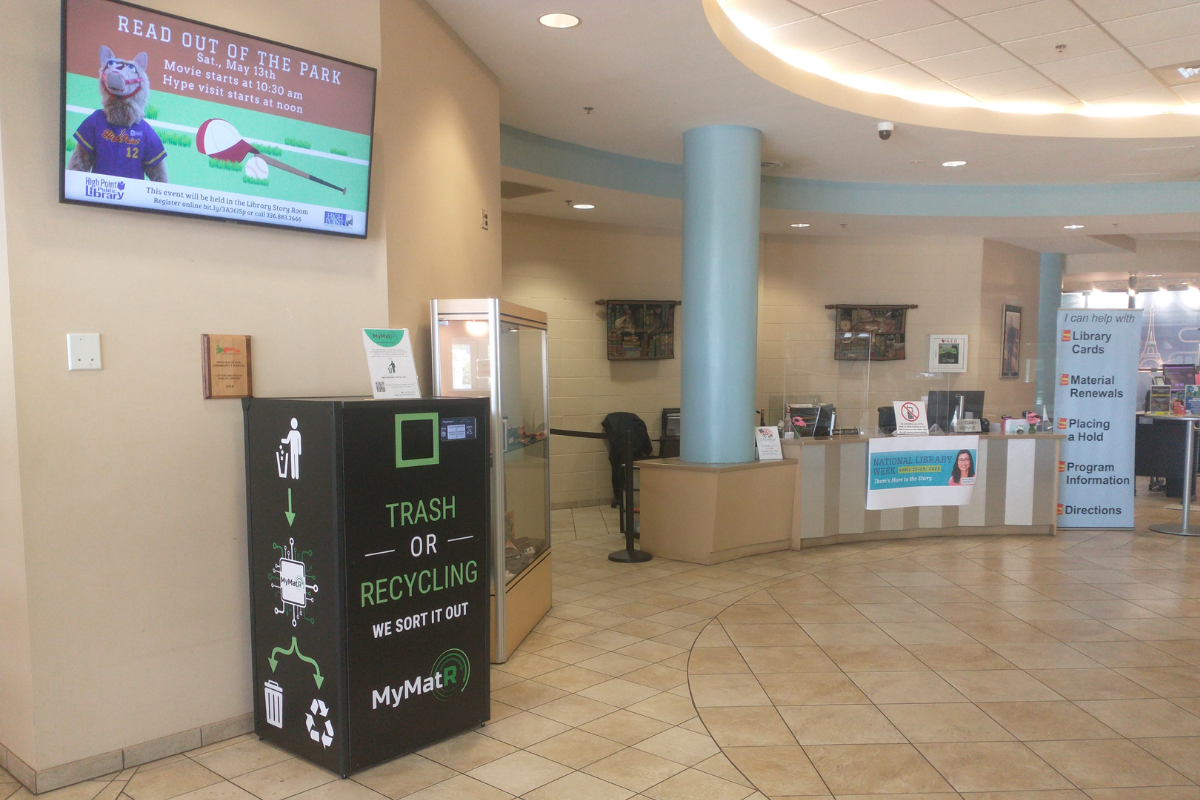
An AI-powered sorting bin from MyMatR is deployed in a pilot program at a public library in High Point, N.C. | Photo courtesy MyMatR

Consumer education is a traditional way to reduce contamination, but the founder of startup MyMatR is combining it with AI to offer a “smart” self-sorting bin for public spaces. 

John Starke, founder of MyMatR, said the first step to increase recycling rates is to offer twin-bin systems in public spaces, one for trash and one for recycling, but there will always be people who don’t use the system and put recyclables in the trash. That’s where the smart bins come in. 

“I think education is very important in the realm of recycling, I really do. What I think is far more important is our infrastructure and our infrastructure at the source of disposal is so incredibly critical,” he said. “Let’s use technology hand-in-hand with education to make things better.” 

MyMatR is an automatic sorting waste container meant for city streets, public offices, airports and other public spaces. 

“It’s designed to be that next generation of waste container, from dumb trash cans to smart trash cans,” Starke said. 

The bin works by taking a photo of items thrown into it, then using AI to identify the item and decide if it should go in the waste side or the recycling side. It’s highly customizable, Starke said, and cities can program the AI for whatever items they accept for recycling. They can also then have easy access to data on what is being placed in the bins. The average sorting accuracy of a MyMatR unit is 90%, and it takes about three seconds for the unit to decide how to sort an item.

If multiple items are put in at the same time, the system will make the decision based on customer guidelines. The customer decides if they would rather maximize landfill diversions or eliminate contamination. 

The bins also have fullness detection sensors and embedded display screens that can educate users on if the object they just put in was recyclable or not. The bins can also be added onto, Starke said, such as adding QR codes or “gamifying” recycling by giving people points for using it.

“It’s a way to educate and give back to those that care, but since the EPA says the national recycling rate is 32%, there’s a large part of people who don’t care,” he said. “So this puts the infrastructure in place” to reduce missorting. 

Looking forward, Starke said he plans to make a solar powered model and wants to expand across America and then eventually go global. 

MyMatR is in its growth phase, Starke said, and is one of a few automatic waste sorting companies in the nation. 

Right now, MaMatR is working with Coca Cola Consolidated, a Volvo manufacturing plant and a BMW plant in South Carolina, the University of South Carolina, Clemson University and the High Point public library in North Carolina. The company is based in Raleigh, N.C.

“It’s your standard waste container we are taking to the next level,” he said. 

Tags: Contamination
TweetShare
Marissa Heffernan

Marissa Heffernan

Marissa Heffernan worked at Resource Recycling from January 2022 through June 2025, first as staff reporter and then as associate editor. Marissa Heffernan started working for Resource Recycling in January 2022 after spending several years as a reporter at a daily newspaper in Southwest Washington. After developing a special focus on recycling policy, they were also the editor of the monthly newsletter Policy Now.

Related Posts

CommanderAI launches searchable hauler database

Inside the Circle: Put AI to work for the people who do the work

byBill Shireman
September 14, 2026

There is more than one way to use AI, and some ways are more valuable than others.

tires

The most important decision in tire recycling happens before the shredder

byPaul Downey, Pliteq
August 3, 2026

Contamination gets the attention, but classification is the bottleneck that actually decides who wins.

Study links tagging tactics to lower contamination rates

byStefanie Valentic
October 14, 2025

A new report from the Solid Waste Association of North America (SWANA) examines the role penalties and education play in...

Community Spotlight: Atlanta’s recycling still improving

byAndrew Hawthorne
July 8, 2025

The recycling program in Atlanta, Georgia, is a work in progress that has seen significant successes, including doubling its recycling...

Effective resident education requires careful messaging

byAntoinette Smith
January 28, 2025

Effective recycling programs rely heavily on human behavior, which can be very hard to change. But developing a targeted strategy...

Tech to spot hidden batteries draws $6.4M investment

byDan Holtmeyer
January 29, 2024

A young technology company's imaging system combines cameras, X-rays and artificial intelligence to allow recycling facility operators to peer into...

Load More
Next Post

Illinois corrugated plant using recycled fiber starts up

2026 Buyers’ Guide

Equipment, services and technology suppliers serving the recycling industry.

Browse the Guide

More Posts

Recyclers reeling from NJ PCR extension

Recyclers reeling from NJ PCR extension

September 23, 2026
Oregon state capitol building with state flag and blue sky.

NAW appeals Oregon EPR ruling

September 25, 2026
Bin to Better gets students involved in reuse, recycling

Bin to Better gets students involved in reuse, recycling

September 24, 2026
Calif. Governor Gavin Newsom at podium.

Newsom signs battery EPR expansion, vetoes SB 54 fund bill

September 24, 2026

Who should pay for lithium-ion battery fire damage?

September 21, 2026
Bipartisan reps introduce bill on recycling claims

House passes bill to ease lithium-ion battery storage rules

September 24, 2026
Analysis: Undersupply of PCR is ‘stifling’ brand goals

US lawmakers urge protection of domestic RPET

September 25, 2026
US packaging is evolving. The recycling system isn’t ready

US packaging is evolving. The recycling system isn’t ready

September 16, 2026
Industry announcements for January 2026

Industry announcements for September 2026

August 31, 2026
Bridge Green, Hartree partner on mineral processing deal

Bridge Green, Hartree partner on mineral processing deal

September 21, 2026
Load More

About & Publications

About Us

Staff

Archive

Magazines

Work With Us

Advertise
Jobs
Contact
Terms and Privacy

Newsletters

Get the latest recycling news and analysis delivered to your inbox every week. Stay ahead on industry trends, policy updates, and insights from programs, processors, and innovators.

Subscribe

Welcome Back!

Login to your account below

Forgotten Password?

Retrieve your password

Please enter your username or email address to reset your password.

Log In

Add New Playlist

No Result
View All Result
  • The Latest
  • Analysis
  • Recycling
  • E-Scrap
  • Plastics
  • Policy Now
  • Conferences
    • E-Scrap Conference
    • Plastics Recycling Conference
    • Resource Recycling Conference
    • Textiles Recovery Summit
  • Magazines
  • About Us
  • Advertise
  • Archive
  • Jobs
  • Staff
Subscribe
This website uses cookies. By continuing to use this website you are giving consent to cookies being used. Visit our Privacy and Cookie Policy.