






Resource Recycling
  • The Latest
  • Analysis
    • All
    • Certification Scorecard
    • Industry Announcements
    • Opinion
    Apple Watch on product box.

    Wearables are coming and ITAD isn’t ready

    Certification Scorecard — Week of April 13, 2026

    EV Battery Pack - Sergii Chernov-Shutterstock

    Redwood, Rivian deal fuels US infrastructure plans

    Bloom ESG and e-Stewards roll out critical metals metric

    Colorado regulators suggest mid-range EPR scenario

    Why collaboration on plastic waste still matters

    Battery recycler Ascend Elements files for bankruptcy

    Battery recycler Ascend Elements files for bankruptcy

    EPR fees are a market signal. Here’s what they’re telling you.

    EPR fees are a market signal. Here’s what they’re telling you.

    Wolframite ore, the primary ore of tungsten from Altai, Russia

    Tungsten scrap export controls draw industry attention

    Certification Scorecard — Week of April 6, 2026

  • Conferences
  • Publications

    Other Topics

    Textiles
    Organics
    Packaging
    Glass
    Brand Owners

    Metals
    Technology
    Research
    Markets
    Grant Watch

    All Topics

Subscribe
No Result
View All Result
Resource Recycling
  • The Latest
  • Analysis
    • All
    • Certification Scorecard
    • Industry Announcements
    • Opinion
    Apple Watch on product box.

    Wearables are coming and ITAD isn’t ready

    Certification Scorecard — Week of April 13, 2026

    EV Battery Pack - Sergii Chernov-Shutterstock

    Redwood, Rivian deal fuels US infrastructure plans

    Bloom ESG and e-Stewards roll out critical metals metric

    Colorado regulators suggest mid-range EPR scenario

    Why collaboration on plastic waste still matters

    Battery recycler Ascend Elements files for bankruptcy

    Battery recycler Ascend Elements files for bankruptcy

    EPR fees are a market signal. Here’s what they’re telling you.

    EPR fees are a market signal. Here’s what they’re telling you.

    Wolframite ore, the primary ore of tungsten from Altai, Russia

    Tungsten scrap export controls draw industry attention

    Certification Scorecard — Week of April 6, 2026

  • Conferences
  • Publications

    Other Topics

    Textiles
    Organics
    Packaging
    Glass
    Brand Owners

    Metals
    Technology
    Research
    Markets
    Grant Watch

    All Topics

Subscribe
No Result
View All Result
Resource Recycling
No Result
View All Result
Home Plastics

Municipal recycling group blasts one area of chemical recycling

byJared Paben
March 23, 2022
in Plastics
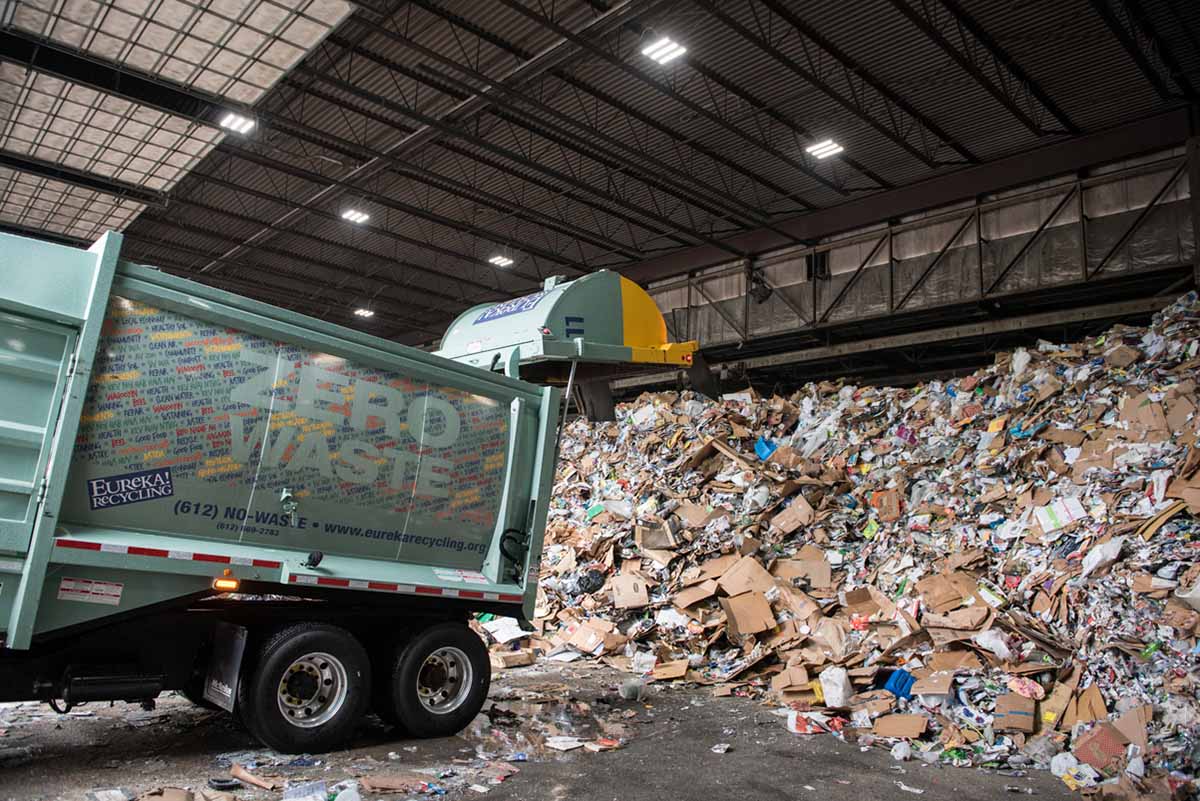
Eureka Recycling, which operates a materials recovery facility (MRF) in Minneapolis, is a member of the Alliance of Mission-Based Recyclers, which criticized plastics-to-fuel processes. | Courtesy of Eureka Recycling

The Alliance of Mission-Based Recyclers called plastics-to-fuel processes “false solutions,” though the group of nonprofit recyclers says it is more open to technologies that are geared toward production of recycled resin.

The Alliance of Mission-Based Recyclers (AMBR) recently issued two reports about chemical recycling (sometimes referred to as “advanced recycling”).

“The end goals of any plastics recycling should be to reduce reliance on virgin fossil fuels and support a circular economy,” Lynn Hoffman, national coordinator for AMBR and co-president of Eureka Recycling, stated in a press release. “Every recycling system should be evaluated based on its ability to meet these goals, and chemical recycling fails the test.”

AMBR is made up of Eureka Recycling in Minneapolis; Eco-Cycle in Boulder, Colo.; Ecology Center in Berkeley, Calif.; and Recycle Ann Arbor of Ann Arbor, Mich. All run MRFs except Ecology Center, which collects curbside recyclables.

The terms “chemical recycling” and “advanced recycling” generally refer to a wide array of processes that use heat, pressure and solvents to break down the molecular chains of polymers into liquids or gases that can then be processed into fuels, oils, waxes, new plastics, or other chemical products.

They’re in contrast to the “mechanical recycling” of plastics, which generally refers to steps such as shredding/grinding, washing/drying, melting and extruding scrap plastic. Such processes leave the polymers’ molecular chains intact.

In two AMBR reports issued March 16, the group argues that plastics-to-fuel technologies perpetuate a reliance on virgin fossil fuels, present risky financial investments, disproportionately impact people of color, and carry other downsides.

One report is an eight-page overview document. The other is a more detailed 21-page guide for legislators, investors and municipalities.

As alternatives to combat plastic litter and low recycling rates, AMBR recommends product bans, extended producer responsibility (EPR), bottle deposits, recycled-content laws, and requirements for environmental justice assessments of chemical recycling and solid waste facilities.

Many of the comments in the report mirror those the AMBR made to the U.S. EPA a year ago, when the EPA was seeking comments on what the agency should count in the nation’s recycling rate.

Group leaves door open for plastics-to-plastics

The AMBR reports don’t completely slam the door on chemical recycling technologies, leaving some space for methods that return recovered resin to the plastics manufacturing pipeline.

“These plastics-to-plastics (PTP) recycling technologies have the potential to complement mechanical recycling programs, but they are also the least developed and most expensive ‘chemical recycling’ processes,” AMBR stated in the eight-page report. “They may play a role in reducing plastic pollution and fossil fuel use, but only when integrated into a larger systemic strategy to reduce, reuse, and then recycle necessary plastic packaging and products.”

A number of companies have announced investment in chemical recycling plants for the production of new plastic.

For example, Eastman is spending up to $250 million on a facility in Kingsport, Tenn., and the company announced plans for a $1 billion depolymerization plant in France. Public relations consultants working for the company have been consistently issuing press releases about new consumer products made with Eastman’s chemically recycled resins.

Additionally, plastics producer Saudi Basic Industries Corporation (SABIC) and chemical recycling company Plastic Energy are producing chemically recycled resins for use in Unilever packaging and Tupperware products. Packaging producer Berry Global is also working to use chemically recycled resin.

Despite the drumbeat of announcements about chemical recycling investments, the sector is still relatively nascent, with the vast majority of plastic used in manufacturing today continuing to be virgin material.

In a statement in response to the AMBR reports, the American Chemistry Council (ACC), which represents plastics producers, noted that plastics companies have invested billions into the technologies to convert more used plastics into new plastic and products. ACC says that since 2017, over 70 projects have been announced, representing $7.7 billion in investments. They have the potential to divert at least 12.1 billion pounds of plastic from landfills, said Joshua Baca, vice president of plastics at ACC.

“Calling advanced recycling a process that ‘burns plastic’ or is focused only on making fuels ignores the facts and is an effort to try to keep plastics out of our economy,” Baca said. “Advanced recycling is a game-changing technology that is critical to accelerating a circular economy. Today it is producing top-quality new plastics that are suitable for the most demanding applications, including food contact, pharmaceutical and medical use.”

In its analysis, AMBR said plastics-to-plastics technologies could be viable if they meet several criteria.

Those include the following: They rely on transparent reviews of environmental and human health impacts, address gaps that aren’t already being filled by mechanical recycling, recover at least 75% of incoming feedstock, maintain valid agreements with buyers using the outputs in new products or packaging, and pay a price for feedstock that at least covers MRFs’ sorting and sales costs.

A version of this story appeared in Resource Recycling on March 22.

 

Tags: Industry Groups
TweetShare
Jared Paben

Jared Paben

Related Posts

Recycling Partnership CEO stepping down

byStefanie Valentic
April 15, 2026

Outgoing CEO Keefe Harrison will remain until August with the organization she built from the ground up.

NERC launches hub to promote PCR demand 

byAntoinette Smith
April 15, 2026

The Northeast Recycling Council's PCR Material Demand Hub offers resources for government procurement, material- and product-specific resources, and certification and...

Reverse Logistics Network launches to support industry

byPaul Lane
April 14, 2026

The reverse logistics community has a new organization to give companies in that sector a place to connect.

Colorado regulators suggest mid-range EPR scenario

Why collaboration on plastic waste still matters

byCrystal Bayliss
April 13, 2026

Six years ago, the U.S. Plastics Pact launched at a moment of rising concern about plastic waste and growing momentum...

Industrial sources drive rise in PVC recycling

byAntoinette Smith
April 13, 2026

Volumes of post-industrial PVC recycled in 2024 rose by 10% from 2019 levels, while post-consumer sources fell and missed a...

End markets, policy key to RPET viability

End markets, policy key to RPET viability

byAntoinette Smith
April 8, 2026

Longer-term actions support domestic RPET markets and can help prevent the loss of public trust in recycling systems, industry experts...

Load More
Next Post
Los Angeles and San Diego ban polystyrene

GDB increases PCR production to 80 million pounds annually

Leading the Charge in Safe Battery Recycling
Sponsored

Leading the Charge in Safe Battery Recycling

byThe Battery Network
April 13, 2026

We’re connecting people, brands, and communities through one nationwide network built to make battery recycling safer, simpler, and more accessible...

Read moreDetails

More Posts

Battery recycler Ascend Elements files for bankruptcy

Battery recycler Ascend Elements files for bankruptcy

April 13, 2026
EPR fees are a market signal. Here’s what they’re telling you.

EPR fees are a market signal. Here’s what they’re telling you.

April 10, 2026

Bloom ESG and e-Stewards roll out critical metals metric

April 15, 2026

Recycling Partnership CEO stepping down

April 15, 2026

AI surge, dealmaking reshape  ITAD industry 

April 16, 2026
Apple Watch on product box.

Wearables are coming and ITAD isn’t ready

April 16, 2026

Oregon’s battery EPR bill officially charged for implementation

April 10, 2026
Bill to update New Jersey e-scrap program heads to governor

New Jersey recyclers talk EPR

April 9, 2026
Industry group: Help us find the plastic bale volumes we need

PET bales sink further as other grades firm 

April 15, 2026

COM2 joins TERRA network as solar recycling expands 

April 17, 2026
Load More

About & Publications

About Us

Staff

Archive

Magazine

Work With Us

Advertise
Jobs
Contact
Terms and Privacy

Newsletter

Get the latest recycling news and analysis delivered to your inbox every week. Stay ahead on industry trends, policy updates, and insights from programs, processors, and innovators.

Subscribe

Welcome Back!

Login to your account below

Forgotten Password?

Retrieve your password

Please enter your username or email address to reset your password.

Log In

Add New Playlist

No Result
View All Result
  • The Latest
  • Analysis
  • Recycling
  • E-Scrap
  • Plastics
  • Policy Now
  • Conferences
    • E-Scrap Conference
    • Plastics Recycling Conference
    • Resource Recycling Conference
    • Textiles Recovery Summit
  • Magazine
  • About Us
  • Advertise
  • Archive
  • Jobs
  • Staff
Subscribe
This website uses cookies. By continuing to use this website you are giving consent to cookies being used. Visit our Privacy and Cookie Policy.