




Resource Recycling
  • The Latest
  • Analysis
    • All
    • Certification Scorecard
    • Industry Announcements
    • Opinion
    SERI works to restore faith in certifications

    Building a defensible E-scrap evidence file

    tires

    The most important decision in tire recycling happens before the shredder

    Intel sign outside of company building.

    Intel’s CapEx tops $20B on server demand while PC volume shrinks

    Google sign on company building with blue sky and clouds above.

    Inside Alphabet’s Q2 results: More capital spending and cloud backlog

    Alpek closing Pennsylvania RPET plant

    Alpek seizing on war-related opportunity 

    Our top stories from March 2023

    Iron Mountain’s data center report: Strong on power, quiet on hardware

  • Conferences
    • Resource Recycling Conference
    • Plastics Recycling Conference
    • E-Scrap: The Longevity Conference
    • Textiles Recovery Summit
  • Publications
    • E-Scrap News
    • Plastics Recycling Update
    • Policy Now
    • Resource Recycling
    • Other Topics
      • All Topics
      • Brand Owners
      • Critical Minerals
      • Glass
      • Grant Watch / RFPs
      • Markets
      • Organics
      • Packaging
      • Research
      • Technology
      • Textiles
Subscribe
No Result
View All Result
Resource Recycling
  • The Latest
  • Analysis
    • All
    • Certification Scorecard
    • Industry Announcements
    • Opinion
    SERI works to restore faith in certifications

    Building a defensible E-scrap evidence file

    tires

    The most important decision in tire recycling happens before the shredder

    Intel sign outside of company building.

    Intel’s CapEx tops $20B on server demand while PC volume shrinks

    Google sign on company building with blue sky and clouds above.

    Inside Alphabet’s Q2 results: More capital spending and cloud backlog

    Alpek closing Pennsylvania RPET plant

    Alpek seizing on war-related opportunity 

    Our top stories from March 2023

    Iron Mountain’s data center report: Strong on power, quiet on hardware

  • Conferences
    • Resource Recycling Conference
    • Plastics Recycling Conference
    • E-Scrap: The Longevity Conference
    • Textiles Recovery Summit
  • Publications
    • E-Scrap News
    • Plastics Recycling Update
    • Policy Now
    • Resource Recycling
    • Other Topics
      • All Topics
      • Brand Owners
      • Critical Minerals
      • Glass
      • Grant Watch / RFPs
      • Markets
      • Organics
      • Packaging
      • Research
      • Technology
      • Textiles
Subscribe
No Result
View All Result
Resource Recycling
No Result
View All Result
Home E-Scrap

Offset’ effort connects telecoms and African e-scrap collectors

Dan LeifbyDan Leif
January 10, 2019
in E-Scrap
E-scrap collection in Uganda.

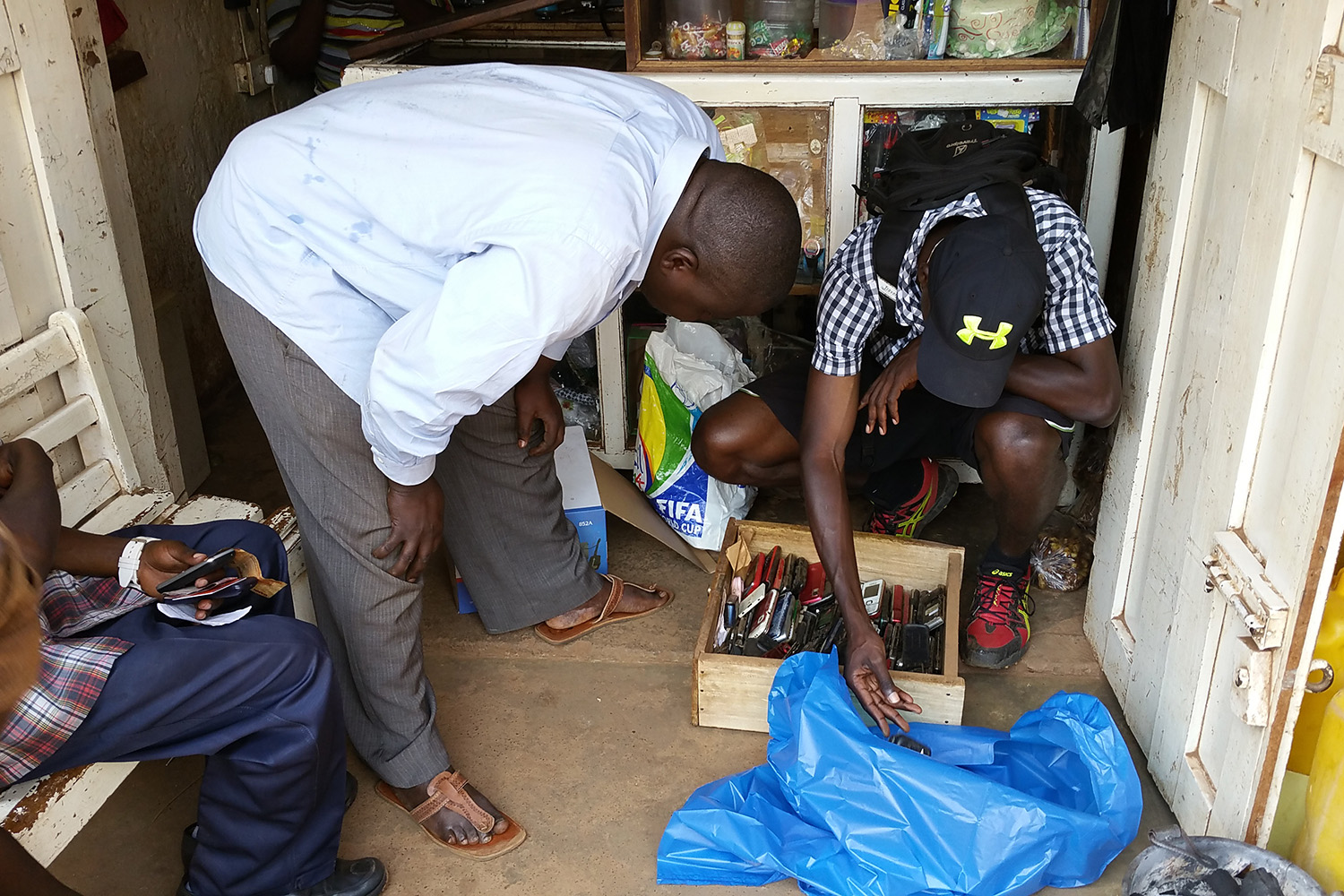
In Uganda, cell phones are collected as part of Closing the Loop.

In Uganda, end-of-life cell phones are collected before being shipped for recycling.

Tech companies are seeing boosted demand for environmental leadership, and e-scrap management concerns continue to mark developing countries. An enterprise in Europe is working to help out on both fronts.

Closing the Loop is a Netherlands-based business that contracts with T-Mobile and other wireless industry stakeholders to provide those companies with a mobile device “offset” program.

Under the model, wireless providers, phone retailers and others add a small fee to the cost of a new phone. Closing the Loop uses that money to work with informal recycling networks in a handful of African countries to collect end-of-life devices, shipping them to Umicore and other recyclers in the EU for processing.

Companies funding the initiative can then promote the fact that for each new product they put on the market, an old one has been collected and processed through proper channels. To date, the effort has collected roughly 2 million devices.

“It’s a one-for-one business model,” said Joost de Kluijver, founder and director of Closing the Loop. “It’s based on both extended producer responsibility and carbon offsetting concepts. We tried to make those good models more practical and more tangible for this market.”

No simple task

Closing the Loop is entering complex territory in establishing and scaling up the mobile offset concept. For years, global stakeholders have encountered barriers when attempting to take funding and materials recovery strategies from wealthier parts of the world and then leverage them in poorer areas.

A used cell phone recycling business in Rwanda.
A collection point in Rwanda.

According to De Kluijver, the goal of Closing the Loop is to allow informal traders to continue to move material and support their livelihoods, but to ensure safe and secure final disposition.

“We want people working in [Ghana’s] Agbogbloshie or Lagos to still do what they’re doing,” he said. “We shouldn’t be trying to roll out a European system; it won’t work. We need to include the African context and African reality. But at the point where that reality starts having a negative effect, that’s where we can make it better. Our approach puts no one out of a job.”

In 2017, U.S.-based Fair Trade Recycling launched an offset initiative that aimed to fund e-scrap collection in Ghana. But that program looked to draw funding from exporters of used material, making it different from the Closing the Loop model of collecting income from companies that push sales of new devices.

After doing work on a water project in Tanzania, De Kluijver launched Closing the Loop as a nonprofit venture in 2012 and transitioned it to a commercial business in 2014. Initially, the idea was to generate revenue entirely from the value of commodities recovered from phones in Ghana, Nigeria and Uganda.

But the economics of that approach didn’t work because it was so costly to try to set up new collection networks. “We lost money there,” said De Kluijver. “Let’s just call it ‘learning money.'”

In 2016, the business pivoted toward the current offset model with corporate backing.

Closing the Loop charges its telecom partners 2 to 5 euros per phone collected. That income allows the business to work with collectors in five African countries – Cameroon, Ghana, Rwanda, Uganda and Zambia. According to De Kluijver, collectors in the system are paid more for end-of-life phones and components than they would be if they relied on existing pathways.

He noted that in Zambia, the business pays 5 to 7 euros per kilo of intact phones. “We didn’t find anyone there paying anywhere near the price,” he said. In Rwanda, Closing the Loop is able to pay about 10 percent more for old phones than local buyers, he said.

Relationships on the ground

Much of the work done by Closing the Loop thus far has involved developing relationships with small-scale traders who help Closing the Loop build collection networks.

“In their country, they have dozens or sometimes several hundred people in their networks,” said De Kluijver. “We estimate 2,000 to 3,000 people have benefited from being part of our supply chain.” He said collection networks now include individuals, churches and repair shop owners.

Closing the Loop founder Joost de Kluijver sits in a shipping container.
Joost de Kluijver, founder and director of Closing the Loop.

Meanwhile, the companies backing the program have a sustainability-oriented story they can tell customers. Such positioning is becoming increasingly important in the mobile market.

“A lot of customers are wanting sustainable consumption,” said De Kluijver. “Our partners are able to reach a new customer group simply by adding a small fee for each phone they are selling.”

In addition to T-Mobile, Closing the Loop has partnered with professional services firm KPMG Netherlands, which supplies mobile devices to its employees and wanted to be able to show it was consuming technology in an environmentally responsible way, De Kluijver said.

And he noted the concept is starting to garner attention from governments in Europe, such as the city of Amsterdam.

Ultimately, Closing the Loop wants to be able to establish a system in which metals recovered from end-of-life phones are tracked through the recycling process and moved back into the supply chain for new mobile products.

Such an infrastructure at scale is still years away, De Kluijver acknowledged. But he noted that mobile companies are becoming increasingly attuned to the upsides of circular IT.

“I believe the telecom industry is the first global industry that could really become waste free,” De Kluijver said. “The more customers we support, the more waste we can collect. And that allows us to become more and more a metal producer – an urban mining one.”

Photos courtesy of Closing the Loop.

 

Tags: Critical MineralsEPRMobile Devices
TweetShare
Dan Leif

Dan Leif

Dan Leif is the managing editor at Resource Recycling, Inc., which publishes Resource Recycling, Plastics Recycling Update and E-Scrap News. He has been with the company since 2013 and has edited different trade publications since 2006. He can be contacted at dan@dev.resource-recycling.com.

Related Posts

Innovation. Partnership. Circular value.

Innovation. Partnership. Circular value.

bySibanye-Stillwater
August 1, 2026

As industries around the world accelerate their transition towards a circular economy, precious metals recycling is evolving from a necessary...

Spin-off lets Linca focus on battery mineral recovery

GAO: Policy, tech updates needed to bolster domestic mineral supply

byPaul Lane
July 30, 2026

Federal investigators say short- and long-term solutions are needed to decrease the nation’s reliance upon foreign-based minerals.

The State of Oregon seal at a park in Salem, Ore.

MRM bids to run Oregon EPR for second year 

byPaul Lane
July 28, 2026

The company won the competitive process for 2026, but was the only company to apply for the 2027 PRO post.

U.S. Capitol building in Washington, D.C.

House committees advance critical mineral bills

byPaul Lane
July 27, 2026

Congressional votes earlier this month advanced three bills that would expand the nation’s critical mineral recycling capabilities. A subcommittee within...

A call to action: End markets and EPR

EPR faces several key questions

byBrian Clark Howard
July 23, 2026

Panelists discuss the promise and perils of EPR nationwide at the PROP conference in Pennsylvania.

Spin-off lets Linca focus on battery mineral recovery

Spin-off lets Linca focus on battery mineral recovery

byPaul Lane
July 23, 2026

The New Zealand-based company will focus on getting its black mass retrieval technology ready for use in a demonstration facility...

Load More
Next Post
Our top stories from December 2018

Our top stories from December 2018

2026 Buyers’ Guide

Equipment, services and technology suppliers serving the recycling industry.

Browse the Guide

More Posts

Innovation. Partnership. Circular value.

Innovation. Partnership. Circular value.

August 1, 2026
SERI works to restore faith in certifications

Building a defensible E-scrap evidence file

August 6, 2026
Copper prices fall to lowest point since spring

EMR recycling plant to reopen in NJ after fire, legal battle

July 21, 2026
RecyClass hits 500 EU recyclability evals

RecyClass hits 500 EU recyclability evals

July 21, 2026
What the NAND flash crunch means for remarketing, refurbishment and residual values

Telamon acquires ITAD consultancy Retire-IT

July 9, 2026
Tech giant pens detailed ‘plastic-free packaging’ guide

What Google’s latest report means for ITAD

July 8, 2026
Canada EV battery reuse pilot to start

Canada EV battery reuse pilot to start

July 8, 2026
Battery fire risk isn’t going away. Insurance is responding

Battery fire risk isn’t going away. Insurance is responding

February 24, 2026

Our top stories from October 2021

November 3, 2021
Intel sign outside of company building.

Intel’s CapEx tops $20B on server demand while PC volume shrinks

July 29, 2026
Load More

About & Publications

About Us

Staff

Archive

Magazine

Work With Us

Advertise
Jobs
Contact
Terms and Privacy

Newsletter

Get the latest recycling news and analysis delivered to your inbox every week. Stay ahead on industry trends, policy updates, and insights from programs, processors, and innovators.

Subscribe

Welcome Back!

Login to your account below

Forgotten Password?

Retrieve your password

Please enter your username or email address to reset your password.

Log In

Add New Playlist

No Result
View All Result
  • The Latest
  • Analysis
  • Recycling
  • E-Scrap
  • Plastics
  • Policy Now
  • Conferences
    • E-Scrap Conference
    • Plastics Recycling Conference
    • Resource Recycling Conference
    • Textiles Recovery Summit
  • Magazine
  • About Us
  • Advertise
  • Archive
  • Jobs
  • Staff
Subscribe
This website uses cookies. By continuing to use this website you are giving consent to cookies being used. Visit our Privacy and Cookie Policy.