





This story originally appeared in the February 2018 issue of Plastics Recycling Update. Subscribe today for access to all print content.
Interest in sustainable packaging continues to mount in the face of environment concerns, marketing pressure and consumer demand.
This fact can be clearly seen in recent initiatives from various corporations that are emphasizing use of post-consumer resin (PCR) in food packaging as well as playing up the importance of recyclability in general.
For example, Procter & Gamble reported that in fiscal year 2016-2017, the company used 34,400 metric tons of PCR, meaning the company is now about a third of the way to its goal of doubling use of PCR plastic between 2010 and 2020.
Additionally, PepsiCo has issued its Global Sustainable Packaging Policy, which speaks to the company’s efforts to increase the use of recycled content of packaging and to promote the use of materials that can be recycled. And Mars, Inc. is working toward 100 percent packaging recyclability by 2025.
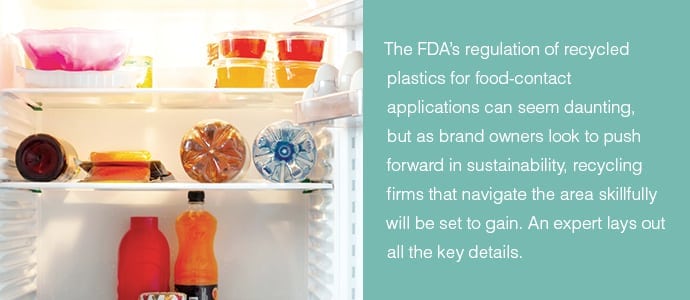
As the use of PCR plastics continues to grow, it is critical to understand the system that governs the regulation of these materials in the U.S. In this article, we focus on the rules covering recycled plastics for food packaging uses.
A focus on material composition
Food-contact plastics are regulated in the U.S. by the Food and Drug Administration (FDA). The agency does not require independent regulatory review or “premarket clearance” for plastics produced by post-consumer recycling processes. This is because FDA’s regulatory system is based on the composition of the plastic, rather than a specific manufacturing process. In other words, recycled plastic food-contact materials must meet the same regulatory requirements that FDA sets out for virgin plastic materials.
In terms of how FDA regulates virgin plastics, this will depend on whether the polymer meets the Federal Food, Drug, and Cosmetic Act’s definition of “food additive.” A food additive is defined in the Act as a substance that is reasonably expected to become a component of food under the intended conditions of use.
If a polymer is properly considered a food additive under the Act, then it will be considered unsafe unless it is used in keeping with a relevant food additive regulation (found in Title 21 of the Code of Federal Regulations) or an effective Food Contact Notification (FCN). Statutory exemptions from FDA premarket clearance are set out for substances that are “generally recognized as safe” or subject of a sanction or approval from FDA prior to the enactment of the Food Additives Amendment of 1958.

Notably, a company can make its own determination – using scientifically sound methods – that a polymer complies with a food additive regulation, FCN or another relevant exemption. Alternatively, a company can establish an acceptable FDA status by demonstrating through appropriately conducted extraction studies or calculations that the polymer is not reasonably expected to become a component of food. If these data or calculations are favorable, then the polymer does not qualify as a food additive, as defined under the Federal Food, Drug, and Cosmetic Act.
In addition, all food-contact materials, including plastics, must be of a purity suitable for their intended use. This requirement is set out in FDA’s Good Manufacturing Practices regulation for food-contact materials. FDA has issued specific guidance on recycled plastics, and these guidlines provide companies with information on how to go about establishing the safety of recycled polymers for food packaging. When it comes to recycled plastics, FDA has three primary concerns:
- Contaminants from post-consumer material may appear in the final food-contact product made from the recycled material.
- Recycled post-consumer material not regulated for food-contact use may be incorporated into food-contact packaging.
- Adjuvants in the recycled plastic may not comply with relevant regulations for food-contact use.
Furthermore, FDA’s guidance specifically addresses the following plastic recycling processes: (1) primary recycling (or the recycling of pre-consumer scrap); (2) secondary recycling (or physical reprocessing, such as grinding, melting and reforming); and (3) tertiary recycling (or regeneration of purified starting materials, such as depolymerization). FDA explains in its guidance that it does not expect the recycling of pre-consumer scrap (primary recycling) to pose a hazard to the consumer.
With respect to secondary and tertiary recycling, FDA has made clear that the manufacturer must demonstrate that possible contaminants from prior use of the plastic are sufficiently removed by the recycling process.
The no objection letter
As discussed above, a company is entitled in the U.S. to independently evaluate the status and safety of a polymer produced through a particular recycling process. However, to support this assessment and to further leverage the product from a marketing standpoint, many companies take their determinations to FDA for review. This process is wholly voluntary and, if the agency agrees with the company’s determination, FDA will issue a no objection letter (NOL) on the suitability of a specific process for producing PCR plastic for food-contact uses.
The NOL includes the name of the company that made the request as well as the identity of the plastic, and it specifies whether the recycling process is physical or chemical, and whether there are any limitations on the conditions of use for the material. The NOL is eventually posted on the agency’s online inventory of PCR plastic submissions (see the list at tinyurl.com/FDA-NOLs).
When making a NOL request to FDA, the agency will want to see the following:
- A complete description of the recycling process, along with information on the source of the recycled plastic and any controls employed to ensure that it meets applicable regulations.
- A written description of the steps taken to ensure that the recycled plastic is not contaminated either before collection or during the recycling process.
- If needed, data to show that the recycling process removes possible contaminants. This can include the results of surrogate contaminant testing (discussed below) and migration testing.
- A description of the proposed conditions of use for the recycled plastic (such as intended temperature of use, type of food with which the plastic will come into contact, the duration of the contact, and whether the food-contact plastic will be for repeated or single-use applications).
Contaminant testing
 In its guidance document, FDA lays out specific recommendations on contaminant testing that may need to be performed to validate secondary and tertiary recycling processes. This guidance is focused on the ability of a secondary or tertiary recycling process to remove contaminants from plastic containers or packaging items that may have been used to store pesticides or automotive chemicals, or otherwise subjected to consumer misuse.
To show that the recycling process is capable of removing potential contaminants, FDA recommends testing where the virgin polymer is first exposed to surrogate contaminants. These surrogate contaminants are intended to represent the common gamut of chemicals that may be accessible to the consumer – this spectrum includes a volatile polar organic substance, a volatile non-polar organic substance, a non-volatile polar organic substance, a non-volatile non-polar organic substance, and a heavy metal salt (this last category has never been detected in PET samples subjected to FDA’s challenge testing, so PET producers generally do not have to specifically run trials for the heavy metal surrogate).
After the virgin polymer sample is exposed to the surrogate contaminants, the “challenged” polymer is run through the manufacturer’s recycling process. If the polymer does not absorb meaningful concentrations of the contaminant after processing, the efficacy and safety of the recycling process can be said to be established.
If the surrogate testing shows that the recycling process is not capable of removing the contaminants, several alternatives are available. These options may include migration testing that simulates the actual use conditions for the recycled materials, blending the recycled material with virgin polymer to dilute the level of the contaminants, limiting the end uses, or using the recycled materials with a functional barrier to prevent migration of the contaminants to the food.
An increasingly imperative area
As we begin 2018, there looks to be no end in sight for the use of recycled plastics in packaging. As stated at the start of this article, major brand owners are continuing to promote the importance of PCR in their product portfolio.
And it’s becoming increasingly clear the trend to think about the environmental component of packaging is more than just a feel-good fad.
Companies are starting to quantify the economic benefits of boosting use of PCR and taking other similar steps. Unilever, for instance, has stated that its brands that are marketed partly by highlighting sustainability aspects are growing 30 percent faster than the rest of the company’s products.
Given PCR’s continued prominence in the food packaging world, it is all the more critical to ensure that stakeholders can skillfully navigate FDA’s regulatory realm and ensure that plastics produced from recycling processes are safe.
Plastics recovery entities across North America should continue to stay on top of the rules and realities of this important issue.
Mitzi Ng Clark is a partner in Keller and Heckman LLP’s San Francisco office. Her practice encompasses a wide range of regulatory issues, including FDA premarket clearance requirements for food and food-contact materials, local and state regulations concerning plastics and chemicals, and other manufacturing issues. She can be contacted at clark@khlaw.com.