



Resource Recycling
  • The Latest
  • Analysis
    • All
    • Certification Scorecard
    • Industry Announcements
    • Opinion
    SERI works to restore faith in certifications

    Building a defensible E-scrap evidence file

    tires

    The most important decision in tire recycling happens before the shredder

    Intel sign outside of company building.

    Intel’s CapEx tops $20B on server demand while PC volume shrinks

    Google sign on company building with blue sky and clouds above.

    Inside Alphabet’s Q2 results: More capital spending and cloud backlog

    Alpek closing Pennsylvania RPET plant

    Alpek seizing on war-related opportunity 

    Our top stories from March 2023

    Iron Mountain’s data center report: Strong on power, quiet on hardware

  • Conferences
    • Resource Recycling Conference
    • Plastics Recycling Conference
    • E-Scrap: The Longevity Conference
    • Textiles Recovery Summit
  • Publications
    • E-Scrap News
    • Plastics Recycling Update
    • Policy Now
    • Resource Recycling
    • Other Topics
      • All Topics
      • Brand Owners
      • Critical Minerals
      • Glass
      • Grant Watch / RFPs
      • Markets
      • Organics
      • Packaging
      • Research
      • Technology
      • Textiles
Subscribe
No Result
View All Result
Resource Recycling
  • The Latest
  • Analysis
    • All
    • Certification Scorecard
    • Industry Announcements
    • Opinion
    SERI works to restore faith in certifications

    Building a defensible E-scrap evidence file

    tires

    The most important decision in tire recycling happens before the shredder

    Intel sign outside of company building.

    Intel’s CapEx tops $20B on server demand while PC volume shrinks

    Google sign on company building with blue sky and clouds above.

    Inside Alphabet’s Q2 results: More capital spending and cloud backlog

    Alpek closing Pennsylvania RPET plant

    Alpek seizing on war-related opportunity 

    Our top stories from March 2023

    Iron Mountain’s data center report: Strong on power, quiet on hardware

  • Conferences
    • Resource Recycling Conference
    • Plastics Recycling Conference
    • E-Scrap: The Longevity Conference
    • Textiles Recovery Summit
  • Publications
    • E-Scrap News
    • Plastics Recycling Update
    • Policy Now
    • Resource Recycling
    • Other Topics
      • All Topics
      • Brand Owners
      • Critical Minerals
      • Glass
      • Grant Watch / RFPs
      • Markets
      • Organics
      • Packaging
      • Research
      • Technology
      • Textiles
Subscribe
No Result
View All Result
Resource Recycling
No Result
View All Result
Home Plastics

Expert explains why processing success starts at the hopper

byJared Paben
May 1, 2020
in Plastics
Expert explains why processing success starts at the hopper
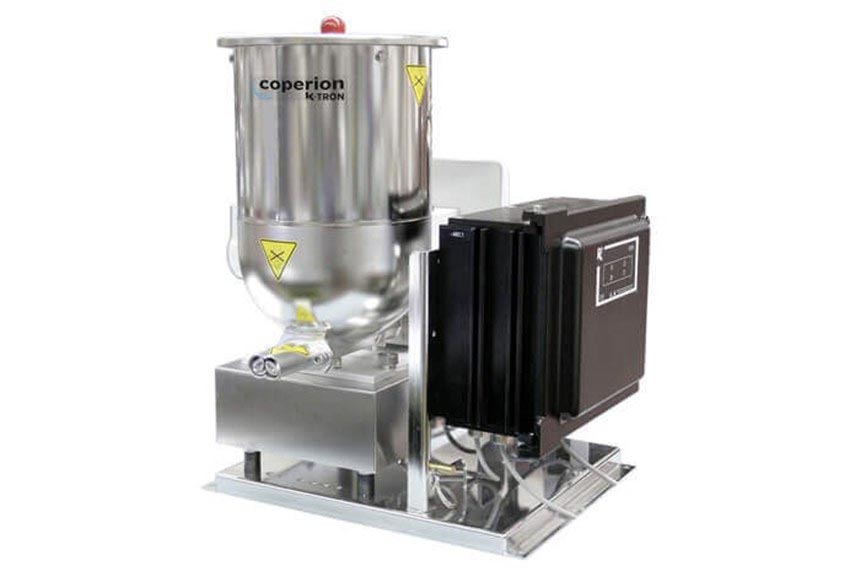
Coperion K-Tron’s feeder can be used for both loss-in-weight feeding to continuous processes and loss-in-weight batching direct to batch blenders. | Courtesy of Coperion K-Tron

The variability of recycled plastic streams doesn’t just present challenges in terms of extruding and molding products. It also complicates the feeding of plastic into compounding equipment.

In a recent presentation, John Winski, director of sales in the Americas for feeding equipment company Coperion K-Tron, discussed the different technologies for methodically moving recycled plastic from a hopper into processing equipment.

Getting this step in the recycling process right is important to ensuring operational efficiency, achieving recycled-content claims, and correctly dosing additives.

During the March 18 webinar, which was organized by trade publication Plastics Technology, Winski described how the variability of recycled plastics streams makes it hard to use a one-size-fits-all approach.

Recycled plastic can enter a hopper in wildly different forms – cubes, pellets, and fibers, for example. Characteristics such as particle shape, size, hardness, bulk density, moisture content, compressibility, cohesiveness and permeability can all affect how the material flows – or doesn’t.

“[Recycled plastics] are unique in themselves in that how they’re processed will really decide how we will handle them,” said Winski, who has 32 years of experience at Coperion K-Tron.

Feeder considerations

Feeders carry material from a hopper into the processing equipment.

When it comes to feeding material, Winski said, shredded bottle scrap is generally an easier material to handle – much less challenging than low-density fluff from post-consumer carpet, for example. But depending on the shredder that was used, the flake size can vary considerably, and that presents feeding challenges.

Winski suggested using a single-screw feeder with either an open flight screw or one with a closed-flight screw in a larger tube. Both approaches relieve pinch points that can restrict the flow of flakes from a storage bin above into the machine below.

“If we tried to feed this material in a twin-screw feeder with these concave screws, it would be a very poor choice, because the material would really get pinched into these screws and would lock the material up,” Winski said.

For regrind that’s a more consistent size, an option is to use a rotary valve feeder, where the material drops from the hopper down into a series of revolving pockets. In that case, it’s crucial to use a shear protector.

“If you don’t have a sheer protector, it’s like putting material into a twin-screw feeder and you’ll have a pinch point,” he said.

Preventing blockages in the hopper

Problems can also crop up in the hopper. Some materials, such as plastic chips, can become interlocked in the hopper, he said. When that happens, they can form what are called “ratholes,” where the material builds up along the lower sides of the hopper, constricting flow into the feeder bowl.

Another problem is the development of “bridges,” where the plastic interlocks and completely clogs the flow into the feeder.

To avoid those situations, Winski recommends the use of an agitator in the feeder bowl, which is located at the bottom of the hopper. That would ensure material in the hopper consistently drops down into the feeder. Additionally, some form of flow agitation in the extension hopper may be needed, he said.

Other options, each with pros and cons, include a vertical agitator in the hopper, flexible liners, air pads, or a bin vibrator.

Winski also said it’s important to consider volumetric versus gravimetric feeders, especially when a processor needs to ensure an accurate amount of material is feeding into equipment at consistent speeds.

The simplest is a volumetric unit, where a turning screw pulls recycled plastic out of the bottom of a hopper. The assumption is material will fall down the hopper and feed out at a  fixed speed, Winski said. The accuracy is usually within 3% to 5%, although it can be worse if the material is more variable.

Gravimetric systems include load cells and a controller, which adjust the speed based on how much weight is being lost in the hopper. Most gravimetric systems note they can provide an accuracy to within 0.5%, but it still varies depending on the flowability and particle size of the material, Winski said. If the hopper is full of a heavy material with a large particle size, the accuracy may be within 1%, he said.

To receive the latest news and analysis about plastics recycling technologies, sign up now for our free monthly Plastics Recycling Update: Technology Edition e-newsletter.
 

2021 Plastics Recycling Conference and Trade Show

Tags: Technology
TweetShare
Jared Paben

Jared Paben

Related Posts

Intel sign outside of company building.

Intel’s CapEx tops $20B on server demand while PC volume shrinks

byDavid Daoud
July 29, 2026

As a result ITAD firms should plan for two separate asset cycles.

Greyparrot positions waste intel as key to effective EPR

Greyparrot secures $27m for growing AI waste data

byAntoinette Smith
July 28, 2026

The AI waste intelligence firm has now raised a total of $60 million to help expand its Analyzer network and...

Google sign on company building with blue sky and clouds above.

Inside Alphabet’s Q2 results: More capital spending and cloud backlog

byDavid Daoud
July 28, 2026

The tech giant spent $44.9 billion in a single quarter building AI infrastructure, with major implications for the ITAD space.

Our top stories from March 2023

Iron Mountain’s data center report: Strong on power, quiet on hardware

byDavid Daoud
July 24, 2026

The company’s 2025 Sustainability Overview tells a story both in the data it presents and in the data it omits.

Rare earth processor lands $5.1M in Defense funds

ERI, Cyclic Materials team up on e-scrap

byDavid Daoud
July 21, 2026

Partnership pairs one of the country's largest electronics recyclers with a rare earth recovery specialist, aiming to build a domestic...

What the NAND flash crunch means for remarketing, refurbishment and residual values

Telamon acquires ITAD consultancy Retire-IT

byDavid Daoud
July 9, 2026

Telamon will be retaining Retire-IT founder Kyle Marks, who built that business over 21 years.

Load More
Next Post

How three cities address recycling in budget-repair plans

2026 Buyers’ Guide

Equipment, services and technology suppliers serving the recycling industry.

Browse the Guide

More Posts

State policy is redefining plastics recycling in the US

State policy is redefining plastics recycling in the US

February 19, 2026
California bill would set up EPR for batteries

California bill would set up EPR for batteries

May 12, 2022
Closeup of a printed circuitboard

Hardware demand puts new focus on parts harvesting

June 5, 2026
Apple store

Apple leads on inputs, faces questions on ITAD

May 1, 2026

In other news: May 2, 2016

May 2, 2016
Analysis: circular design still elusive in laptops

PC shipments grew in Q1, but questions remain

April 23, 2026

Recycled copper output climbs as market shows surplus

April 6, 2026
Ten e-scrap projects receive federal prize funds

Recycling rates for rare earths could double by 2040

July 17, 2026
Top stories from August 2024

Top stories from August 2024

September 6, 2024
Phonecheck's phone rating and erasing machine.

AI robot grades, erases up to 55 phones an hour

December 7, 2022
Load More

About & Publications

About Us

Staff

Archive

Magazine

Work With Us

Advertise
Jobs
Contact
Terms and Privacy

Newsletter

Get the latest recycling news and analysis delivered to your inbox every week. Stay ahead on industry trends, policy updates, and insights from programs, processors, and innovators.

Subscribe

Welcome Back!

Login to your account below

Forgotten Password?

Retrieve your password

Please enter your username or email address to reset your password.

Log In

Add New Playlist

No Result
View All Result
  • The Latest
  • Analysis
  • Recycling
  • E-Scrap
  • Plastics
  • Policy Now
  • Conferences
    • E-Scrap Conference
    • Plastics Recycling Conference
    • Resource Recycling Conference
    • Textiles Recovery Summit
  • Magazine
  • About Us
  • Advertise
  • Archive
  • Jobs
  • Staff
Subscribe
This website uses cookies. By continuing to use this website you are giving consent to cookies being used. Visit our Privacy and Cookie Policy.