Resource Recycling
  • The Latest
  • Analysis
    • All
    • Certification Scorecard
    • Industry Announcements
    • Opinion
    NJ’s PCR delay risks making its own excuse permanently true

    NJ’s PCR delay risks making its own excuse permanently true

    E-scrap magnet recycling company scales up

    Why only some rare-earth sources are economically viable

    e-Stewards to develop an ITAD-specific standard

    Certification scorecard — week of Sept. 21

    Who should pay for lithium-ion battery fire damage?

    America’s critical-materials buildout has a feedstock problem

    Certification scorecard – week of Sept. 14

  • Conferences
    • Resource Recycling Conference
    • Plastics Recycling Conference
    • E-Scrap: The Longevity Conference
    • Textiles Recovery Summit
  • Publications
    • E-Scrap News
    • Plastics Recycling Update
    • Policy Now
    • Resource Recycling
    • Other Topics
      • All Topics
      • Brand Owners
      • Critical Minerals
      • Glass
      • Grant Watch / RFPs
      • Markets
      • Organics
      • Packaging
      • Research
      • Technology
      • Textiles
Subscribe
No Result
View All Result
Resource Recycling
No Result
View All Result
Home Resource Recycling Magazine

Community Spotlight: County guides and fortifies local programs

Colin StaubbyColin Staub
October 26, 2017
in Resource Recycling Magazine

If it seems daunting to tackle contamination and hone recycling efforts in a single community recycling program, try taking on those tasks in four dozen municipalities simultaneously. For one Ohio county, that’s business as usual.

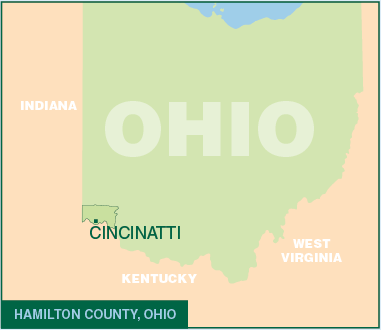
The Hamilton County Recycling and Solid Waste District does not provide actual recycling services for its residents, but the county provides assistance and works to lift diversion rates throughout its more than 400 square miles of land area.

With slightly more than 800,000 residents, the county contains communities that are urban, suburban and rural, and its largest jurisdiction is Cincinnati, a city with about 300,000 residents.

“We’re a very mixed county,” said Michelle Balz, assistant solid waste manager for the Hamilton County recycling and solid waste district.

Strong private-sector presence

There are 48 political jurisdictions in the solid waste district, Balz said, all of which have local control over how or whether recycling is offered to their residents.

What exactly that service entails varies from program to program. Some municipalities contract with a private hauler to provide curbside recycling collection, some use city crews to collect materials. Other communities provide recycling drop-off receptacles.

Recycling in Hamilton County dates back to the 1980s. A state law passed late in the decade required every county in Ohio to form a solid waste district. In some counties, that meant rolling out an entirely new service, often county-managed, for residents to begin recycling. But when Hamilton County’s solid waste district formed, the area already had a strong private sector recycling infrastructure, Balz said, meaning the county didn’t have to build its own materials recovery facility or landfill.

“We relied on the private sector or on individual communities that had their own collection crews,” Balz explained.

Collection programs began with bins and have evolved over the years to the point where the most common recycling program in Hamilton County is curbside, cart-based single-stream collection. Only a couple communities out of the four dozen rely solely on drop-off efforts.

There are no laws requiring residents to recycle, but the majority of communities have automatic recycling, meaning the residents do not have to opt in or pay an additional fee in order to receive recycling service.

“Those communities tend to have higher participation,” Balz said.

A smaller number of communities use a subscription program in which residents must pay an additional fee to gain access to recycling service.

Hamilton County’s residential contamination rate is around 11 percent. It uses a coordinated “Recycle Right” outreach campaign to help residents understand what to put in bins and carts.

County ties it together

With 48 communities and 48 different programs, all managed and operated at the local level, the Hamilton County Solid Waste District takes on a planning and assistance role. The office writes a 15-year solid waste management plan every five years, which looks down the road to gauge whether the county has adequate infrastructure to handle projected service levels.

The management plan also has the county identifying the programming it will use to meet statewide residential, commercial and industrial diversion goals.

“Mainly, our programming is helping anyone that makes trash reduce how much trash they create,” Balz said. The largest program the county provides is called the Residential Recycling Incentive Program, which gives money to communities to help offset the cost of curbside and drop-off recycling programs.

This year, that fund contained $1.05 million that was available for local program assistance.

“It’s basically like a pie of money that’s split up amongst the communities based on their recycling rate and how many tons they’ve recycled,” Balz noted. “The higher their recycling rate goes, the more money they get.”

The county also provides assistance beyond the funding realm. One initiative sends county personnel out to local schools to help them set up recycling programs and educate students about recycling. Under another assistance program, county staff will visit all types of businesses and provide technical assistance and supplies for them to help set up a program.

“We’re not offering the service, but we kind of hold their hand through the process,” Balz explained.
In some cases, the county can fill in gaps in service between its communities. The county has installed three yard debris drop-off sites targeted at residents who don’t have access to curbside organics collection in their local programs.

Much of the county’s work comes down to spreading the word about recycling and educating residents on how best to do it.

A campaign called Recycle Right aims specifically at combating contamination, often by targeting one problem material at a time. The county sends out mailers and uses other paid advertising detailing how to and how not to recycle batteries, for instance.

The county’s diversion rate, including residential, commercial and industrial streams from all communities, sits at nearly 51 percent. The residential contamination rate currently hovers between 11 and 12 percent.

But with the variance in how service is provided from community to community, Balz noted reporting from different programs can leave some discrepancies. Local recyclers are not required to report figures to the county, so the countywide rate is based on a voluntary survey of service providers.

A new year, a new priority

Food scraps have been a particular area of focus for Hamilton County. The county puts on seminars in the spring and fall, regularly drawing 500 attendees and focusing on how to start backyard composting.

But the organics focus stretches upstream as well. For instance, the county has helped develop what it calls school food share tables, which are placed in cafeterias and serve as a space for students to place food they are not going to eat. The food is open to any other students, and if it’s not eaten by the end of the lunch period, it’s donated to a local food pantry.

Part of the county’s solid waste management plan allocates $85,000 per year to work toward a specific priority. Next year, the priority area is organics.

“We’re going to be working on reducing residential wasted food, but then also working on the food recovery aspect of things,” Balz said.

Think your local program should be featured in this space? Send a note to news@dev.resource-recycling.com.

This article originally appeared in the October 2017 issue of Resource Recycling. Subscribe today for access to all print content.

Tags: Local Programs
TweetShare
Colin Staub

Colin Staub

Colin Staub was a reporter and associate editor at Resource Recycling until August 2025.

Related Posts

Bin to Better gets students involved in reuse, recycling

Bin to Better gets students involved in reuse, recycling

byPaul Lane
September 24, 2026

E-scrap among three focus areas for student-run, California-based environmental advocacy group.

APR reports success for 2026 recycling tours 

APR reports success for 2026 recycling tours 

byAntoinette Smith
September 23, 2026

In May, more than 2,500 visitors toured 41 facilities in the US and Mexico, during APR's second annual Recycling in...

Leadership at a pivotal moment

Leadership at a pivotal moment

byBrian Clark Howard
September 10, 2026

CalRecycle Director Zoe Heller is heading up an agency tasked with ambitious recycling and sustainability goals. Can she pull it...

Recology CEO Sal Coniglio in front of one of the hauler's trucks

Recology’s Sal Coniglio on business and policy working together

byBrian Clark Howard
August 31, 2026

The CEO of the West Coast hauler and recycler shares his thoughts on EPR, organics and what keeps him up...

New Compudopt CEO hopes to nurture agency’s growth

byPaul Lane
August 14, 2026

Allison Kotarski assumed the organization’s top spot after several years as COO.

Bags of collected agricultural twine for Cleanfarms twine recycling contest

News in Brief: August 10, 2026

byIsabella Burke
August 10, 2026

An Alberta twine recycling contest, Pellitteri expands waste and recycling services into the Milwaukee area and the Canadian government awards...

Load More
Next Post

October 2017

2026 Buyers’ Guide

Equipment, services and technology suppliers serving the recycling industry.

Browse the Guide

More Posts

Ten e-scrap projects receive federal prize funds

Recycling rates for rare earths could double by 2040

July 17, 2026

In other news: May 2, 2016

May 2, 2016
Intel sign outside of company building.

Intel’s CapEx tops $20B on server demand while PC volume shrinks

July 29, 2026
Feds to develop repairable computer donation program

The whitebox blind spot in PC recycling

April 24, 2026
Textile EPR and the definition of recycling

Textile Exchange reports progress in production

September 22, 2026

America’s critical-materials buildout has a feedstock problem

September 18, 2026

Microsoft confirms PC sales slump

August 4, 2026
Closeup of a printed circuitboard

Hardware demand puts new focus on parts harvesting

June 5, 2026
Data erasure firm expands wearable device capabilities

Apple hits 30% recycled content, debuts new recovery tech

April 17, 2026
E-scrap magnet recycling company scales up

Why only some rare-earth sources are economically viable

September 24, 2026
Load More

About & Publications

About Us

Staff

Archive

Magazines

Work With Us

Advertise
Jobs
Contact
Terms and Privacy

Newsletters

Get the latest recycling news and analysis delivered to your inbox every week. Stay ahead on industry trends, policy updates, and insights from programs, processors, and innovators.

Subscribe

Welcome Back!

Login to your account below

Forgotten Password?

Retrieve your password

Please enter your username or email address to reset your password.

Log In

Add New Playlist

No Result
View All Result
  • The Latest
  • Analysis
  • Recycling
  • E-Scrap
  • Plastics
  • Policy Now
  • Conferences
    • E-Scrap Conference
    • Plastics Recycling Conference
    • Resource Recycling Conference
    • Textiles Recovery Summit
  • Magazines
  • About Us
  • Advertise
  • Archive
  • Jobs
  • Staff
Subscribe
This website uses cookies. By continuing to use this website you are giving consent to cookies being used. Visit our Privacy and Cookie Policy.
-
00:00
00:00

Queue

Update Required Flash plugin
-
00:00
00:00