



Resource Recycling
  • The Latest
  • Analysis
    • All
    • Certification Scorecard
    • Industry Announcements
    • Opinion
    NJ’s PCR delay risks making its own excuse permanently true

    NJ’s PCR delay risks making its own excuse permanently true

    E-scrap magnet recycling company scales up

    Why only some rare-earth sources are economically viable

    e-Stewards to develop an ITAD-specific standard

    Certification scorecard — week of Sept. 21

    Who should pay for lithium-ion battery fire damage?

    America’s critical-materials buildout has a feedstock problem

    Certification scorecard – week of Sept. 14

  • Conferences
    • Resource Recycling Conference
    • Plastics Recycling Conference
    • E-Scrap: The Longevity Conference
    • Textiles Recovery Summit
  • Publications
    • E-Scrap News
    • Plastics Recycling Update
    • Policy Now
    • Resource Recycling
    • Other Topics
      • All Topics
      • Brand Owners
      • Critical Minerals
      • Glass
      • Grant Watch / RFPs
      • Markets
      • Organics
      • Packaging
      • Research
      • Technology
      • Textiles
Subscribe
No Result
View All Result
Resource Recycling
  • The Latest
  • Analysis
    • All
    • Certification Scorecard
    • Industry Announcements
    • Opinion
    NJ’s PCR delay risks making its own excuse permanently true

    NJ’s PCR delay risks making its own excuse permanently true

    E-scrap magnet recycling company scales up

    Why only some rare-earth sources are economically viable

    e-Stewards to develop an ITAD-specific standard

    Certification scorecard — week of Sept. 21

    Who should pay for lithium-ion battery fire damage?

    America’s critical-materials buildout has a feedstock problem

    Certification scorecard – week of Sept. 14

  • Conferences
    • Resource Recycling Conference
    • Plastics Recycling Conference
    • E-Scrap: The Longevity Conference
    • Textiles Recovery Summit
  • Publications
    • E-Scrap News
    • Plastics Recycling Update
    • Policy Now
    • Resource Recycling
    • Other Topics
      • All Topics
      • Brand Owners
      • Critical Minerals
      • Glass
      • Grant Watch / RFPs
      • Markets
      • Organics
      • Packaging
      • Research
      • Technology
      • Textiles
Subscribe
No Result
View All Result
Resource Recycling
No Result
View All Result
Home Recycling

How robots are cleaning up a MRF’s paper bales

byJared Paben
October 22, 2019
in Recycling
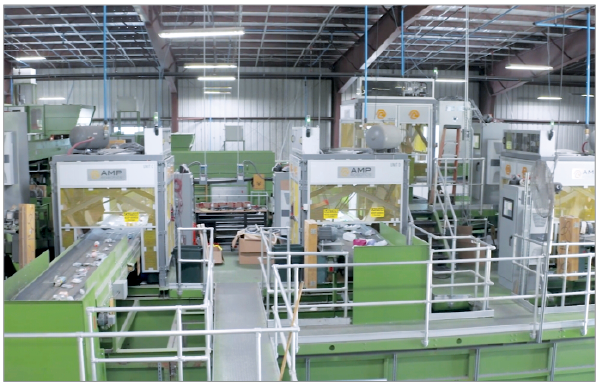
With 14 robots connected to 10 vision systems, Single Stream Recyclers (SSR) in Sarasota, Fla. has more robots under one roof than any other MRF.

A Florida company leveraging 14 robotic sorters is among the first recycling facilities to use the technology on fiber lines, boosting the value of paper bales.

“We’ve definitely realized the upside to having them with our end-market pricing,” said John Hansen, co-owner of Single Stream Recyclers (SSR). “What we thought would happen has really happened.”

Sarasota, Fla.-based SSR sports 14 robotic sorting arms connected to 10 visioning systems, which identify items on the belt based on their appearance. That’s more systems under one roof than any other known MRF in North America. The robots were provided by Denver-based software company AMP Robotics.

After AMP and SSR worked to overcome challenges adapting the robots to paper lines, the facility is today creating cleaner bales with a reduced headcount.

“At SSR, they’ve really shown just how far robots can go, where those robots are doing the bulk of the sorting of what used to be manual sorting in the facility,” said Matanya Horowitz, founder and CEO of AMP Robotics.

Installing the robots

Even before it installed the robots, SSR’s 100,000-square-foot MRF had an impressive array of sorting technologies. The facility opened in March 2018, with the main plant supplied by Quebec-based equipment supplier Sherbrooke OEM. The MRF has Stadler ballistic separators and eight Eagle Vizion optical sorters.

In May, SSR bought and installed six robots from AMP, each a delta-style robot with a vision system. They went in the following locations on the container line:

  • Two for quality control for PET.
  • One for QC for HDPE.
  • One for QC of PP.
  • One for QC of UBCs.
  • One picking cartons and other materials of value from the residue line.

The Carton Council provided funding to help pay for the carton-picking unit.

Hansen pointed to a few factors that spurred SSR to adopt robots. Labor is always a challenge, in terms of turnover and employee no-shows, he noted. SSR also started to pay closer attention when robots crossed the threshold of 30-40 picks per minute. “We saw that the technology had advanced far enough where it made sense,” Hansen said.

When AMP was founded five years ago, the company started by tackling container lines. The company is consistently building out a database of images the robotic systems reference to identify items in a fraction of a second. As AMP and other robot providers have developed their technologies, pick speeds have also increased significantly.

At SSR, the container line units were performing well within days of installation, Hansen said.

“The container line QC ones got up to speed in a real hurry and were really effective very, very early on,” Hansen said. “Literally days after the installation, days later they were picking 70 to 80 picks per minute.”

In May, AMP announced it had developed a dual-arm system, called the AMP Cortex dual-robot system (DRS), equipped to handle the onslaught of material on a fiber line. Two months after buying the first six robots for the container line, SSR bought another eight for its paper lines, Hansen said.

Horowitz said SSR was the first facility to install AMP’s robots on a paper line, although others have since done so, as well.

Overcoming paper line challenges

In September, SSR installed two DRS systems on a line making mixed-paper bales and two on a line making ONP bales. There are a total of eight sorting arms, each pair connected to a vision system. The delta-style robots are provided by Omron Robotics.

On the paper lines, the units are pulling out OCC, film and containers.

The delta-style robotic arms are working in pairs because the fiber belt is so wide. The belt speeds and material volumes are also high. Hansen said when humans were providing the bulk of the paper line QC, the belt was running at 140 feet per minute; with the robots, it’s running at 260-270 feet per minute, to create a better spread between materials.

Horowitz said preparing the units for the high belt speeds was a challenge, both in terms of accurate identification and reliable gripping. AMP has had to capture a lot of image data from the paper lines so the systems can identify materials, including those partially obscured by paper.

“As long as we can see even a bit of it, our robots can go after it,” he said.

A core problem they had to solve was gripping film, ensuring it doesn’t clog the gripper and fail to release, Horowitz explained.

At startup, the neural network’s ability to ID materials on the paper line wasn’t as advanced as for containers, Hansen said. That being said, “our product difference is still better than when we had people there.” And the paper line recognition abilities continues to improve, he said.

As is the case with other pieces of equipment, material preparation is key for robots, Hansen said. “If you have a bunch of burden depth and can’t adjust your lines to get singulation, you’re not going to have great success,” he said.

Because of the robots, SSR has been able to reduce headcount by 20, Hansen said. Because the facility is now running two shifts, that’s effectively a decrease of 40 people a day. Some of the employees will be retrained to monitor the robots, ensuring the grippers don’t get clogged or torn. SSR will have two people monitor the fiber robots and one monitor the container robots.

The robots are generating cleaner paper bales with higher yields, Hansen said. As a result, SSR is getting above-average prices. Hansen said the market for mixed paper will return eventually, and if facilities decide not to clean up their fiber, it will be destined for landfill.

Resource Recycling in August 2019 charted the fast adoption in North America of robots from AMP, Bulk Handling Systems (BHS), Machinex and ZenRobotics. According to Resource Recycling’s data, BHS has deployed the most robots in the U.S. overall.

 

Tags: MRFsPaper FiberTechnology
TweetShare
Jared Paben

Jared Paben

Related Posts

Cutting healthcare plastics could save $18B

Report provides path to reduce medical e-scrap

byPaul Lane
September 25, 2026

The European report found that circularity in medical devices is possible through several potential initiatives.

Study assesses environmental cost of excess data storage

BAN paper says AI e-scrap estimates are low

byPaul Lane
September 17, 2026

The advocacy group said current estimates on the scrap resulting from data centers don’t account for the full picture of...

Google Pixel 6 phone

Google makes repairability part of design ethos

byBrian Clark Howard
September 16, 2026

The tech titan supports the right-to-repair movement in several key ways.

CommanderAI launches searchable hauler database

Inside the Circle: Put AI to work for the people who do the work

byBill Shireman
September 14, 2026

There is more than one way to use AI, and some ways are more valuable than others.

CleanLane aims to redefine organics recovery in Oregon

CleanLane aims to redefine organics recovery in Oregon

byKeith Loria
September 10, 2026

CleanLane is an ambitious materials recovery facility that will combine advanced recycling, anaerobic digestion and renewable natural gas production under...

Northeast commodity values for Q2 reach 2-year high

Will a MRF shortage limit EPR growth?

byKatherine Doerr
September 10, 2026

Where will all the EPR-collected SSR go? Will there be enough MRFs to handle the material?

Load More
Next Post

Mapping out MRF infrastructure nationwide

2026 Buyers’ Guide

Equipment, services and technology suppliers serving the recycling industry.

Browse the Guide

More Posts

Recyclers reeling from NJ PCR extension

Recyclers reeling from NJ PCR extension

September 23, 2026
Oregon state capitol building with state flag and blue sky.

NAW appeals Oregon EPR ruling

September 25, 2026
Bin to Better gets students involved in reuse, recycling

Bin to Better gets students involved in reuse, recycling

September 24, 2026
Calif. Governor Gavin Newsom at podium.

Newsom signs battery EPR expansion, vetoes SB 54 fund bill

September 24, 2026

Who should pay for lithium-ion battery fire damage?

September 21, 2026
Bipartisan reps introduce bill on recycling claims

House passes bill to ease lithium-ion battery storage rules

September 24, 2026
Analysis: Undersupply of PCR is ‘stifling’ brand goals

US lawmakers urge protection of domestic RPET

September 25, 2026
US packaging is evolving. The recycling system isn’t ready

US packaging is evolving. The recycling system isn’t ready

September 16, 2026
Industry announcements for January 2026

Industry announcements for September 2026

August 31, 2026
Bridge Green, Hartree partner on mineral processing deal

Bridge Green, Hartree partner on mineral processing deal

September 21, 2026
Load More

About & Publications

About Us

Staff

Archive

Magazines

Work With Us

Advertise
Jobs
Contact
Terms and Privacy

Newsletters

Get the latest recycling news and analysis delivered to your inbox every week. Stay ahead on industry trends, policy updates, and insights from programs, processors, and innovators.

Subscribe

Welcome Back!

Login to your account below

Forgotten Password?

Retrieve your password

Please enter your username or email address to reset your password.

Log In

Add New Playlist

No Result
View All Result
  • The Latest
  • Analysis
  • Recycling
  • E-Scrap
  • Plastics
  • Policy Now
  • Conferences
    • E-Scrap Conference
    • Plastics Recycling Conference
    • Resource Recycling Conference
    • Textiles Recovery Summit
  • Magazines
  • About Us
  • Advertise
  • Archive
  • Jobs
  • Staff
Subscribe
This website uses cookies. By continuing to use this website you are giving consent to cookies being used. Visit our Privacy and Cookie Policy.