


Resource Recycling
  • The Latest
  • Analysis
    • All
    • Certification Scorecard
    • Industry Announcements
    • Opinion
    SERI works to restore faith in certifications

    Building a defensible E-scrap evidence file

    tires

    The most important decision in tire recycling happens before the shredder

    Intel sign outside of company building.

    Intel’s CapEx tops $20B on server demand while PC volume shrinks

    Google sign on company building with blue sky and clouds above.

    Inside Alphabet’s Q2 results: More capital spending and cloud backlog

    Alpek closing Pennsylvania RPET plant

    Alpek seizing on war-related opportunity 

    Our top stories from March 2023

    Iron Mountain’s data center report: Strong on power, quiet on hardware

  • Conferences
    • Resource Recycling Conference
    • Plastics Recycling Conference
    • E-Scrap: The Longevity Conference
    • Textiles Recovery Summit
  • Publications
    • E-Scrap News
    • Plastics Recycling Update
    • Policy Now
    • Resource Recycling
    • Other Topics
      • All Topics
      • Brand Owners
      • Critical Minerals
      • Glass
      • Grant Watch / RFPs
      • Markets
      • Organics
      • Packaging
      • Research
      • Technology
      • Textiles
Subscribe
No Result
View All Result
Resource Recycling
  • The Latest
  • Analysis
    • All
    • Certification Scorecard
    • Industry Announcements
    • Opinion
    SERI works to restore faith in certifications

    Building a defensible E-scrap evidence file

    tires

    The most important decision in tire recycling happens before the shredder

    Intel sign outside of company building.

    Intel’s CapEx tops $20B on server demand while PC volume shrinks

    Google sign on company building with blue sky and clouds above.

    Inside Alphabet’s Q2 results: More capital spending and cloud backlog

    Alpek closing Pennsylvania RPET plant

    Alpek seizing on war-related opportunity 

    Our top stories from March 2023

    Iron Mountain’s data center report: Strong on power, quiet on hardware

  • Conferences
    • Resource Recycling Conference
    • Plastics Recycling Conference
    • E-Scrap: The Longevity Conference
    • Textiles Recovery Summit
  • Publications
    • E-Scrap News
    • Plastics Recycling Update
    • Policy Now
    • Resource Recycling
    • Other Topics
      • All Topics
      • Brand Owners
      • Critical Minerals
      • Glass
      • Grant Watch / RFPs
      • Markets
      • Organics
      • Packaging
      • Research
      • Technology
      • Textiles
Subscribe
No Result
View All Result
Resource Recycling
No Result
View All Result
Home Recycling

Software brings efficient data to organics collection

byJared Paben
October 30, 2023
in Recycling
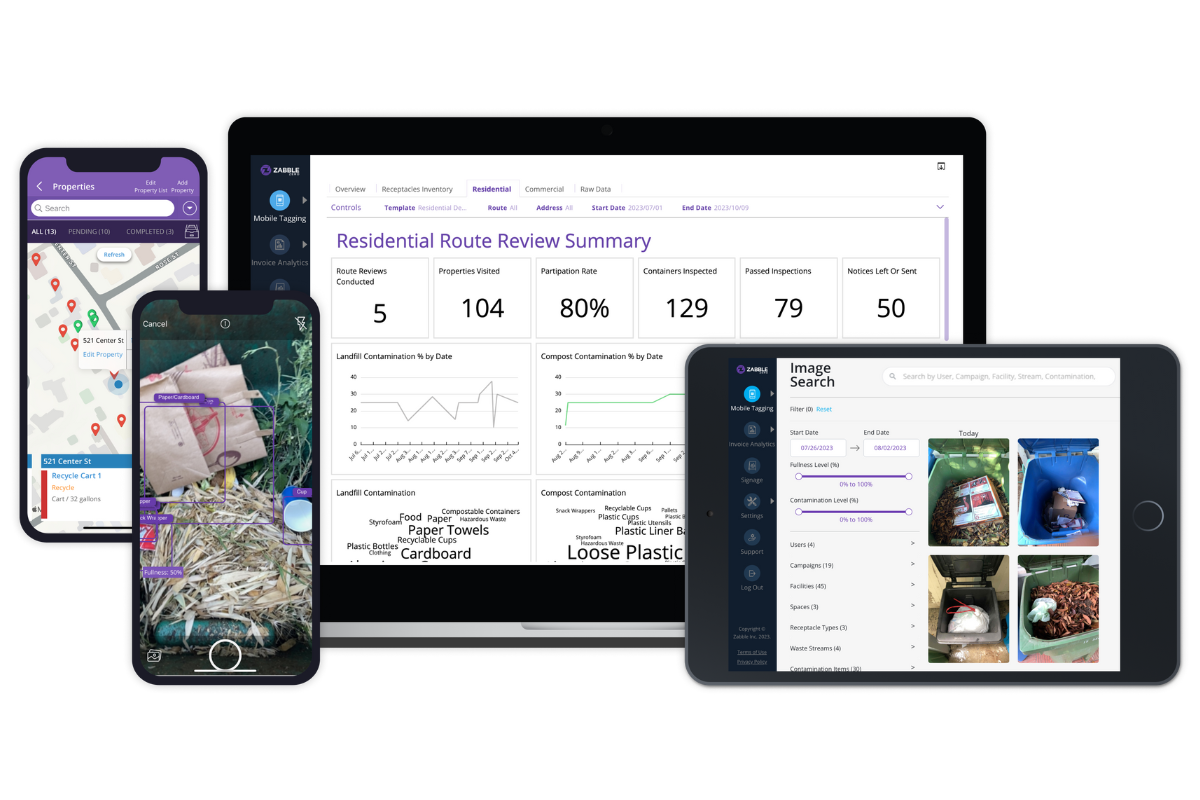
Now that California has mandated organics collection by local governments, Zabble hopes to see growing demand for its contamination monitoring tools. | Courtesy of Zabble

When Zabble interviewed dozens of municipal recycling stakeholders in California, one of the issues the company heard about was the inability to use contamination monitoring mobile device software in the field when there’s no network signal.

That outreach helped inform the latest rollout of Zabble’s software capabilities. 

“The core focus on our design was robustness and how to make sure that they continue to drive those efficiencies even when there was no access to the internet,” said Nik Balachandran, CEO and founder of the small but growing company that’s centered in the San Francisco Bay Area. 

Zabble, which has received funding from the U.S. EPA, is a data collection and analytics platform that allows recycling programs to track their recycling performance. Using AI-powered software, the company allows for real-time monitoring of recycling rates and contamination. 

To date, universities have made up the bulk of Zabble’s clients, who pay a monthly subscription charge. But California’s implementation of Senate Bill 1383, which requires local governments to provide organics collection service to residents, “gave us an avenue” to roll out its offering to municipal recycling programs to collect granular data on organics diversion and contamination at the curb, Balachandran said. 

The rollout of SB 1393 requires jurisdictions to conduct monitoring of their curbside organics collection stream. The California Department of Resources Recycling and Recovery (CalRecycle) recently announced it will provide a total of $90 million in local assistance grants to help jurisdictions comply with the organics mandates. For the first time, software such as Zabble’s constitutes an allowed expense under those grants, which are divided among local governments based on population, Balachandran said. 

“The state has also kind of realized that technology could be really beneficial if it’s built properly,” he said. 

EPA helps evolving the platform 

Zabble has received multiple Small Business Innovation Research (SBIR) program grants from EPA. Last year, EPA gave Zabble a $400,000 SBIR grant to further develop its technology. In 2021, EPA provided Zabble an SBIR grant to help it first test its AI-powered visioning capabilities to automatically detect and categorize materials in the wrong bins using a cell phone image. 

EPA funds helped pay for research that included outreach to 33 jurisdictions, six consulting organizations and seven haulers earlier this year. That outreach helped inform the development and rollout of Zabble’s latest software offering, called “Mobile Tagging for Jurisdictions,” which is aimed at helping local governments comply with the state requirements that they monitor their organics programs. 

The mobile device software is designed to automatically detect cart fill and contamination levels, simultaneously linking the data to the address, all without having a network connection (in areas without good cell signal, many cart auditors use a pen and paper as a backup, Zabble’s outreach found). 

The software system then helps jurisdictions analyze their results and determine how to best address contamination with the households. Balachandran noted jurisdictions can take advantage of the no-code app development, essentially allowing program staff without coding knowledge to drag-and-drop to build an app with data fields they’ll find most useful. 

Growth opportunities abound

CalRecycle data indicates roughly 75% of jurisdictions in the  state now have residential organics collection in place. That means the majority are now shifting into the monitoring phase. 

A handful of municipalities are currently using Zabble’s software when they flip lids. Those include the city of Berkeley, the Castro Valley Sanitary District and two others that Balachandran declined to identify. 

Zabble is working with them to determine how many organics carts they need to sample to produce representative data on systemwide contamination levels, so they don’t end up under- or oversampling. 

“With Zabble’s AI-powered technology, we’re partnering to uncover efficiencies with lid flips, unlock valuable time and resources and gain granular contamination insights to improve our programs,” Julia Heath, recycling program manager at the city of Berkeley, stated in a press release. “This enables us to channel more of our efforts toward reducing our environmental footprint and building a sustainable future for our city and county.”

Zabble, itself, is a growing company. After enjoying steady two- or three-times annual revenue growth in recent years, the company is now roughly breaking even, Balachandran said. Employing a mix of full-time employees and contractors, Zabble has a fully remote, fully U.S. based workforce, Balachandran said. 

Tags: CaliforniaCollectionOrganicsTechnology
TweetShare
Jared Paben

Jared Paben

Related Posts

Intel sign outside of company building.

Intel’s CapEx tops $20B on server demand while PC volume shrinks

byDavid Daoud
July 29, 2026

As a result ITAD firms should plan for two separate asset cycles.

Greyparrot positions waste intel as key to effective EPR

Greyparrot secures $27m for growing AI waste data

byAntoinette Smith
July 28, 2026

The AI waste intelligence firm has now raised a total of $60 million to help expand its Analyzer network and...

Google sign on company building with blue sky and clouds above.

Inside Alphabet’s Q2 results: More capital spending and cloud backlog

byDavid Daoud
July 28, 2026

The tech giant spent $44.9 billion in a single quarter building AI infrastructure, with major implications for the ITAD space.

Wisconsin opens e-recycling grant process

byPaul Lane
July 28, 2026

Funds are available for collection programs as the state touts growth in electronic recycling in its latest annual report.

Our top stories from March 2023

Iron Mountain’s data center report: Strong on power, quiet on hardware

byDavid Daoud
July 24, 2026

The company’s 2025 Sustainability Overview tells a story both in the data it presents and in the data it omits.

MTA loses track of recycling, costing NYC Transit $800,000

byStefanie Valentic
July 23, 2026

A new MTA inspector general report finds NYC Transit lost nearly $800,000 after years of mishandled recycling and the contractor...

Load More
Next Post

Environmental groups launch plastic laws database

2026 Buyers’ Guide

Equipment, services and technology suppliers serving the recycling industry.

Browse the Guide

More Posts

Innovation. Partnership. Circular value.

Innovation. Partnership. Circular value.

August 1, 2026
SERI works to restore faith in certifications

Building a defensible E-scrap evidence file

August 6, 2026
Copper prices fall to lowest point since spring

EMR recycling plant to reopen in NJ after fire, legal battle

July 21, 2026
RecyClass hits 500 EU recyclability evals

RecyClass hits 500 EU recyclability evals

July 21, 2026
What the NAND flash crunch means for remarketing, refurbishment and residual values

Telamon acquires ITAD consultancy Retire-IT

July 9, 2026
Tech giant pens detailed ‘plastic-free packaging’ guide

What Google’s latest report means for ITAD

July 8, 2026
Canada EV battery reuse pilot to start

Canada EV battery reuse pilot to start

July 8, 2026
Battery fire risk isn’t going away. Insurance is responding

Battery fire risk isn’t going away. Insurance is responding

February 24, 2026

Our top stories from October 2021

November 3, 2021
Spin-off lets Linca focus on battery mineral recovery

GAO: Policy, tech updates needed to bolster domestic mineral supply

July 30, 2026
Load More

About & Publications

About Us

Staff

Archive

Magazine

Work With Us

Advertise
Jobs
Contact
Terms and Privacy

Newsletter

Get the latest recycling news and analysis delivered to your inbox every week. Stay ahead on industry trends, policy updates, and insights from programs, processors, and innovators.

Subscribe

Welcome Back!

Login to your account below

Forgotten Password?

Retrieve your password

Please enter your username or email address to reset your password.

Log In

Add New Playlist

No Result
View All Result
  • The Latest
  • Analysis
  • Recycling
  • E-Scrap
  • Plastics
  • Policy Now
  • Conferences
    • E-Scrap Conference
    • Plastics Recycling Conference
    • Resource Recycling Conference
    • Textiles Recovery Summit
  • Magazine
  • About Us
  • Advertise
  • Archive
  • Jobs
  • Staff
Subscribe
This website uses cookies. By continuing to use this website you are giving consent to cookies being used. Visit our Privacy and Cookie Policy.