





Summit County, Utah, boasts one of the largest ski resorts in the U.S., bringing tourists from around the world to experience the majestic slopes in Park City. The region has even been selected as the site of the 2034 Winter Olympics.
But while a boon to the local economy, the region’s status as a vacation destination is among the factors contributing to the less-flattering achievement of a 12% diversion rate. Meanwhile, the county has limited space at its landfill and only expensive alternatives for sending municipal solid waste out of the area.
Now a group of local recycling stakeholders, including the nonprofit drop-off recycling facility operator Recycle Utah, are building support for a new $25 million MRF and other changes that would significantly increase diversion and maximize the life of the county’s landfill.
Recycle Utah, government representatives and consulting firm RRS outlined their efforts in a community meeting on Jan. 7.
Located in the northeast corner of Utah, Summit County has about 42,000 residents. Jim Bedell, current executive director and former board member of Recycle Utah, provided a mixed picture of the county’s recycling progress. Recycle Utah’s Park City drop-off facility experiences remarkably low contamination, but the county as a whole has relatively low diversion.
Bedell provided a rundown of similar communities in the Mountain West region, ranking them by diversion: Boulder, Colorado, is at 52%; Boulder County is at 35%. Teton County, Wyoming, home to Jackson Hole, sits at 35%. Blaine County, Idaho, home to Sun Valley, is at 34%. Aspen, Colorado, is at 40%. Vail, Colorado, is at 31%.
“All of these peers of ours are sort of at or above the national average,” Bedell said, referencing the EPA’s calculation of a 32% average in 2018. “Given our community’s successful focus on sustainable living in so many different areas, it’s really mind boggling that we’re at 12%, but that’s where we are.”
Besides raising the diversion rate, a focus of the current project is to process recyclables locally rather than having to send them to MRFs in Salt Lake City.
With the help of RRS, Recycle Utah is proposing to build a MRF that would expand on the capabilities of Recycle Utah’s successful – but very small – drop-off recycling center. The organization is proposing to act as a hub in a regional hub-and-spoke model of recycling collection, a popular model for rural areas.
Plan calls for investment in a MRF
Many of the top tourist draws in the area have waste reduction and sustainability goals, including the major Park City Mountain resort and the Deer Valley Resort. In fact, many municipalities and community groups in the county have set goals related to recycling and waste.
The project spearheaded by Recycle Utah is aiming to help synthesize and make progress toward those goals, explained Kristen Wieland, a consultant with RRS. The firm met with local stakeholders last year and drafted a plan for how Recycle Utah can expand and shift to meet the current needs.
Despite all the established goals, there is one major outstanding problem, Wieland explained: “There really has been no investment in any infrastructure or programming to get those goals achieved.”
And despite those goals, the recycling infrastructure remains limited. Recycle Utah sits on just 13,000 square feet of land and has simply outgrown its location, especially if it is going to play a larger role in improving county diversion, said Steven Klemann, another consultant with RRS.
RRS came up with two options, the first offering a phased approach to a full MRF and the second involving building a full MRF all at once. Recycle Utah, Bedell explained, decided to go all in on the second option, aiming to build a small but complete single-stream facility.
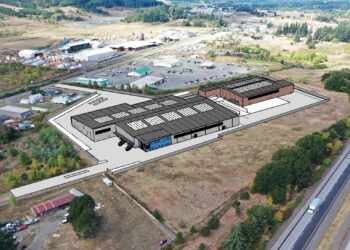
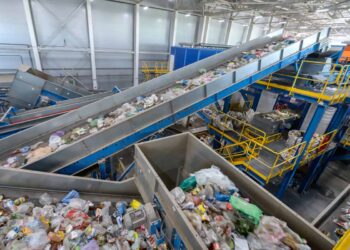
The plan proposes a 30,000-square-foot facility on 5 to 6 acres of total land, maintaining a residential drop-off area similar to the existing facility but adding sorting capacity with conveyors and optical sorters or potentially robotics. Such a facility would be able to bring in the Park City-collected curbside commingled recyclables. It would be sorted locally and then sent to buyers.
“By having a facility like this localized, you are now creating a facility that is a lot closer than 60 minutes each way,” Klemann said. “Now you have local processing infrastructure fully integrated for this community and for surrounding communities.”
Recycle Utah already has a site in mind, a centrally-located industrial property near Interstate 80. Now the work turns to building community support and fundraising, because Recycle Utah can’t foot the bill for a $25 million facility alone. Bedell noted the organization supports a model where the local governments pool funding to secure the land and the building.
Recycle Utah is willing to contribute some of its savings and invest in a capital campaign to outfit the equipment for the facility, Bedell added. Optical sorting systems have both come down in price and become more modular, he said.
“When we first asked about the possibilities of optical sorting, they said, ‘Yeah, if you’re like, the city of Boulder or Ann Arbor, sure, you can afford it,'” he said. “Now, the way that technology is evolving, we can afford it.”
Tourism destination brings unique challenges
A major goal of the Recycle Utah project is to preserve landfill space, explained Tim Loveday, Summit County solid waste superintendent, who oversees the county’s two landfills. One accepts municipal solid waste and one handles C&D debris.
“These things, you know, they’re a finite amount of space,” Loveday said, and that’s been increasingly on county officials’ radar. Current estimates put the MSW landfill reaching capacity by 2053, “if things go really well,” Loveday said.
The C&D landfill has less pressing constraints and has room to expand. But the MSW landfill doesn’t have that luxury: “After 2053, there’s no more space, it closes and we’ll have to send our waste elsewhere,” Loveday said.
“At the end of the day, you call it recycle, reuse, whatever you want to do, but for me, at my scale, it’s about diversion,” Loveday said. “I need it diverted away from the landfill.”
The county has a pretty unique environment, he added, evolving from a mining and ranching community to one driven by tourism. And tourism “significantly affects the way we manage waste and the amount of waste we have in the county,” Loveday said.
EPA generation estimates suggest the county would be producing 4.9 pounds per day of MSW per resident, or 38,450 tons per year. That would be fairly easy to manage, he noted. But as a tourism community, with people coming in and out frequently and with a lot of tourism-catering businesses, the county is actually averaging 7.6 pounds per day per “resident,” or 57,000 tons per year.
“That is a 48% increase in tonnage, that’s a 48% increase in cost,” Loveday said. “So there’s a lot more to deal with in Summit County than just your standard residential-type load.”
And those are just the disposal numbers. Another challenge is the rise of short-term vacation rentals – currently, some 70% of residential housing in the Snyderville basin part of the county is being rented out through short-term rental sites, Loveday said.
“The No. 1 payer of tax in Summit County is AirBnB,” he noted.
That creates unique challenges for solid waste management. Visitors don’t necessarily know the local recycling rules, driving up contamination. Summit County runs a commingled recycling program that doesn’t accept glass, but it gets a lot of glass in part because of the large percentage of vacationers.
Additionally, houses have to be cleaned after every stay, which generates material to be disposed of, but inbound lodgers won’t want to arrive to find a full garbage can. That creates a cleaning schedule that doesn’t necessarily line up with the county’s collection schedule, which is once per week for garbage and every other week for recycling. The result? Material is often being improperly disposed of in dumpsters, not being hauled directly to the county landfill.
“It’s a pretty big deal that we need to be able to address,” Loveday said.
Without expanded recycling capacity, the county has some unpleasant options. In the event its landfill fills up before 2053, it could build a transfer station. That would cost about $3 million, Loveday estimated, then the county would have to ship the material through the station out to a landfill elsewhere.
Currently, the cost to ship MSW out of Summit County to another landfill is $175 per ton, Loveday said. That’s not too much higher than the $142 per ton cost to process residential recycling currently, but it’s more than four times the local commercial disposal cost of $40 per ton.
“That’s a big impact on our community, all the more reason we need to divert and all the more reason Recycle Utah needs to be successful in making that happen,” he said.