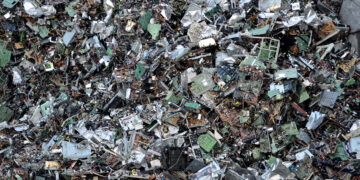







ChatGPT and Microsoft Copilot get the most attention, but the forms of artificial intelligence (AI) used in modern recycling operations can benefit society in far more tangible ways, even if people don’t notice them. A look behind the curtains reveals that waste management and tech companies are using AI to improve waste sorting, manage their operations and increase recycling rates.
AI users report the technology has made the industry more efficient, effective and profitable. For example, AI-based sorting is able to operate dozens of times faster than people with fewer mistakes and may soon be able to learn business specifics better than the people who make the machines. That reduces operational and labor costs while allowing facilities to recover more materials that previously may have ended up in landfills.
“Some people assume that the waste and recycling sector is resistant to innovation,” said Ambarish Mitra, co-founder of the English recycling company Greyparrot. “In reality, the industry is full of innovators willing to experiment with new technologies.”
That experimentation may make for a greener future in many regards.
Humble beginnings
AI, at an elemental level, has been a part of sorting processes for nearly a century. The Electric Sorting Co. began using optical sorters – which analyze products fed down a line by bouncing light off of them – to sort beans in 1932. That company ultimately became part of Satake USA in Texas.
MSS Optical Sorters of Nashville incorporated the technology into recycling in the early 1970s, using a separator to pull aluminum from waste streams. By the 1990s, material recovery facilities (MRFs) were able to build basic, full-scale automation into their sorting, using screens and scales to separate items. Norwegian recycling company Tomra introduced rule-based automation in the middle part of that decade, using sensors and predefined rules for enhanced sorting.
Advances in near-infrared sorting around this time made the process more precise, evolving over time to allow machines to sort plastics by polymer type. Color cameras that were added to machines around the turn of the century helped lead to better sorting decisions and better handling.
Bigger, better machines
With investments in deep-learning technology, companies today perform advanced visual sorting, nearly real-time machine monitoring and data analytics. Machines can adapt to that data for better long-term performance. Companies behind some of this technology say the ends justify the means, which may initially be hard to interpret.
“Our aim is to encourage recyclers and processors to embrace the transformative potential of AI and explore how it can help them achieve their operational goals, meet rising demand for recycled content and take advantage of new, expanded market opportunities,” said Fabrizio Radice, Tomra’s senior vice president and head of sales and marketing. His company’s technology can help recyclers sort food-grade and non-food-grade plastic, which is included in the topics discussed in the company’s e-book “AI in Recycling Unlocking the Possibilities.”
Among the many market opportunities is polypropylene, a material Amcor recycles with its CleanStream technology. The technology learns and adapts to varied feedstock, according to Simon Kinnear of Nielsen McAllister, its public relations contractor. This AI-enabled sorting technology incorporates Tomra’s GAINnext object recognition AI in Amcor’s UK and Ireland operations, helping the company deliver a minimum 95% food-contact-suitable feedstock.
“AI analytics is beginning to play a key role in tracking plastic materials across their entire life cycle, improving the business case for collection and driving the recycling value chain,” Amcor stated in a release. “That data makes it easier to understand flows of plastics, benchmark recycling rates and design more efficient recovery systems.”
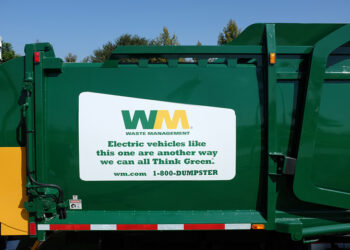
WM has equipped nearly three dozen of its recycling facilities worldwide with AI sorting technology, according to Brent Bell, vice president of recycling. Using AI has nearly doubled processing output at each facility to 40-45 tons per hour.
The company is on track to spend more than $1.4 billion to build or upgrade 39 facilities by the end of 2026, he said. These upgrades should add 2.8 million tons of processing capacity and keep WM at the forefront of the technological shift.
“As packaging evolves and consumer expectations for recycling and sustainability rise, AI can enable recyclers to keep pace without having to replace equipment in facilities,” Bell explained.
Beyond the sorting application
Improved data collection and use don’t apply simply to sorting. CurbWaste, a New York City-based waste management software company, is using part of a recent $28 million Series B funding round to bolster its AI offerings, which owner Mike Marmo hopes will give everyone in the recycling and waste hauling value chain the tools they need to empower their companies’ various job functions.
By boosting the software’s AI offerings, Marmo said users across the recycling value chain – from haulers to processors to commodity brokers – could more readily access easy-to-understand information to discover areas for improvement, enabling them to make proactive decisions.
“The waste industry is very fragmented in terms of data, and this is a way they can enable growth,” he said.
For example, salespeople would gain access to data that allows them to reach otherwise unreachable customer segments. Profit and usage reports, meanwhile, could give recycling executives insight into maintenance, fuel usage and which business segments perform the best.
“We think of waste as a utility, and in order to be a utility it has to be measurable,” Marmo said. “If we can take repetitive tasks and create visibility and automation … that’s very important.”
Machine-aided learning can take companies a long way. Analyzer units from Greyparrot can discern 111 distinct waste categories. The AI waste analytics system, which was introduced in 2019, detected more than 40 billion waste objects in more than 180 systems at MRFs across 20 countries in 2024. Mitra with Greyparrot said that number’s on pace to top 100 billion this year.
The software uses computer vision to track and identify waste in real time to give recyclers more data on their operations, he explained. The addition of the Deepnest packaging waste intelligence platform this year has given brands and packaging producers insight into a company’s cumulative global data and performance in global waste systems, e.g., how many recycled products were made into a feedstock for new packaging or if they performed poorly once remade into something.
“We’re leveraging that unprecedented visibility into post-consumption resources to drive change at the very top of the value chain,” Mitra said.
Why data matters
This unprecedented push for information isn’t just for knowledge’s sake, AI leaders say. For starters, data collected in MRFs can enhance sustainability.
“We can’t transition to a circular economy without knowing what happens to resources beyond the bin,” Mitra said.
The added knowledge also allows companies to sustain themselves, he added. Virgin plastic importers and those who deal in uncertified recycled products create competition for recyclers and other members of the value chain. This requires recyclers to have quick access to the products in their inventory, e.g., the quantity of PETE, HDPE, aluminum, etc., so they can track what goes where, remaining viable while meeting compliance requirements.
“For recyclers, AI waste analytics is now a survival tool,” Mitra said. “Protecting profits means recovering higher quality material more efficiently, and that’s not possible without a data-driven approach to operations, investment and sales.”
Removing a portion of the human element can grant access to information and action that otherwise may not be visible, Marmo of CurbWaste said. Giving real-time access to fueling, maintenance and other business logistics can’t help but create efficiency.
“We’re not trying to displace people,” he noted. “We want to empower those people. If we can take repetitive tasks and create visibility and automation … that’s very important.”
Bell concurs, saying AI has helped put more WM employees into more productive positions.
“By automating the most physically demanding tasks, AI allows us to shift employees into more tech-forward roles such as operating and optimizing equipment via tablets,” he said. “This transformation not only improves working conditions but also boosts our ability to deliver higher-value materials to manufacturers, who can use them to create new products.”

What’s next?
AI is only expected to get more advanced, helping the machines it controls sort recyclables faster, more accurately and with greater degrees of specificity.
“The industry is working to utilize AI for all sorting aspects, including self-diagnosis, maintenance and optimization without human intervention, leading to higher uptimes, better performance, and a reduction in costs and energy consumption,” Tomra wrote in its book.
Greyparrot has already seen its AI platform yield some of these results, Mitra said. In the United Kingdom, the company launched a pilot project to automate sampling in order to comply with Environment Agency (EA) requirements. This AI sampling methodology is under EA review. It’s also working with plant builders, manufacturers and software developers to create systems that can combine near-infrared recognition with AI waste analytics as well as a platform to maximize the waste sector’s input into circular packaging design.
“Our goal isn’t just to impact recycling rates from within the sector,” Mitra said. “We’re targeting ecosystem-wide change.”
Down the road, AI could integrate with Internet of Things (IoT) devices and adapt to feedstock variations to ensure purity, yield and recovery targets. This could lead to recycling and waste facilities linking as one large organism rather than a series of disparate machines.
“The system will integrate with enterprise resource planning and supply chain management systems, using predictive analytics to make business decisions,” Tomra stated in its AI in Recycling e-book.
One major business decision upon which there seems to be consensus, Bell said, is that AI isn’t going anywhere – and its use will extend beyond making memes. The technology allows recyclers and waste handlers to be more responsive to change, he noted, and will become more integral to how companies like WM operate.
“That flexibility is key to future-proofing recycling and ensuring we continue to meet the needs of our customers and communities, today and into the future,” he said.
Paul Lane has worked with Resource Recycling since March 2025. His work has also appeared in the New York Times, Buffalo News, American City Business Journals and other publications.