




Resource Recycling
  • The Latest
  • Analysis
    • All
    • Certification Scorecard
    • Industry Announcements
    • Opinion
    SERI works to restore faith in certifications

    Building a defensible E-scrap evidence file

    tires

    The most important decision in tire recycling happens before the shredder

    Intel sign outside of company building.

    Intel’s CapEx tops $20B on server demand while PC volume shrinks

    Google sign on company building with blue sky and clouds above.

    Inside Alphabet’s Q2 results: More capital spending and cloud backlog

    Alpek closing Pennsylvania RPET plant

    Alpek seizing on war-related opportunity 

    Our top stories from March 2023

    Iron Mountain’s data center report: Strong on power, quiet on hardware

  • Conferences
    • Resource Recycling Conference
    • Plastics Recycling Conference
    • E-Scrap: The Longevity Conference
    • Textiles Recovery Summit
  • Publications
    • E-Scrap News
    • Plastics Recycling Update
    • Policy Now
    • Resource Recycling
    • Other Topics
      • All Topics
      • Brand Owners
      • Critical Minerals
      • Glass
      • Grant Watch / RFPs
      • Markets
      • Organics
      • Packaging
      • Research
      • Technology
      • Textiles
Subscribe
No Result
View All Result
Resource Recycling
  • The Latest
  • Analysis
    • All
    • Certification Scorecard
    • Industry Announcements
    • Opinion
    SERI works to restore faith in certifications

    Building a defensible E-scrap evidence file

    tires

    The most important decision in tire recycling happens before the shredder

    Intel sign outside of company building.

    Intel’s CapEx tops $20B on server demand while PC volume shrinks

    Google sign on company building with blue sky and clouds above.

    Inside Alphabet’s Q2 results: More capital spending and cloud backlog

    Alpek closing Pennsylvania RPET plant

    Alpek seizing on war-related opportunity 

    Our top stories from March 2023

    Iron Mountain’s data center report: Strong on power, quiet on hardware

  • Conferences
    • Resource Recycling Conference
    • Plastics Recycling Conference
    • E-Scrap: The Longevity Conference
    • Textiles Recovery Summit
  • Publications
    • E-Scrap News
    • Plastics Recycling Update
    • Policy Now
    • Resource Recycling
    • Other Topics
      • All Topics
      • Brand Owners
      • Critical Minerals
      • Glass
      • Grant Watch / RFPs
      • Markets
      • Organics
      • Packaging
      • Research
      • Technology
      • Textiles
Subscribe
No Result
View All Result
Resource Recycling
No Result
View All Result
Home Recycling

An ambitious recycling policy proposal could go local

Colin StaubbyColin Staub
August 18, 2020
in Recycling
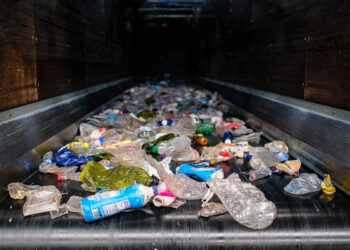
Sen. Tom Udall and Rep. Alan Lowenthal recently outlined how components of their national recycling act might be adapted to fit different states. | DeawSS/Shutterstock

Two members of Congress who have pushed for EPR, a national deposit system and more are now encouraging state and municipal lawmakers to introduce their own versions of the legislation.

The Break Free From Plastic Pollution Act, introduced in Congress in February, contains numerous measures that affect the U.S. recycling system, including extended producer responsibility (EPR) for packaging, a national container deposit, minimum recycled content requirements and more. In EPR systems, producers of different material types are mandated to manage and/or fund recovery systems.

The bill was introduced by Sen. Tom Udall, D-N.M., and Rep. Alan Lowenthal, D-Calif., and it has generated significant discussion within the recycling sector. It was referred into a House committee and has not seen action since then.

But on Aug. 12, Udall and Lowethal released a memo that serves as a guide for how local and state lawmakers can bring policies from the national act into their own jurisdictions. The memo was addressed to the National Caucus of Environmental Legislators, a group of state lawmakers across the country who are particularly interested in environmental issues.

“We encourage you to use the attached blueprints along with the bill text and our supplemental materials to craft robust legislation for your state,” Udall and Lowenthal wrote. “Whatever you decide, we encourage you to build on the great action that has already taken place across the country and to further push for change that will have a lasting impact.”

In a statement to Resource Recycling, Udall said the blueprint for state action was developed in response to “the growing support and interest in this legislation from across the country.” He also framed it as a complement to the national act, not a shift away from pushing for national legislation.

He noted that addressing plastic waste requires work in all levels of government.

“Action at the state and local level enables people to combat the plastic trash they see everywhere in their communities and will accelerate action at the federal level by bringing industry to the table for national solutions,” Udall said.

Encouraging states to ‘think bigger’

The memo breaks out descriptions of policies including EPR, container deposits, product bans, source reduction, alternative material use, recycled-content mandates, plastic waste export restrictions, a moratorium on plastics production facilities, and more.

In their memo, the federal lawmakers offer a few examples of how Break Free From Plastic Pollution components might be adapted to fit different states. For example, they note that 10 states have introduced or are working to introduce EPR bills for all packaging materials.

“These states may wish to consider introducing some of the complementary legislative elements related to single-use plastics and beverage containers mentioned in this memo,” the lawmakers wrote. “Other jurisdictions might find the model elements in this memo to be best practices to incorporate in a new comprehensive bill that places EPR for all packaging materials at its core. Still others might consider a multi-faceted approach to plastics alone as what you most need as a first step.”

Additionally, the memo pledges assistance from the lawmakers’ offices or the organizations that support the national act, and it includes sample legislation covering EPR, container deposits, product bans and more.

Udall said the blueprint for state action also aims to encourage states to work together on regulatory development.

“We designed these blueprints to support legislators at the state and local level and will encourage those states that have been leading to think bigger, including regional partnerships to build a stronger response to plastic and packaging pollution,” he said.

Bill had its roots in state discussions

The American Chemistry Council (ACC), which represents plastic resin makers and other plastics stakeholders, has voiced concern with some of the national act’s components. A plastics leader at the organization discussed the recent call for state-level action in an interview with Resource Recycling.

The national bill includes measures “that have been proposed at the state level for a number of years,” said Keith Christman, managing director of ACC’s Plastics Division. He pointed to container deposit systems, EPR and specific bans on products as examples.

Indeed, the bill’s advocates also wrote in the memo that the national act was “based on proposed legislation and existing statutes from various states combined for the first time to create a comprehensive bill to address plastic pollution and packaging waste in the United States.”

Because of that state-level history, a renewed push for states to adopt such measures is not particularly concerning from an industry advocacy perspective.

“We’ve been engaging in discussions with states for years, and we’ll be continuing to engage with them,” Christman said.

He added that ACC supports the goals of eliminating plastic pollution, even if the group disagrees with some of the tactics in the national bill. Plastics industry stakeholders have been particularly opposed to components of the national bill that single out plastic rather than having regulations apply to all materials. For example, the national bill includes a temporary pause of up to three years on permitting plastics production facilities, with an aim to revise environmental regulations and conduct studies on the impacts of such facilities.

These regulations could lead brands to switch to other materials that might carry environmental impacts greater than those associated with plastic, Christman noted.

However, the ACC is not opposed to all the policy tools included in the Break Free From Plastic Pollution framework.

For instance, Christman said the industry group has voiced growing support for recycled content in packaging, although he cautioned that regulations mandating recycled content must be carefully crafted, in part to avoid disrupting existing use or commitments by brands.

ACC’s position on recycled content inclusion has evolved alongside plastics processing technologies, Christman explained. He pointed to the suite of plastics conversion technologies known as chemical recycling or advanced recycling.

“Some challenges around recycled content have been the ability to use recycled material in food contact, for example,” Christman said.

Chemical recycling technologies can be one way to ease those challenges and get higher levels of recycled content into food packaging, Christman explained. He noted a recent announcement from Berry Global and Sabic to supply chemically recycled plastic for use in Philadelphia-brand cream cheese packaging sold in Europe.
 

Tags: Legislation & EnforcementPlastics
TweetShare
Colin Staub

Colin Staub

Colin Staub was a reporter and associate editor at Resource Recycling until August 2025.

Related Posts

Spin-off lets Linca focus on battery mineral recovery

GAO: Policy, tech updates needed to bolster domestic mineral supply

byPaul Lane
July 30, 2026

Federal investigators say short- and long-term solutions are needed to decrease the nation’s reliance upon foreign-based minerals.

The State of Oregon seal at a park in Salem, Ore.

MRM bids to run Oregon EPR for second year 

byPaul Lane
July 28, 2026

The company won the competitive process for 2026, but was the only company to apply for the 2027 PRO post.

California releases deposit system update draft rules

Groups move to intervene in SB 343 lawsuit

byStefanie Valentic
July 27, 2026

Earth Island Institute and Californians Against Waste have filed to intervene in the federal lawsuit that halted enforcement of California's...

U.S. Capitol building in Washington, D.C.

House committees advance critical mineral bills

byPaul Lane
July 27, 2026

Congressional votes earlier this month advanced three bills that would expand the nation’s critical mineral recycling capabilities. A subcommittee within...

RecyClass hits 500 EU recyclability evals

RecyClass hits 500 EU recyclability evals

byAntoinette Smith
July 21, 2026

The most recent evaluations include Avery Dennison's RFID tag for PET bottles, ahead of the first PPWR enforcement in mid-August.

Former president of CRT processor sentenced to prison

Groups say injunction doesn’t settle labeling issues

byStefanie Valentic
July 17, 2026

Californians Against Waste and the National Stewardship Action Council say a federal injunction blocking SB 343 pauses enforcement but still...

Load More
Next Post

Asian film processor details new 'credit' funding system

2026 Buyers’ Guide

Equipment, services and technology suppliers serving the recycling industry.

Browse the Guide

More Posts

State policy is redefining plastics recycling in the US

State policy is redefining plastics recycling in the US

February 19, 2026
Apple store

Apple leads on inputs, faces questions on ITAD

May 1, 2026
California bill would set up EPR for batteries

California bill would set up EPR for batteries

May 12, 2022
Closeup of a printed circuitboard

Hardware demand puts new focus on parts harvesting

June 5, 2026
Analysis: circular design still elusive in laptops

PC shipments grew in Q1, but questions remain

April 23, 2026

In other news: May 2, 2016

May 2, 2016

Recycled copper output climbs as market shows surplus

April 6, 2026

ITAD is moving past its adolescent phase: beyond end-of-life

June 10, 2026
TÜV rolls out traceability audits for recycled inputs

TÜV rolls out traceability audits for recycled inputs

January 14, 2026
E-Scrap EPR round-up part 2: California

E-Scrap EPR round-up part 2: California

September 25, 2025
Load More

About & Publications

About Us

Staff

Archive

Magazine

Work With Us

Advertise
Jobs
Contact
Terms and Privacy

Newsletter

Get the latest recycling news and analysis delivered to your inbox every week. Stay ahead on industry trends, policy updates, and insights from programs, processors, and innovators.

Subscribe

Welcome Back!

Login to your account below

Forgotten Password?

Retrieve your password

Please enter your username or email address to reset your password.

Log In

Add New Playlist

No Result
View All Result
  • The Latest
  • Analysis
  • Recycling
  • E-Scrap
  • Plastics
  • Policy Now
  • Conferences
    • E-Scrap Conference
    • Plastics Recycling Conference
    • Resource Recycling Conference
    • Textiles Recovery Summit
  • Magazine
  • About Us
  • Advertise
  • Archive
  • Jobs
  • Staff
Subscribe
This website uses cookies. By continuing to use this website you are giving consent to cookies being used. Visit our Privacy and Cookie Policy.