




Resource Recycling
  • The Latest
  • Analysis
    • All
    • Certification Scorecard
    • Industry Announcements
    • Opinion
    SERI works to restore faith in certifications

    Building a defensible E-scrap evidence file

    tires

    The most important decision in tire recycling happens before the shredder

    Intel sign outside of company building.

    Intel’s CapEx tops $20B on server demand while PC volume shrinks

    Google sign on company building with blue sky and clouds above.

    Inside Alphabet’s Q2 results: More capital spending and cloud backlog

    Alpek closing Pennsylvania RPET plant

    Alpek seizing on war-related opportunity 

    Our top stories from March 2023

    Iron Mountain’s data center report: Strong on power, quiet on hardware

  • Conferences
    • Resource Recycling Conference
    • Plastics Recycling Conference
    • E-Scrap: The Longevity Conference
    • Textiles Recovery Summit
  • Publications
    • E-Scrap News
    • Plastics Recycling Update
    • Policy Now
    • Resource Recycling
    • Other Topics
      • All Topics
      • Brand Owners
      • Critical Minerals
      • Glass
      • Grant Watch / RFPs
      • Markets
      • Organics
      • Packaging
      • Research
      • Technology
      • Textiles
Subscribe
No Result
View All Result
Resource Recycling
  • The Latest
  • Analysis
    • All
    • Certification Scorecard
    • Industry Announcements
    • Opinion
    SERI works to restore faith in certifications

    Building a defensible E-scrap evidence file

    tires

    The most important decision in tire recycling happens before the shredder

    Intel sign outside of company building.

    Intel’s CapEx tops $20B on server demand while PC volume shrinks

    Google sign on company building with blue sky and clouds above.

    Inside Alphabet’s Q2 results: More capital spending and cloud backlog

    Alpek closing Pennsylvania RPET plant

    Alpek seizing on war-related opportunity 

    Our top stories from March 2023

    Iron Mountain’s data center report: Strong on power, quiet on hardware

  • Conferences
    • Resource Recycling Conference
    • Plastics Recycling Conference
    • E-Scrap: The Longevity Conference
    • Textiles Recovery Summit
  • Publications
    • E-Scrap News
    • Plastics Recycling Update
    • Policy Now
    • Resource Recycling
    • Other Topics
      • All Topics
      • Brand Owners
      • Critical Minerals
      • Glass
      • Grant Watch / RFPs
      • Markets
      • Organics
      • Packaging
      • Research
      • Technology
      • Textiles
Subscribe
No Result
View All Result
Resource Recycling
No Result
View All Result
Home Recycling

How cities are strengthening programs for long-term success

Marissa HeffernanbyMarissa Heffernan
September 13, 2022
in Recycling
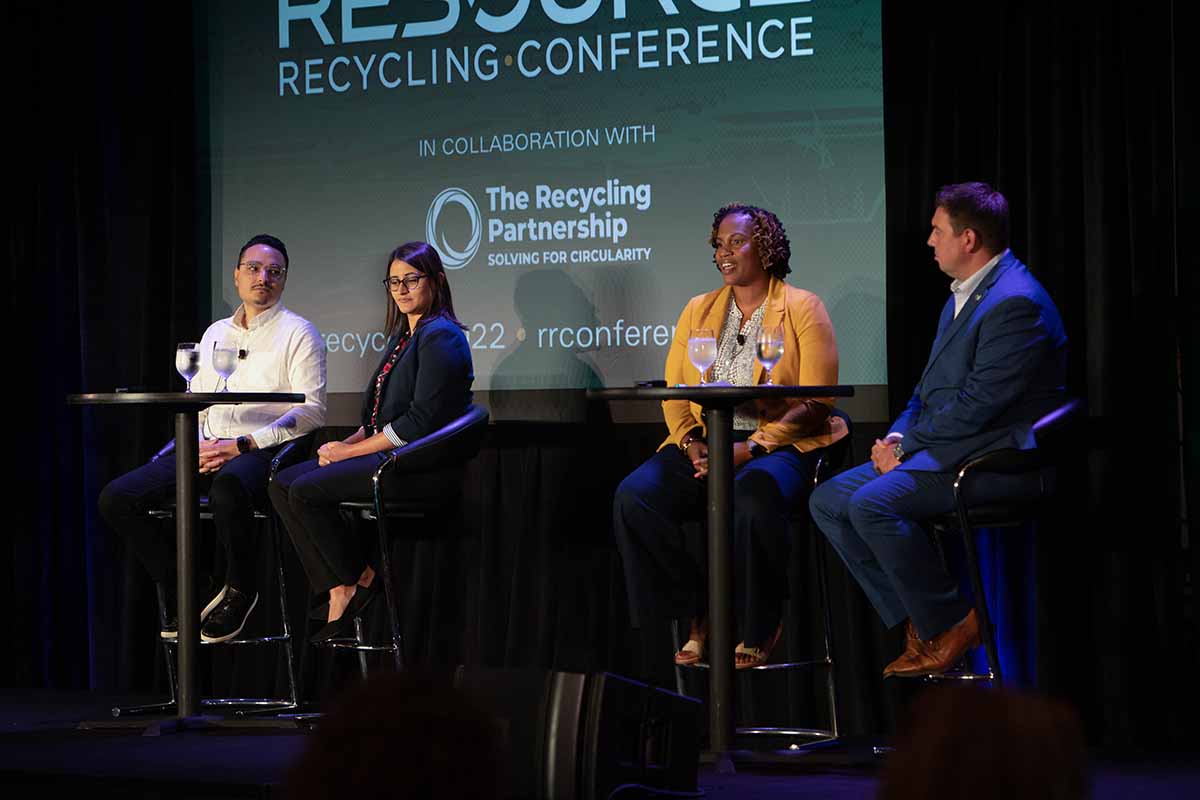
The “Resiliency at the Local Level” session at the 2022 Resource Recycling Conference featured (l to r): Eduardo Rodriguez, Alexis Yaple, Kanika Greenlee and Zach Woodruff. | Big Wave Productions/Resource Recycling, Inc.

Resilience in recycling requires a number of elements: upgrading technology, extending contracts or even buying carts for residents.

Representatives from cities large and small described the efforts they’ve made in the “Resiliency at the Local Level” session, held Aug. 16 as part of the Resource Recycling Conference held Aug. 15-17 in Austin, Texas.  

Zach Woodruff, city administrator for Whitehall, Ohio, said that to him, resilience means the city “finally acknowledging we’re not going to do things the way that we used to – we’re really going to change our process to make it more efficient, improve our outcomes and to really work to improve the lives of our residents.” 

Kanika Greenlee, executive director of the Keep Atlanta Beautiful Commission, said COVID-19 required resilience because the pandemic “showed you where the cracks are in your system and magnified them.” 

In Atlanta, bulk collection had to be suspended and then altered to scheduled drop-offs, and a Recycling Partnership grant-funded program to decrease contamination and increase participation had to be delayed. 

However, Greenlee said the city started a partnership with the Foodservice Packaging Institute and added items to its accepted recycling list, such as beverage cups, during the pandemic.

Now, she’s turned her attention to the city’s MRF contract. Currently, it only lasts for a single year, but Greenlee said she wants to get to a three- or five-year contract with renewable options so the city has to focus fewer resources every year on renegotiation. 

Planning for the future also meant updating the vehicle replacement plan and doing a study to see how the city could better use its automatic side loaders (ASLs). Greenlee said before, the three ASLs were used as support, because it was assumed that the city’s streets were too narrow to use them fully. However, a feasibility study showed over 80% of Atlanta’s pickup routes would work for ASLs, so now the city has ordered five more and plans to continue growing the number in the fleet.  

Greenlee said to address labor shortages, the city also turned to temporary staffing agencies and streamlined its onboarding. It decided to competitively source CDL drivers and create an internal CDL program to encourage people to get certified. 

Eduardo Rodriguez, city of Phoenix, speaking at the Resource Recycling Conference.
Eduardo Rodriguez speaks about the city of Phoenix’s recent MRF upgrades, with session moderator Craig Wittig and city of Phoenix colleague Alexis Yaple listening on. | Big Wave Productions/Resource Recycling, Inc.

Upgrades in Arizona

In one of America’s largest cities, resiliency takes the form of MRF upgrades and virtual education programs. Eduardo Rodriguez, operations manager for the city of Phoenix, said in 2019 the city decided to conduct a $4.5 million upgrade to its North Gateway MRF. 

That project added anti-wrap disc screens, a drumfeeder, paper and PET opticals and a ballistic separator. It also repurposed an old PET optical for PP and expanded the presort line. 

“During those times it was very challenging, especially when there was no market for it, but we felt very strongly that this was the way to go,” he said. “We couldn’t just let go of recycling.”

That upgrade ended up helping the city weather the COVID-19 years, during which time it saw a 20% increase in inbound recycling just after it shut down another city MRF on 27th Avenue to replace it with a new facility.  

Phoenix processes its own recycling and that of five other cities, but was “able to handle that material very easily,” Rodriguez said. “We had the capacity.” 

Alexis Yaple, zero waste coordinator for Phoenix, said her team of six educators switched from reaching 20,000 people face-to-face per year through MRF tours, tabling events and presentations to a digital strategy. 

They created a site called recycle+ with virtual tours of MRFs and compost facilities, webinar series and virtual presentations in Spanish and English. They also launched the “Recycle Right Wizard” in collaboration with 10 other cities in the area, which allows people to search for a given material and receive instructions for how to handle it. 

“Inbound questions to the call center decreased when we started using it,” Yaple said of the wizard, adding that “on the back end you have a lot of stats so you can see what people are searching for and target your marketing.” 

The city is also creating a resource innovation campus on 40 acres at the new 27th Avenue MRF. Yaple said it will help the city process material on site by partnering with other local businesses.

Phoenix leaders also decided early on that it wanted to own all its infrastructure, Rodriguez said. It does a revenue split with its processor that gives the city 88%, and ownership also gives Phoenix flexibility.  

“The big benefit that we’re seeing for that is we’re in control of what needs to be changed in the equipment,” Rodriguez said. “So if we need to upgrade to meet new specifications, we have that control.”

Looking forward, the city left space to add other bunkers for different materials as markets change and is looking into AI. 

Convincing Ohio community to use carts

In Ohio, Woodruff helped roll out trash and recycling carts, instead of letting residents supply their own or, more typically, pile garbage bags up by the side of the road. 

That 2020-2021 transition to a volume-based system for solid waste and recycling gave residents an incentive to recycle and reduce, Woodruff said, as it used a tiered pricing system. 

“It’s similar to other utilities,” he said. “You pay for the amount of water you use, you pay for the amount of electricity we use,” and now residents pay for the size of trash bin they use. 

All residents got a trash and recycling cart, which the city paid for through a five-year financing plan and grants from the Solid Waste Authority of Central Ohio (SWACO) and The Recycling Partnership. Woodruff said the city also got a one-time SWACO grant for the transition. 

He said there’s a savings of about $7,300 per year by switching to volume-based service, and participation in recycling grew from 26% to 95%. Solid waste going to landfill was reduced by 25%, and the city has less litter now. 

Woodruff said while there was a lot of original frustration from residents who did not want to change, “now if we were to go back the opposite way, I know there would be as much pushback.” 

“I would like to see more communities do what we’re doing but I don’t know that a lot of people have that will to do something different,” he added.

 

Tags: CollectionLocal ProgramsMRFs
TweetShare
Marissa Heffernan

Marissa Heffernan

Marissa Heffernan worked at Resource Recycling from January 2022 through June 2025, first as staff reporter and then as associate editor. Marissa Heffernan started working for Resource Recycling in January 2022 after spending several years as a reporter at a daily newspaper in Southwest Washington. After developing a special focus on recycling policy, they were also the editor of the monthly newsletter Policy Now.

Related Posts

Facility fires on pace to match 2025

byPaul Lane
July 29, 2026

The mid-year report from Fire Rover found the number of fire incidents remains elevated compared to historical averages.

Wisconsin opens e-recycling grant process

byPaul Lane
July 28, 2026

Funds are available for collection programs as the state touts growth in electronic recycling in its latest annual report.

Compudopt names new CEO

Compudopt names new CEO

byPaul Lane
July 24, 2026

Allison Kotarski will lead the Texas-based nonprofit, which gets refurbished electronics into new hands.

MTA loses track of recycling, costing NYC Transit $800,000

byStefanie Valentic
July 23, 2026

A new MTA inspector general report finds NYC Transit lost nearly $800,000 after years of mishandled recycling and the contractor...

Cascade Asset Management sees higher sales volumes

Sorted: Restoring mineral supplies, one junk drawer at a time

byPaul Lane
July 20, 2026

Industry experts say educating businesses and their customers about how to turn in used electronic devices can free up useful...

Utah highway project to reuse pavement

Utah highway project to reuse pavement

byAntoinette Smith
July 2, 2026

The state Department of Transportation is using cold in-place recycling to repurpose existing roadway, save millions and reduce emissions.

Load More
Next Post

More price drops for recycled paper and plastic

2026 Buyers’ Guide

Equipment, services and technology suppliers serving the recycling industry.

Browse the Guide

More Posts

LG collection volume increased notably in 2024

LG collection volume increased notably in 2024

July 17, 2025
In Our Opinion: Coalitions: The EPR Differentiator

Inside NAW’s constitutional case against packaging EPR

July 6, 2026
California provides funding to boost thermoform recycling

APR and ANIPAC promote recycling in Mexico

May 27, 2026
Analysis: circular design still elusive in laptops

PC shipments grew in Q1, but questions remain

April 23, 2026
Li-Cycle in need of more financing to continue

Li-Cycle in need of more financing to continue

April 10, 2025
Closeup of a lithium-ion battery.

Here are the rules on handling lithium-ion batteries

February 13, 2020

WM’s Q2 recycling and renewable energy EBITDA jumps

July 29, 2026

Certification Scorecard — Week of July 27, 2026

July 29, 2026
Alpek closing Pennsylvania RPET plant

Alpek seizing on war-related opportunity 

July 27, 2026
Texas processor preparing to open new facility

Sumitomo bets on AI, data centers with GreenTek deal

July 14, 2026
Load More

About & Publications

About Us

Staff

Archive

Magazine

Work With Us

Advertise
Jobs
Contact
Terms and Privacy

Newsletter

Get the latest recycling news and analysis delivered to your inbox every week. Stay ahead on industry trends, policy updates, and insights from programs, processors, and innovators.

Subscribe

Welcome Back!

Login to your account below

Forgotten Password?

Retrieve your password

Please enter your username or email address to reset your password.

Log In

Add New Playlist

No Result
View All Result
  • The Latest
  • Analysis
  • Recycling
  • E-Scrap
  • Plastics
  • Policy Now
  • Conferences
    • E-Scrap Conference
    • Plastics Recycling Conference
    • Resource Recycling Conference
    • Textiles Recovery Summit
  • Magazine
  • About Us
  • Advertise
  • Archive
  • Jobs
  • Staff
Subscribe
This website uses cookies. By continuing to use this website you are giving consent to cookies being used. Visit our Privacy and Cookie Policy.