




Resource Recycling
  • The Latest
  • Analysis
    • All
    • Certification Scorecard
    • Industry Announcements
    • Opinion
    NJ’s PCR delay risks making its own excuse permanently true

    NJ’s PCR delay risks making its own excuse permanently true

    E-scrap magnet recycling company scales up

    Why only some rare-earth sources are economically viable

    e-Stewards to develop an ITAD-specific standard

    Certification scorecard — week of Sept. 21

    Who should pay for lithium-ion battery fire damage?

    America’s critical-materials buildout has a feedstock problem

    Certification scorecard – week of Sept. 14

  • Conferences
    • Resource Recycling Conference
    • Plastics Recycling Conference
    • E-Scrap: The Longevity Conference
    • Textiles Recovery Summit
  • Publications
    • E-Scrap News
    • Plastics Recycling Update
    • Policy Now
    • Resource Recycling
    • Other Topics
      • All Topics
      • Brand Owners
      • Critical Minerals
      • Glass
      • Grant Watch / RFPs
      • Markets
      • Organics
      • Packaging
      • Research
      • Technology
      • Textiles
Subscribe
No Result
View All Result
Resource Recycling
  • The Latest
  • Analysis
    • All
    • Certification Scorecard
    • Industry Announcements
    • Opinion
    NJ’s PCR delay risks making its own excuse permanently true

    NJ’s PCR delay risks making its own excuse permanently true

    E-scrap magnet recycling company scales up

    Why only some rare-earth sources are economically viable

    e-Stewards to develop an ITAD-specific standard

    Certification scorecard — week of Sept. 21

    Who should pay for lithium-ion battery fire damage?

    America’s critical-materials buildout has a feedstock problem

    Certification scorecard – week of Sept. 14

  • Conferences
    • Resource Recycling Conference
    • Plastics Recycling Conference
    • E-Scrap: The Longevity Conference
    • Textiles Recovery Summit
  • Publications
    • E-Scrap News
    • Plastics Recycling Update
    • Policy Now
    • Resource Recycling
    • Other Topics
      • All Topics
      • Brand Owners
      • Critical Minerals
      • Glass
      • Grant Watch / RFPs
      • Markets
      • Organics
      • Packaging
      • Research
      • Technology
      • Textiles
Subscribe
No Result
View All Result
Resource Recycling
No Result
View All Result
Home Resource Recycling Magazine

First-person perspective: Zooming in on consumer impact

byJennifer Bogs
January 10, 2025
in Resource Recycling Magazine
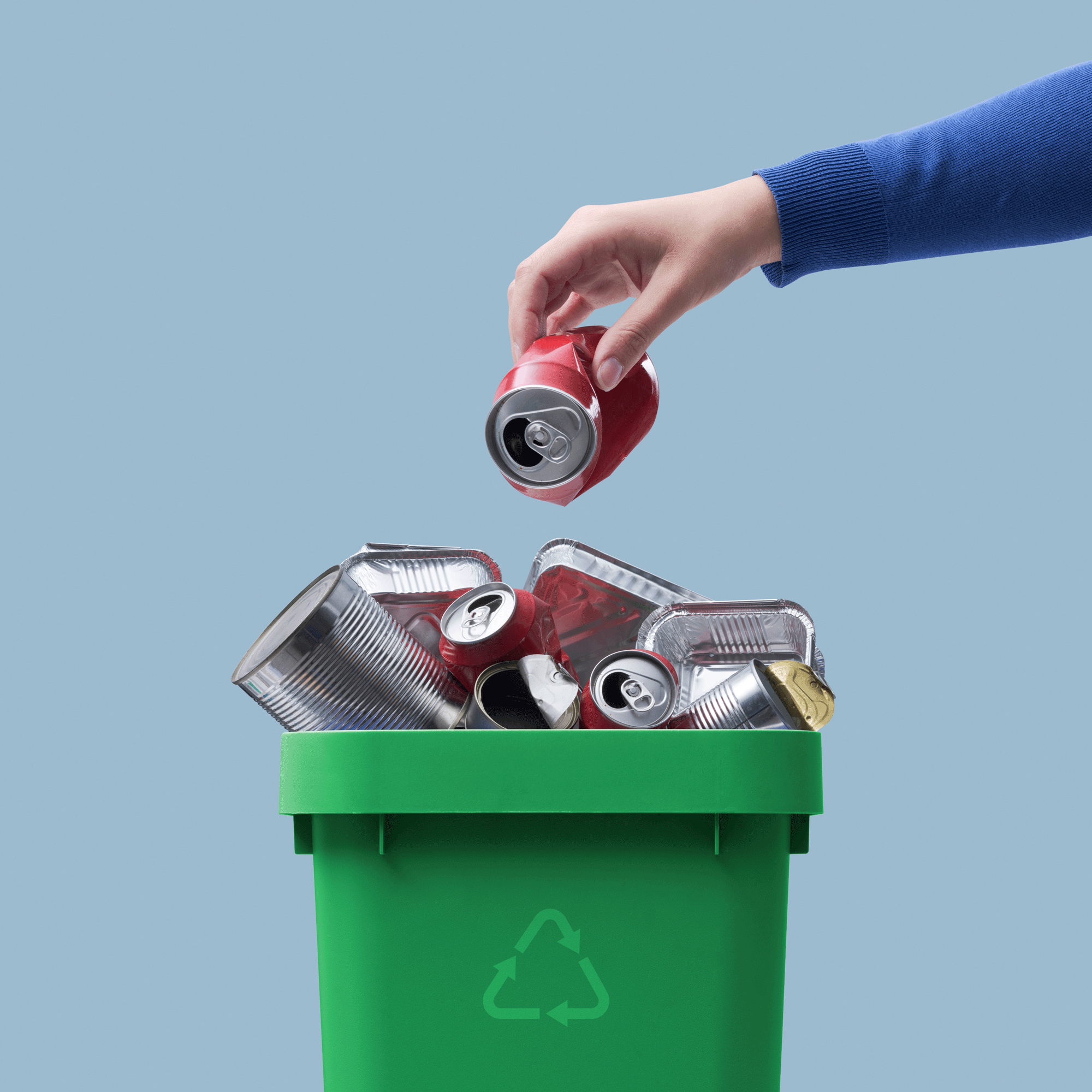
Stokkete/Shutterstock

This article appeared in the January 2025 issue of Resource Recycling. Subscribe today for access to all print content.

Across all consumer goods categories, the U.S. is striving to limit packaging waste and to slow the flow of landfill contributions. Regulators and environmentalists know that time is running out to combat climate change and that moving from a linear to circular model is one of the most effective strategies for preserving materials, reducing resource consumption and decreasing production-related emissions. Yet recycling rates in the U.S. continue to fall short of their potential — largely due to a lack of access and understanding for consumers. This raises the question: If we could simply improve consumer recycling habits of consumers for even one type of packaging, how much could we shift future recycling rates and landfill volumes?

Aluminum as a clear avenue

The beverage can serves as a package with unique opportunity for moving the needle, given its market-ready path toward a greater circular economy. While most modern consumers know that the beverage can is a recyclable item, many do not understand just how impactful that recyclability is in terms of the bigger picture. Used beverage cans are able to be recycled from an empty can to a new can on the shelf in as few as 60 days — a remarkable turnaround that not only saves precious materials from landfill but also saves more than 90% of the energy required in production using virgin materials.

Aluminum cans are also one of the highest-valued formats in the recycling stream given the fact that they can be recycled an infinite number of times without loss of properties like strength and durability. In fact, the Can Manufacturers Institute says that the profit from aluminum beverage cans effectively enables the entire recycling system to operate — typically accounting for more than 33% of the revenue at an average MRF, more than any other single material commodity.

Unfortunately, the majority of consumers are unaware of the importance of UBCs for recycling systems and are not always committed to making responsible choices for material disposal, leaving a tremendous opportunity gap for greater collection.

Creating care and commitment within consumers

While there are numerous ways to make beverage can recycling easier for consumers, there is no action without buy-in. Consumers must feel connected to the products they are using as well as
personally responsible for their choices in order to develop new, more productive habits.

With this in mind, driving consumer education about the damaging effects of landfill waste and resource consumption on the future of our planet, as well as the benefits of properly disposing of key packaging formats like the beverage can, helps to drive more mindful behavior and long-term stewardship.
When a consumer knows that the way they interact with just one beverage can plays a tangible role in a potential environmental outcome, they are more apt to do their part.

Often this education can be done in tandem with localized events where can collection is active and accessible. Some examples include:

  • Sponsoring contests at sporting events: Various minor league teams around the U.S. have received sponsorship support from manufacturers and beverage brands to hold a collection contest of all used beverage packaging in stadium and arena stands, incentivizing responsible disposal and recycling on-site while providing longer-term education and reminders to all attendees along the way.
  • Hosting competitions at schools: CMI has led a One Million Can Challenge with elementary schools in key regions of the U.S. to drive awareness of the importance of UBC collection not only with families and communities but with the younger generation, who can develop impactful habits early on.
  • Creating greater accessibility in high-consumption areas: Metal packaging industry initiatives like Every Can Counts continue to meet consumers where they are, placing recycling ambassadors at local festivals, community parks, academic institutions and other high-traffic areas where passersby can be taught to be more thoughtful about recycling in relation to their daily activities and lifestyles.

Strength in numbers

Ultimately, when it comes to increasing national recycling rates, it is imperative we remember that small actions can create significant impact. Focusing on one substrate, and partnering with one school or one neighborhood to drive more awareness, can be part of a much larger patchwork of efforts happening across the U.S. With the mindset that no one initiative is too minor, we stand a chance to advance the circular economy and foster a much healthier environment long-term.

Jennifer Bogs is a global director of sustainability at Crown overseeing the strategy and implementation of the company’s sustainability program at approximately 400 locations in 40 countries while leading a global team of sustainability professionals. She has 20-plus years’ experience in the environmental field and 9-plus years of experience in sustainability.

The views and opinions expressed are those of the author and do not imply endorsement by Resource Recycling, Inc. If you have a subject you wish to cover in an op-ed, please send a short proposal to news@dev.resource-recycling.com for consideration.


TweetShare
Jennifer Bogs

Jennifer Bogs

Related Posts

Newsom nixes recycled content claims bill

Newsom nixes recycled content claims bill

byAntoinette Smith
September 28, 2026

Supporters of AB 2253 said the bill would address greenwashing, while opponents said it demonized mass-balance accounting and didn't reflect...

NJ’s PCR delay risks making its own excuse permanently true

NJ’s PCR delay risks making its own excuse permanently true

byEdward Kosior
September 28, 2026

In this editorial, Prof. Edward Kosior explores how policy uncertainty discourages investment and risks destroying existing recycling capacity.

trash bags

Sorted: Should we use recycled trash bags?

byBrian Clark Howard
September 28, 2026

Manufacturers’ resistance is rooted in performance and cost, but the products may have an important role to play.

Analysis: Undersupply of PCR is ‘stifling’ brand goals

US lawmakers urge protection of domestic RPET

byAntoinette Smith
September 25, 2026

In a letter to the US Trade Representative, five representatives asked the USTR to consider trade remedies and support verification...

Oregon state capitol building with state flag and blue sky.

NAW appeals Oregon EPR ruling

byStefanie Valentic
September 25, 2026

NAW is challenging an Oregon judge's ruling in favor of the state's extended producer responsibility law.

Cutting healthcare plastics could save $18B

Report provides path to reduce medical e-scrap

byPaul Lane
September 25, 2026

The European report found that circularity in medical devices is possible through several potential initiatives.

Load More
Next Post

News from GFL Environmental, Glass Packaging Institute and more

2026 Buyers’ Guide

Equipment, services and technology suppliers serving the recycling industry.

Browse the Guide

More Posts

Recyclers reeling from NJ PCR extension

Recyclers reeling from NJ PCR extension

September 23, 2026
Oregon state capitol building with state flag and blue sky.

NAW appeals Oregon EPR ruling

September 25, 2026
Bin to Better gets students involved in reuse, recycling

Bin to Better gets students involved in reuse, recycling

September 24, 2026
Calif. Governor Gavin Newsom at podium.

Newsom signs battery EPR expansion, vetoes SB 54 fund bill

September 24, 2026

Who should pay for lithium-ion battery fire damage?

September 21, 2026
Bipartisan reps introduce bill on recycling claims

House passes bill to ease lithium-ion battery storage rules

September 24, 2026
Analysis: Undersupply of PCR is ‘stifling’ brand goals

US lawmakers urge protection of domestic RPET

September 25, 2026
US packaging is evolving. The recycling system isn’t ready

US packaging is evolving. The recycling system isn’t ready

September 16, 2026
Industry announcements for January 2026

Industry announcements for September 2026

August 31, 2026
Bridge Green, Hartree partner on mineral processing deal

Bridge Green, Hartree partner on mineral processing deal

September 21, 2026
Load More

About & Publications

About Us

Staff

Archive

Magazines

Work With Us

Advertise
Jobs
Contact
Terms and Privacy

Newsletters

Get the latest recycling news and analysis delivered to your inbox every week. Stay ahead on industry trends, policy updates, and insights from programs, processors, and innovators.

Subscribe

Welcome Back!

Login to your account below

Forgotten Password?

Retrieve your password

Please enter your username or email address to reset your password.

Log In

Add New Playlist

No Result
View All Result
  • The Latest
  • Analysis
  • Recycling
  • E-Scrap
  • Plastics
  • Policy Now
  • Conferences
    • E-Scrap Conference
    • Plastics Recycling Conference
    • Resource Recycling Conference
    • Textiles Recovery Summit
  • Magazines
  • About Us
  • Advertise
  • Archive
  • Jobs
  • Staff
Subscribe
This website uses cookies. By continuing to use this website you are giving consent to cookies being used. Visit our Privacy and Cookie Policy.