





Since I started at Resource Recycling this year, I have been looking for ways to buy more products made from recycled content. That’s because sources keep telling me that demand for recycled plastic resins, paper, metals, glass and other materials is a critical “pull” on the whole system that promotes and supports recycling. Without a healthy demand for recycled products, prices drop and, ultimately, less material is collected and processed.
I had been thinking about plastic trash bags ever since I attended the Plastics Recycling Conference in February. On a panel there in San Diego, Anja Brandon, director of plastics policy for the Ocean Conservancy, said, “We should not be putting virgin plastic in our trash bags when we have end markets that are collapsing.”
I brought up Brandon’s point to fellow staff at Resource Recycling, and they said there has been pushback from bag makers on using recycled resins on a number of fronts, from cost to availability to performance. That made me want to learn more.
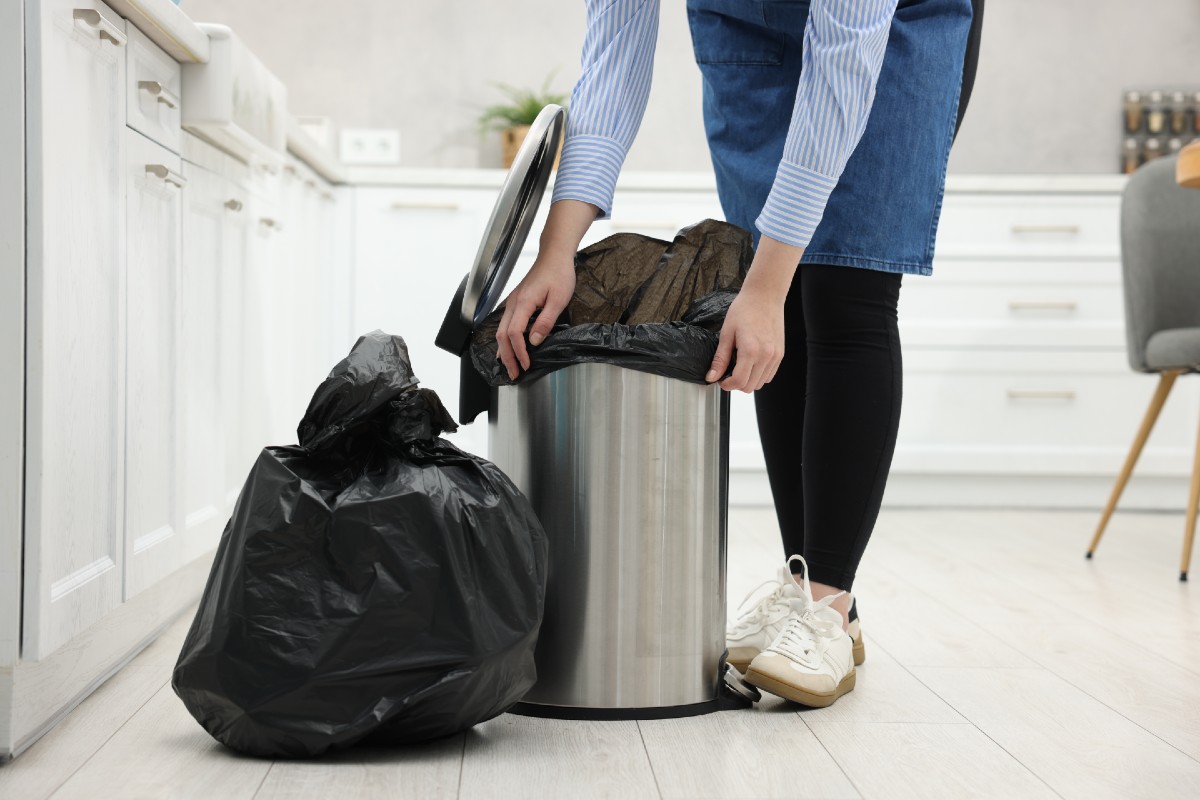
Recently, my wife and I discovered 100% recycled plastic trash bags for sale online, so we bought a box. The trash bags work great in our kitchen and around the house. We got them from Grove Collaborative, an online shop for eco-friendly and wellness products.
Grove didn’t respond to requests for comment for this story, but the product packaging says, “No new or virgin plastic is used in these bags.” The label continues, “Made in the USA of global components in partnership with WasteZero.”
Availability and performance
To find out how widespread recycled trash bags are, I reached out to The Recycling Partnership (TRP). Katherine Huded, TRP’s executive director of strategic engagement, told me, “Globally, trash bags are a proven end market for recycled polyethylene, but in the US, they still represent an underutilized opportunity. Right now, domestic recycled content in trash bags ranges anywhere from 10% to 65%, with a few innovative brands pushing all the way to 100%. While the market relies primarily on post-commercial, industrial and agricultural film feedstocks, there is tremendous potential for post-consumer residential film (PCR).”
Shannon Bouton, president and CEO of Delterra, told me, “Some targeted mandates in US states have begun pushing manufacturers to incorporate PCR into trash bags.”
For example, California’s Recycled Content Trash Bag Program requires that trash bags sold in the state be at least 10% actual post-consumer material. A similar program in Washington sets a 20% recycled content target for plastic trash bags by 2027 (up from 15% in 2025). New Jersey has a similar law covering trash bags. But hinting at the potential fluidity of such state laws, New Jersey recently extended exemptions to its PCR mandate for food-contact packaging to 2030.
Bouton said, “In Europe, we see much broader use of PCR in trash bags as a result of economic supports from EPR laws, as well as PCR mandates that require the use of recycled material in certain products, which shows that this is a viable application in the right policy environment.”
GDB International is a plastics recycler based in New Brunswick, New Jersey, and sells resin pellets to a wide swath of customers, from global brands to mom-and-pop shops, and many make trash bags out of the material.
Sunil Bagaria, president and founder of GDB, said that state’s recycled content mandate has been enormously helpful in building demand for his company’s recycled (low-density polyethylene and linear low-density PE (LDPE/LLDPE) resin. The law requires plastic trash bags to contain 5%-20% PCR, depending on thickness, and will increase to 10%-40% in 2027.
“It helps us to continue to stay in business because of this regulation,” said Bagaria, who added that without state mandates, customers tend to only buy recycled resin when it was significantly cheaper than virgin material. Going further, Bagaria said he would like to see even higher percentage mandates as well as higher fines for brands that don’t meet the state’s targets, for more incentive, at a time when some recyclers are struggling.
And on the performance question, Huded said, “When looking at residential film recycling, trash bags are an ideal end market because they can accommodate the color and visual variability of post-consumer material. Modern bag formulations and engineering techniques easily compensate for resin shifts, ensuring the final product meets strict performance, stretch and strength standards.”
At the end of the day, consumers expect a trash bag to perform well, said Huded. “Delivering that same strength and leak protection with recycled content relies on the makers of trash bags to invest in the system and deliver the same critical product attributes they know their consumers look for.”
Alan Schrob, vice president of circular solutions for North America for Borouge International, which mechanically recycles film, agreed that trash bags can be a good vehicle for recycled resins. “Most Americans have high demands for their trash bags, with the expectation that the bags will be able to stretch and hold a lot without tearing,” said Schrob. “The structures that enable that level of performance are surprisingly complex.”
Huded added, “Where performance varies, the answer isn’t to dismiss recycled content. It’s to work with experienced manufacturers that can ensure the use of tight feedstock specifications, advanced blending, film gauge optimization and precise additives.”
Schrob also noted that since lower-quality film bales have had low value in recent years that has made it harder for some to consider recycling for trash bags. “Feedstock that has higher levels of mixed materials and contamination makes it more difficult to meet the performance requirements of products like trash liners,” he said. “To improve performance, increased sortation is typically required. This makes the feedstock cost higher due to the lower yield, or the lower amount of usable content, from those bales.”
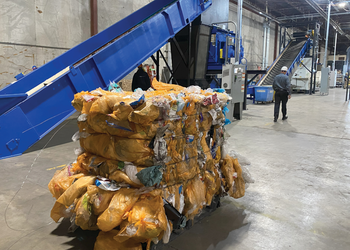
Bagaria of GDB said one valuable feedstock for his company has been single-use garment bags from major retailers, which provide relatively clean film that eventually works great in new trash bags.
To build a resilient film supply chain, what’s needed is proven end use applications that reliably scale post-consumer resin (PCR), Huded said. “Trash bags are a prime target, as they are a high-volume, everyday commodity capable of providing steady, long-term demand for recycled film,” she said.
In fact, Bouton and colleagues found in a recent report that when they analyzed the most promising uses for recycled household flexible plastics (generally quite contaminated and commingled with other materials), they found that dark-colored trash bags were one of eight applications that showed promise for incorporating this material. (My Grove recycled trash bags are dark gray.)
Price and circularity
Grove sells a 20-count roll of 13-gallon, 100% recycled trash bags for $7.99. Walmart online sells a 20-count of the same size bags for $2.44, made from virgin LDPE plastic. So there is a price differential today, at a time when affordability is top of mind for many. There is also the carbon footprint of ordering bags online to consider, versus picking them up from the local store you are already visiting for groceries or other supplies.
Some people have questioned the goal of recycled trash bags on the grounds that the products typically end up in a landfill, and therefore aren’t as “circular” as some would like. But Huded said, “Given how nascent film recycling is, integrating post-consumer resin into plastic trash bags is currently a scalable way to extend the useful life of flexible plastics while signaling to the recycling system that there is a use for the material. Those signals are critical cues that indicate support to build a recycling supply chain for nascent materials.”
Bouton agreed, noting that trash bags can be a good vehicle for recycled resin because they can tolerate a wider range of performance than, say, stretch film.
“All demand is good demand and using PCR in trash bags is great for pulling PCR from film,” said Rebecca Mick, program director – film and packaging innovation with the Association of Plastic Recyclers (APR). “Our reclaimers need demand so that they can make investments to handle more material and more complicated material.”
Mick added, “Film recycling is still in a building-like phase. We’re not going to go from a food pack to a food pack. We’re just not there yet. So this is a really good way to kind of kickstart things by having demand in applications that we know can handle it.”
Resource Recycling is owned by APR.
Huded said state mandates for recycled content in products like trash bags have been a key lever for stimulating demand. What’s needed to drive up adoption are more state mandates and long-term corporate commitments to buying and using PCR. The US trash bag market is estimated at roughly $3 billion annually.
“As states implement extended producer responsibility (EPR) and PCR policies across the country, developing reliable end markets like trash bags will be critical to meeting compliance targets and building a viable film recycling system,” said Huded.
Huded noted that, “Ultimately, the challenge isn’t whether recycled content can perform in a trash bag, which it can. The real hurdle is increasing demand for post-consumer recycled film to use in applications such as trash bags.”
I plan on doing my part by ordering more recycled trash bags next time I run out.