
Resource Recycling
  • The Latest
  • Analysis
    • All
    • Certification Scorecard
    • Industry Announcements
    • Opinion
    NJ’s PCR delay risks making its own excuse permanently true

    NJ’s PCR delay risks making its own excuse permanently true

    E-scrap magnet recycling company scales up

    Why only some rare-earth sources are economically viable

    e-Stewards to develop an ITAD-specific standard

    Certification scorecard — week of Sept. 21

    Who should pay for lithium-ion battery fire damage?

    America’s critical-materials buildout has a feedstock problem

    Certification scorecard – week of Sept. 14

  • Conferences
    • Resource Recycling Conference
    • Plastics Recycling Conference
    • E-Scrap: The Longevity Conference
    • Textiles Recovery Summit
  • Publications
    • E-Scrap News
    • Plastics Recycling Update
    • Policy Now
    • Resource Recycling
    • Other Topics
      • All Topics
      • Brand Owners
      • Critical Minerals
      • Glass
      • Grant Watch / RFPs
      • Markets
      • Organics
      • Packaging
      • Research
      • Technology
      • Textiles
Subscribe
No Result
View All Result
Resource Recycling
No Result
View All Result
Home Plastics

More collaboration needed to reduce plastic pollution

Brian Clark HowardbyBrian Clark Howard
March 4, 2026
in Plastics
More collaboration needed to reduce plastic pollution

Anja Brandon of the Ocean Conservancy speaks during a panel during the 2026 Plastics Recycling Conference, as Scott Trenor, APR, Lindsey Jurca of Greenpeace and Arturo Rojas of WRAP look on. | Big Wave Productions

Panelists from environmental non-governmental organizations (NGOs) and the plastics recycling industry sought to find common ground during the Plastics Recycling Conference in San Diego on Feb. 24.

The ultimate goal, they agreed, is to reduce the plastic pollution crisis gripping the world.

“No one wants to see plastic on the beach, or in the park, and telling that story will help people have continued interest in our recycling system,” said Anja Brandon, director of plastics policy for the Ocean Conservancy NGO.

Emily Tipaldo, session moderator and program manager at the Association of Plastic Recyclers (APR), stressed that plastics recyclers right now are “up against a lot,” with a flood of low-cost virgin resins in the market and expanding capacity of fossil fuel-based plastics production globally.

Lindsey Jurca, a senior campaigner for Greenpeace, acknowledged the challenges, saying “we need recycled plastics to be cheaper.” She said subsidies to petroleum companies need to be reduced to “balance out” the playing field.

The plastics recycling industry would benefit from some policy interventions, agreed Scott Trenor, APR technical director. Examples include post-consumer recycled (PCR) content mandates for a number of products, “not just for packaging but across durable goods,” he said. “Let’s look at pipes and storage containers; we could really use a nudge to grow those markets.”

“We should not be putting virgin plastic in our trash bags when we have end markets that are collapsing,” said Brandon.

APR owns Resource Recycling, Inc., organizer of the conference and publisher of Plastics Recycling Update.

Voluntary targets?

The panelists discussed the value of voluntary targets by brands for recycled content. “Voluntary agreements have an important role to play,” said Arturo Rojas, a senior specialist with the UK-based NGO WRAP (Waste and Resources Action Programme), which works to drive circularity in plastic packaging. Voluntary targets can help companies test new technologies and prove them out, he said.

Trenor cautioned that companies can too often fall short on voluntary commitments, leaving recyclers who have built up their infrastructure hanging out to dry.

Brandon pointed to a study at the University of California, Santa Barbara that found that the most effective way to reduce plastic pollution would be to enact a 40% minimum PCR content standard in products, which would lead to a 51% decrease in globally mismanaged plastic. That beat plastic bans and virgin production caps in the study.  “That really blew my mind as someone who has been working in this space for a long time,” Brandon said.

Seeking solutions

A global plastics treaty, including a cap on production, would help increase recycling rates, said Jurca of Greenpeace, which recently put out a report critical of plastics recycling.

But Brandon said plastics recycling “is not an either-or question”: “We can’t do it without recycling. This is going to take a suite of solutions, and we need every tool.” She pointed to reuse and reducing virgin plastic production as other tools in the box.

Trenor agreed that recycling “isn’t the only solution.”

Jurca said more scientific research is needed to ensure that recycled plastics are safe for use in food-contact packaging and consumer products, given concerns over endocrine disruption and other possible harms.

But Trenor said that science “is not where it needs to be.” In an email after the panel, Trenor added, “There are procedures and processes that FDA, Health Canada, EFSA and other regulatory bodies have to help ensure safe use of recycled plastics in food packaging. While sometimes recycled materials that shouldn’t be used in food applications are misused, that’s due to producers, not necessarily the recycler. This is where traceability and PCR certification can play an important role.”

Trenor said via email that studies on the health effects of plastics and their components have shown correlations with potential impacts but not causation. “This is partially due to the newness of this work as well as the difficulty in performing health studies.”

Jurca added via email that during the panel she “agreed that rigorous research into the health implications of plastics is important, particularly given the material’s ubiquity and the growing number of studies linking plastic-associated chemicals to endocrine disruption and other health concerns. At the same time, I emphasized that as the science continues to evolve, we already have sufficient evidence to justify the application of precautionary principles.” 

Brandon added that there are easy, effective solutions to plastic pollution available now, such as adding a filter to a washing machine to catch microplastics shedding off synthetic clothing.

“There is technology we can start doing today while we work on more long-term solutions,” she said.

Tags: Conferences & Events
TweetShare
Brian Clark Howard

Brian Clark Howard

Brian Clark Howard is managing editor of Resource Recycling and an award-winning journalist with 25 years of experience. He is the co-author of several books and previously served as an editor and writer at The Hill, National Geographic, The Daily Green, E/The Environmental Magazine and The Daily Mail. He has covered a wide range of topics, from the environment to politics.

Related Posts

Panasonic’s Andrea Murphy: Why design for disassembly starts with recyclers

byChris Liu
October 22, 2026

Can a manufacturer close the loop on its own products, or does circularity only work when recyclers, municipalities, and the...

Brokers of shame: 10,000+ containers of U.S. e-waste to Asia

byChris Liu
October 16, 2026

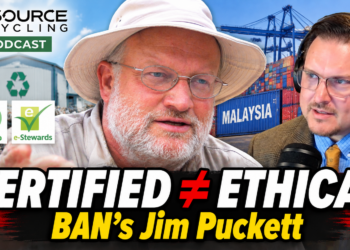
A certified recycler stamp is not proof of ethical downstream management. That’s the core point Jim Puckett, founder and chief...

Inside the 2026 E-Scrap Awards in New Orleans

byChris Liu
October 15, 2026

Uriah Kiser sits down with Matthew Young of Electronics Value Recovery and Emily Chapman of Resource Recycling for a full...

SB 54 plan for cartons, film draws warning

byStefanie Valentic
September 15, 2026

The new law's cartons and film targets could add 100,000 tons of plastic contamination to California's paper exports annually, a...

Panelists: Textile recycling requires more automation

Committee picked to shape 2027 Textile Recovery Summit

byPaul Lane
September 11, 2026

Committee members will help pick topics of interest for the March event.

Panelists reflect on Illinois battery EPR

Panelists reflect on Illinois battery EPR

byAntoinette Smith
August 26, 2026

The new EPR program for household batteries is providing insight to help shape future efforts for embedded batteries and more,...

Load More
Next Post
Emerging US EPR programs spark harmonization talks

Washington designates CAA to lead EPR implementation

2026 Buyers’ Guide

Equipment, services and technology suppliers serving the recycling industry.

Browse the Guide

More Posts

Textile EPR and the definition of recycling

Textile Exchange reports progress in production

September 22, 2026
NJ’s PCR delay risks making its own excuse permanently true

NJ’s PCR delay risks making its own excuse permanently true

September 28, 2026
E-scrap magnet recycling company scales up

Why only some rare-earth sources are economically viable

September 24, 2026
Ten e-scrap projects receive federal prize funds

Recycling rates for rare earths could double by 2040

July 17, 2026

In other news: May 2, 2016

May 2, 2016

America’s critical-materials buildout has a feedstock problem

September 18, 2026
Intel sign outside of company building.

Intel’s CapEx tops $20B on server demand while PC volume shrinks

July 29, 2026
Closeup of a printed circuitboard

Hardware demand puts new focus on parts harvesting

June 5, 2026
Data erasure firm expands wearable device capabilities

Apple hits 30% recycled content, debuts new recovery tech

April 17, 2026

Who should pay for lithium-ion battery fire damage?

September 21, 2026
Load More

About & Publications

About Us

Staff

Archive

Magazines

Work With Us

Advertise
Jobs
Contact
Terms and Privacy

Newsletters

Get the latest recycling news and analysis delivered to your inbox every week. Stay ahead on industry trends, policy updates, and insights from programs, processors, and innovators.

Subscribe

Welcome Back!

Login to your account below

Forgotten Password?

Retrieve your password

Please enter your username or email address to reset your password.

Log In

Add New Playlist

No Result
View All Result
  • The Latest
  • Analysis
  • Recycling
  • E-Scrap
  • Plastics
  • Policy Now
  • Conferences
    • E-Scrap Conference
    • Plastics Recycling Conference
    • Resource Recycling Conference
    • Textiles Recovery Summit
  • Magazines
  • About Us
  • Advertise
  • Archive
  • Jobs
  • Staff
Subscribe
This website uses cookies. By continuing to use this website you are giving consent to cookies being used. Visit our Privacy and Cookie Policy.
-
00:00
00:00

Queue

Update Required Flash plugin
-
00:00
00:00