







Resource Recycling
  • The Latest
  • Analysis
    • All
    • Certification Scorecard
    • Industry Announcements
    • Opinion
    NJ’s PCR delay risks making its own excuse permanently true

    NJ’s PCR delay risks making its own excuse permanently true

    E-scrap magnet recycling company scales up

    Why only some rare-earth sources are economically viable

    e-Stewards to develop an ITAD-specific standard

    Certification scorecard — week of Sept. 21

    Who should pay for lithium-ion battery fire damage?

    America’s critical-materials buildout has a feedstock problem

    Certification scorecard – week of Sept. 14

  • Conferences
    • Resource Recycling Conference
    • Plastics Recycling Conference
    • E-Scrap: The Longevity Conference
    • Textiles Recovery Summit
  • Publications
    • E-Scrap News
    • Plastics Recycling Update
    • Policy Now
    • Resource Recycling
    • Other Topics
      • All Topics
      • Brand Owners
      • Critical Minerals
      • Glass
      • Grant Watch / RFPs
      • Markets
      • Organics
      • Packaging
      • Research
      • Technology
      • Textiles
Subscribe
No Result
View All Result
Resource Recycling
  • The Latest
  • Analysis
    • All
    • Certification Scorecard
    • Industry Announcements
    • Opinion
    NJ’s PCR delay risks making its own excuse permanently true

    NJ’s PCR delay risks making its own excuse permanently true

    E-scrap magnet recycling company scales up

    Why only some rare-earth sources are economically viable

    e-Stewards to develop an ITAD-specific standard

    Certification scorecard — week of Sept. 21

    Who should pay for lithium-ion battery fire damage?

    America’s critical-materials buildout has a feedstock problem

    Certification scorecard – week of Sept. 14

  • Conferences
    • Resource Recycling Conference
    • Plastics Recycling Conference
    • E-Scrap: The Longevity Conference
    • Textiles Recovery Summit
  • Publications
    • E-Scrap News
    • Plastics Recycling Update
    • Policy Now
    • Resource Recycling
    • Other Topics
      • All Topics
      • Brand Owners
      • Critical Minerals
      • Glass
      • Grant Watch / RFPs
      • Markets
      • Organics
      • Packaging
      • Research
      • Technology
      • Textiles
Subscribe
No Result
View All Result
Resource Recycling
No Result
View All Result
Home Plastics

Canada tariffs latest in new normal for RPET

Antoinette SmithbyAntoinette Smith
September 11, 2026
in Plastics, Recycling
Canada tariffs latest in new normal for RPET

Lightspring / Shutterstock

Editor’s note: This story has been updated to include a Sept. 15 statement from GPI.

Canada’s retaliatory tariffs of 15% to 50% on US goods took effect on Monday, in response to the Trump administration’s 50% tariffs on Canadian products.

The latest development in the ongoing tariff uncertainty of the past year – which has exacerbated existing struggles caused by competition with virgin resin and subdued demand – RPET markets are unlikely to see much effect, according to an ICIS analyst.

In July, after more than a year of global back-and-forth with a wide array of trade partners, US President Donald Trump announced 50% tariffs on Canadian goods, claiming “discriminatory treatment.” Subsequent talks collapsed Aug. 22 and the US implemented the tariffs on billions of dollars in Canadian products.

The US tariff levels on Canadian PET imports “are generally consistent with those that have been in place since the administration introduced reciprocal tariffs,” said Corbin Olson, senior analyst at commodity intelligence firm ICIS. “As a result, the market has largely already absorbed and adjusted to these measures. The recent developments have not significantly altered tariff levels in a way that would be expected to create another major market disruption.”

Even so, trade policy remains a “source of hesitation” for market players, Olson said. 

The top 10 countries importing PET into the US – virgin PET as well as RPET flake and pellet, under the same tariff code – represent 85% of 2026 volumes through July, according to US International Trade Commission (ITC) data.

For the year to date, Canada is sixth on the list of PET importers, at 60,100 metric tons (mt) or 7% of total imports. Mexico is at the top of the list, providing about one-fifth of total volumes that entered the US. 
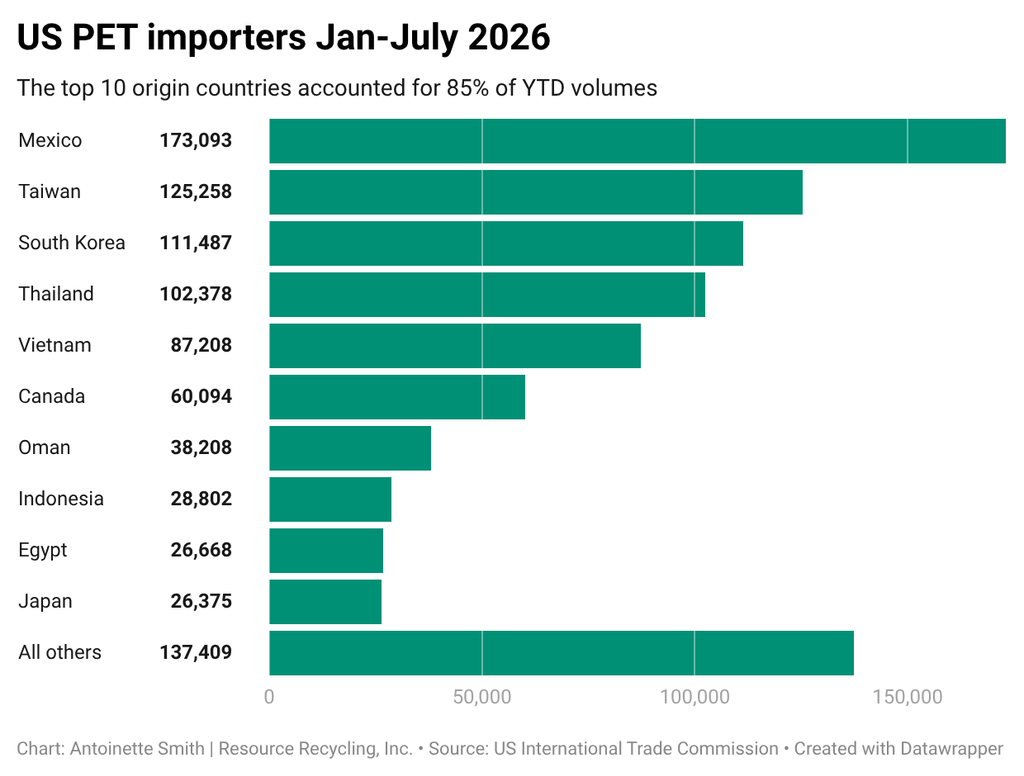
An ICIS analysis indicated that Canadian PET is currently subject to a 16.5% total standard duty, plus a 13.6% anti-dumping duty (ADD). ADDs are not exempt under current free trade agreements, Olson said. 

Olson noted that the US has free trade agreements with four of the top 10 PET importing countries, and exemptions may be made on a shipment-by-shipment basis according to compliance with stipulations on rules of origin.

In addition to the most recent tariffs, seven of the top 10 PET importers are among the economies subject to an ongoing Section 301 overcapacity investigation from the US Trade Representative (USTR). As yet, tariff rates and timing have not been announced.

Olson recommended that stakeholders consult their global trade compliance or customs department for final determinations on applicability, “as eligibility is very often dependent upon submitted (or lack of) paperwork and information is likely to evolve.”

Other material industries respond

When trade talks broke down in late August, trade associations representing paper products and glass packaging released statements.

American Forest & Paper Association (AF&PA) President and CEO Heidi Brock: “The US pulp, paper, packaging and tissue supply chain is deeply integrated across North America. New counter-tariffs on US goods, including pulp and paper products, risk adding uncertainty and cost for manufacturers, workers, customers and communities on both sides of the border.

“AF&PA supports trade policies that address unfair practices and strengthen US manufacturing. At the same time, escalating tariff disputes between the US and Canada will disrupt the cross-border supply chains that help mills and manufacturers invest, compete and deliver essential products people depend on every day.

“We urge both governments to return to the negotiating table and work toward solutions that address legitimate trade concerns without undermining the North American manufacturing base or the long-standing partnerships that support jobs and economic activity throughout the region.”

In its own statement Sept. 15, trade association the Glass Packaging Institute (GPI), called for “all parties to resume negotiations on the US-Canada trade dispute. In addition, as members of the Toasts Not Tariffs Coalition, we support the coalition’s call for a de-escalation of reciprocal tariffs on beverage alcohol and encourage both countries to restore access to beer, wine and spirits from their neighboring country. These tariffs and product bans are a force multiplier that ripples through the supply chain for those products, adding to the impact on the glass industry of North America and our supply chain of raw materials and packaging.

“For over a hundred years, glass manufacturers in the US and Canada have operated as an integrated supply chain, with each plant focused on producing specialty containers that other plants do not supply,” GPI continued. “This supply chain cannot be reconfigured overnight. The escalating trade dispute threatens both American and Canadian manufacturers, workers, and their supply chain – while opening the door to further imports from China, jeopardizing domestic manufacturing investment.  

“The stakes are clear: while American glass manufacturers are shipping fewer bottles to US wine and spirits markets, overseas suppliers are gaining ground.”


Tags: CanadaMarketsPETTrade & Tariffs
TweetShare
Antoinette Smith

Antoinette Smith

Antoinette Smith has covered commodity plastics and supply chains for more than a decade, with a special focus on economic impacts and consumer behavior. She brings a balanced, thoughtful view to recycling stories, and isn't afraid to ask "why?" Contact Antoinette at antoinette@dev.resource-recycling.com.

Related Posts

trash bags

Sorted: Should we use recycled trash bags?

byBrian Clark Howard
September 28, 2026

Manufacturers’ resistance is rooted in performance and cost, but the products may have an important role to play.

Analysis: Undersupply of PCR is ‘stifling’ brand goals

US lawmakers urge protection of domestic RPET

byAntoinette Smith
September 25, 2026

In a letter to the US Trade Representative, five representatives asked the USTR to consider trade remedies and support verification...

Recyclers reeling from NJ PCR extension

Recyclers reeling from NJ PCR extension

byAntoinette Smith
September 23, 2026

The recent three-year extension for exemptions to the state's PCR mandates elicited frustration and confusion among recyclers.

Textile EPR and the definition of recycling

Textile Exchange reports progress in production

byPaul Lane
September 22, 2026

The organization said the industry has made some sustainability progress, but there’s much room for improvement.

ALPLA’s holistic approach to packaging design

ALPLA’s holistic approach to packaging design

byAntoinette Smith
September 18, 2026

The packaging and recycling company's North American design lead explains why recyclability goals can't exist in isolation.

Additive cuts acetaldehyde migration in RPET bottles

PET roadmap pairs demand, CO2 footprint

byAntoinette Smith
September 15, 2026

A new industry roadmap from NAPCOR combines ISO-compliant methodology and a conservative approach toward PET decarbonization, to reduce the carbon...

Load More
Next Post
California Governor Gavin Newsom speaking at podium.

What's on Newsom's desk after the CA session end

2026 Buyers’ Guide

Equipment, services and technology suppliers serving the recycling industry.

Browse the Guide

More Posts

Recyclers reeling from NJ PCR extension

Recyclers reeling from NJ PCR extension

September 23, 2026
Oregon state capitol building with state flag and blue sky.

NAW appeals Oregon EPR ruling

September 25, 2026
Colorado’s EPR programs move from planning to practice

Colorado’s EPR programs move from planning to practice

September 17, 2026
Bin to Better gets students involved in reuse, recycling

Bin to Better gets students involved in reuse, recycling

September 24, 2026

Who should pay for lithium-ion battery fire damage?

September 21, 2026

SB 54 plan for cartons, film draws warning

September 15, 2026
Industry announcements for January 2026

Industry announcements for September 2026

August 31, 2026
Calif. Governor Gavin Newsom at podium.

Newsom signs battery EPR expansion, vetoes SB 54 fund bill

September 24, 2026
Bipartisan reps introduce bill on recycling claims

House passes bill to ease lithium-ion battery storage rules

September 24, 2026
US packaging is evolving. The recycling system isn’t ready

US packaging is evolving. The recycling system isn’t ready

September 16, 2026
Load More

About & Publications

About Us

Staff

Archive

Magazines

Work With Us

Advertise
Jobs
Contact
Terms and Privacy

Newsletters

Get the latest recycling news and analysis delivered to your inbox every week. Stay ahead on industry trends, policy updates, and insights from programs, processors, and innovators.

Subscribe

Welcome Back!

Login to your account below

Forgotten Password?

Retrieve your password

Please enter your username or email address to reset your password.

Log In

Add New Playlist

No Result
View All Result
  • The Latest
  • Analysis
  • Recycling
  • E-Scrap
  • Plastics
  • Policy Now
  • Conferences
    • E-Scrap Conference
    • Plastics Recycling Conference
    • Resource Recycling Conference
    • Textiles Recovery Summit
  • Magazines
  • About Us
  • Advertise
  • Archive
  • Jobs
  • Staff
Subscribe
This website uses cookies. By continuing to use this website you are giving consent to cookies being used. Visit our Privacy and Cookie Policy.