Resource Recycling
  • The Latest
  • Analysis
    • All
    • Certification Scorecard
    • Industry Announcements
    • Opinion
    NJ’s PCR delay risks making its own excuse permanently true

    NJ’s PCR delay risks making its own excuse permanently true

    E-scrap magnet recycling company scales up

    Why only some rare-earth sources are economically viable

    e-Stewards to develop an ITAD-specific standard

    Certification scorecard — week of Sept. 21

    Who should pay for lithium-ion battery fire damage?

    America’s critical-materials buildout has a feedstock problem

    Certification scorecard – week of Sept. 14

  • Conferences
    • Resource Recycling Conference
    • Plastics Recycling Conference
    • E-Scrap: The Longevity Conference
    • Textiles Recovery Summit
  • Publications
    • E-Scrap News
    • Plastics Recycling Update
    • Policy Now
    • Resource Recycling
    • Other Topics
      • All Topics
      • Brand Owners
      • Critical Minerals
      • Glass
      • Grant Watch / RFPs
      • Markets
      • Organics
      • Packaging
      • Research
      • Technology
      • Textiles
Subscribe
No Result
View All Result
Resource Recycling
No Result
View All Result
Home E-Scrap

Chill out – and improve commodities recovery

byJared Paben
March 23, 2017
in E-Scrap
E-waste, Rice University

If melting items can help combine different materials, exposing them to ultra-low temperatures can keep them apart. That’s the idea behind a new technique for separating different materials in shredded e-scrap.

Researchers at Rice University and the Indian Institute of Science say freezing shredded e-scrap and crushing it to nanodust can simplify the materials-separation process, allowing for improved recovery.

The hope is the method will provide an environmentally friendly replacement to the smelting and leaching techniques used to recover valuable metals and alloys today.

“We take advantage of the physics. When you heat things, they are more likely to combine,” said Chandra Sekhar Tiwary, a researcher on the project, stated in a press release. “But in low temperatures, they don’t like to mix. The materials’ basic properties – their elastic modulus, thermal conductivity and coefficient of thermal expansion – all change. They allow everything to separate really well.”

Researchers sent printed circuit boards from computer mice into a deep-freeze device called a cryo-mill. The equipment contained argon gas and a single steel ball. It used a steady stream of liquid nitrogen to keep the container at minus 182 degrees Fahrenheit.

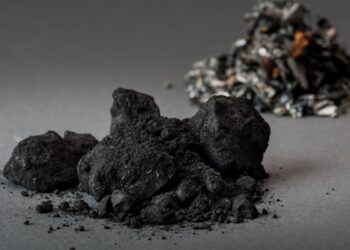
When shaken, the ball first smashed the polymer element of the boards before hitting the metals and then the oxides. The process took place just long enough to separate the materials into a powder, with particles between 20 and 100 nanometers wide (there are a billion nanometers in a meter).

The crushing process can take up to three hours, after which the particles are bathed in water to separate them.

The process is the subject of a paper in the journal Materials Today. The paper was written by Tiwary and fellow researchers Pulickel Ajayan, Kamanio Chattopadhyay and D.P. Mahapatra.


Tags: AsiaCritical Minerals
TweetShare
Jared Paben

Jared Paben

Related Posts

E-scrap magnet recycling company scales up

Why only some rare-earth sources are economically viable

byDavid Daoud
September 24, 2026

Rare-earth recycling economics depend on several factors, and there is no single price or date that makes the process pencil...

Bridge Green, Hartree partner on mineral processing deal

Bridge Green, Hartree partner on mineral processing deal

byPaul Lane
September 21, 2026

The agreement will see Bridge Green’s lithium carbonate sold to and marketed by Hartree.

America’s critical-materials buildout has a feedstock problem

byDavid Daoud
September 18, 2026

As the US invests in critical-minerals capacity will facilities have enough material to process?

Canada Plastics Pact reports 2024 progress

Trade tensions shift global mineral partnerships 

byPaul Lane
September 15, 2026

Canada is seeking new trade partners amid worsening US relations, while South Korea is trying to tap into deep Asian...

Spin-off lets Linca focus on battery mineral recovery

Critical mineral policy shift creates opportunity

byPaul Lane
September 14, 2026

Government leaders are calling for minerals to stay onshore, but industry leaders say more public investment would maximize the ability...

Cyclic Materials’ Arizona mineral facility opens

byPaul Lane
September 9, 2026

The Mesa property will perform commercial-scale rare earth mineral recycling.

Load More
Next Post
Shipping container stacked at a port.

Flow of e-plastics into China slows

2026 Buyers’ Guide

Equipment, services and technology suppliers serving the recycling industry.

Browse the Guide

More Posts

Textile EPR and the definition of recycling

Textile Exchange reports progress in production

September 22, 2026
NJ’s PCR delay risks making its own excuse permanently true

NJ’s PCR delay risks making its own excuse permanently true

September 28, 2026
E-scrap magnet recycling company scales up

Why only some rare-earth sources are economically viable

September 24, 2026
Ten e-scrap projects receive federal prize funds

Recycling rates for rare earths could double by 2040

July 17, 2026

In other news: May 2, 2016

May 2, 2016

America’s critical-materials buildout has a feedstock problem

September 18, 2026
Intel sign outside of company building.

Intel’s CapEx tops $20B on server demand while PC volume shrinks

July 29, 2026
Closeup of a printed circuitboard

Hardware demand puts new focus on parts harvesting

June 5, 2026

Who should pay for lithium-ion battery fire damage?

September 21, 2026
Data erasure firm expands wearable device capabilities

Apple hits 30% recycled content, debuts new recovery tech

April 17, 2026
Load More

About & Publications

About Us

Staff

Archive

Magazines

Work With Us

Advertise
Jobs
Contact
Terms and Privacy

Newsletters

Get the latest recycling news and analysis delivered to your inbox every week. Stay ahead on industry trends, policy updates, and insights from programs, processors, and innovators.

Subscribe

Welcome Back!

Login to your account below

Forgotten Password?

Retrieve your password

Please enter your username or email address to reset your password.

Log In

Add New Playlist

No Result
View All Result
  • The Latest
  • Analysis
  • Recycling
  • E-Scrap
  • Plastics
  • Policy Now
  • Conferences
    • E-Scrap Conference
    • Plastics Recycling Conference
    • Resource Recycling Conference
    • Textiles Recovery Summit
  • Magazines
  • About Us
  • Advertise
  • Archive
  • Jobs
  • Staff
Subscribe
This website uses cookies. By continuing to use this website you are giving consent to cookies being used. Visit our Privacy and Cookie Policy.
-
00:00
00:00

Queue

Update Required Flash plugin
-
00:00
00:00