






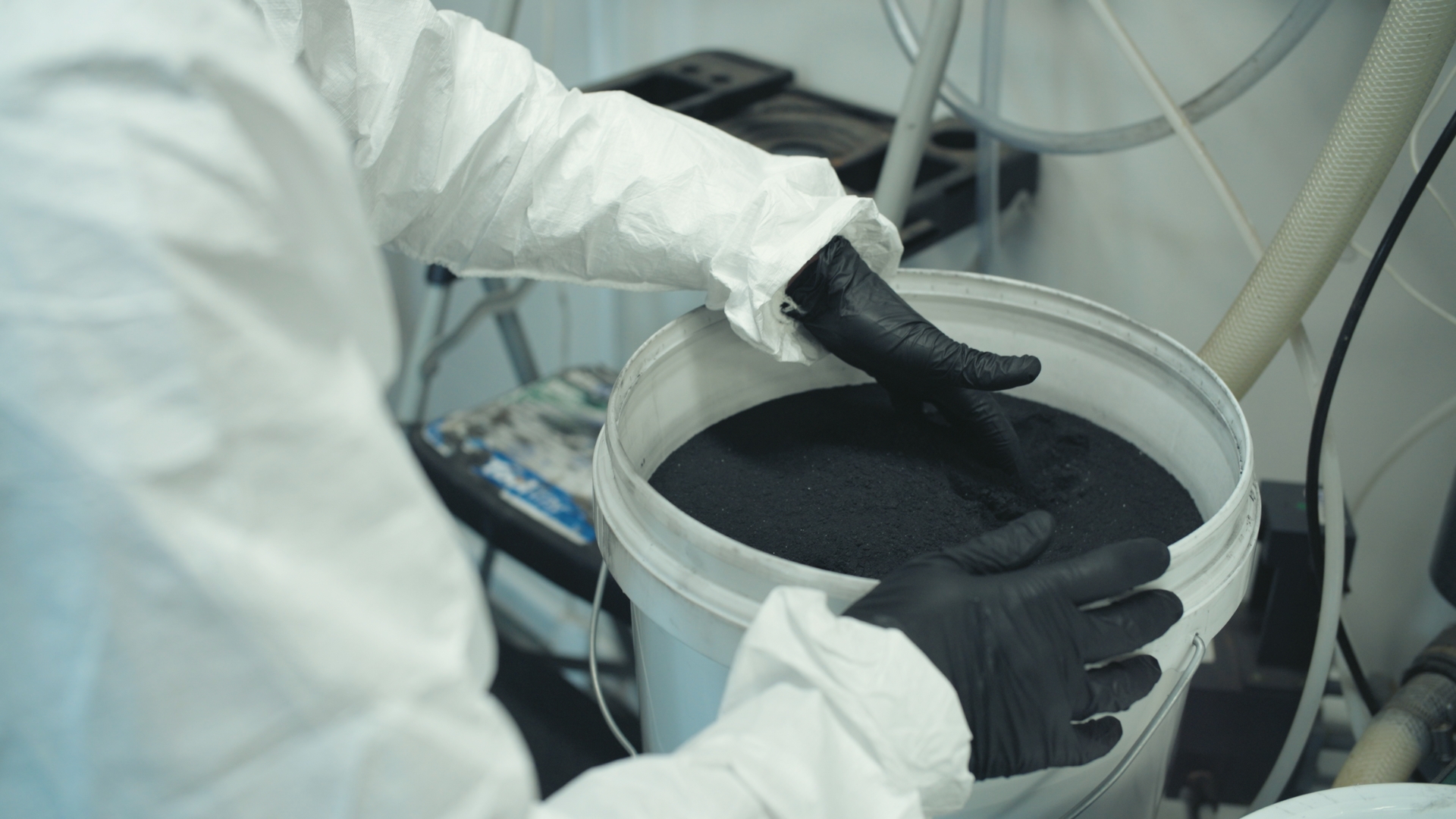
Editor’s note: Critical mineral recovery will be the topic of a featured session at the 2026 E-Scrap: The Longevity Conference Oct. 26-28 in New Orleans. The federal government made several moves over the summer to shore up the US critical mineral supply. Industry insiders say the moves are laudable in national security terms, but more can and should be done to create a truly circular domestic system.
The Department of Commerce published a temporary final rule last month banning the export of black mass and tungsten waste without prior authorization. That followed a presidential determination in July authorizing the Secretary of Commerce to restrict the export of critical minerals.Government leaders say the moves are meant to make the nation less reliant upon foreign-sourced minerals for batteries, electronics and other materials. The Government Accountability Office issued a report earlier this summer detailing the need to bolster domestic critical mineral supplies, warning that US supplies of several minerals such as arsenic and manganese are entirely foreign-sourced.
That’s among the reasons Congress is considering several bills to bolster the domestic mineral supply.But the US faces a processing gap that has to be overcome in order to make these moves effective. As one example, S&P Global Energy estimates US companies are creating 60,000 metric tons of black mass per year, yet domestic facilities can only refine 25,000 metric tons of that material. Analysts with Benchmark Intelligence estimate it could take US refiners until the end of the decade to eliminate that gap.
Those analysts also note the move will likely reduce global black mass demand, as Asian refiners buy the majority of US-made black mass. The resulting lower prices would increase the competitiveness of domestic refiners, allowing them to obtain feedstock more cheaply.
“A ban on the export of black mass should redirect feedstock toward US recyclers,” said Frederick Bloomfield, a senior black mass pricing analyst at Benchmark. “The key question is whether the policy will accelerate the buildout of US black mass refining capacity and mitigate critical mineral leakage, or whether these rules can be circumvented.”
More public help could improve market
The government’s actions are a good first step toward creating this more competitive domestic market, according to Jeet Basi, president and CEO of Modern Mining, a North Carolina-based e-scrap recycling and mineral recovery company. Channeling reusable materials back into the supply chain is much faster than mining, a process he said can take a decade or more to get going and has a small success rate. But public funding could help close processing gaps such as the one that exists with black mass, he said.
“We think the administration is recognizing an important strategic reality: Materials that we’ve historically labeled waste increasingly really need to be viewed as a strategic domestic mineral resource,” he said. “The first pillar is beefing up the feedstock. Export control is a step in the right direction. Then the second pillar is the downstream processing ecosystem, public and private development. It’s great to have a bunch of material, but unless you can monetize what’s inside that feedstock, you’re not really creating the value you’re looking for.”
Financial issues have been a barrier. Battery processor Li-Cycle and recycler Ascend Elements have both filed for bankruptcy within about the past year after trying to get processing operations off the ground. Nonetheless, private companies are taking steps to fill the processing void. Gloyd Recycling Solutions began installing its BIDS system in US facilities this summer, allowing processors to shred battery-embedded devices in house and eliminating the need to package and ship material elsewhere. Cyclic Materials opened a facility in Arizona earlier this month to recycle rare earth minerals. Also this month, R3 Lithium — which acquired some of Ascend’s assets — opened a facility in Georgia to recover lithium carbonate from black mass and scrap to use in lithium-ion batteries.
“Every battery already in service in this country is a lithium deposit,” said Eric Gratz, R3’s CTO and an Ascend co-founder. “It is above ground, it is concentrated and nobody has to dig for it. What has been missing is the ability to get lithium back out of it, at commercial scale, in the United States. That is the thing we have now demonstrated — not in a laboratory, and not as a pilot.”
Despite these advances, the Global Electronics Association (GEA) feels the government can do more to close gaps not just in processing but also sorting, collection and demand generation. A joint statement from three GEA leaders — senior director of sustainability strategy Kelly Scanlon, vice president of North American government relations Kevin O’Hanlon and sustainability program manager Seth Jacobsen — called for more action to create what they called a durable domestic ecosystem.
“Legislatively, the industry would benefit from measures that support investment in domestic recycling and refining capacity, encourage public-private partnerships, reduce unnecessary permitting delays, strengthen R&D and support industry-led standards,” they said. “It is also important that policy avoids creating bottlenecks or unintended consequences for manufacturers and recyclers. The goal should be a practical framework that strengthens supply-chain resilience while enabling responsible environmental outcomes.”
Basi agrees. While businesses may not prefer regulation in certain matters, backing up legislation with financing and structure can help generate the framework to strengthen the domestic mineral supply chain.
“That’s truly where the public-private partnership can turn things around, public policies that incentivize manufacturers to use recycled products,” he said. “Mandate certain recycled contents. We all know among ourselves that using recycled materials is the right thing to do.”
Private companies can do their part
Government assistance would help, but industry leaders say the stage is set for a more robust US market even if there isn’t further action. R3 CEO Linh Austin said the move and subsequent buildout of companies like his will only benefit industries such as cell phones and data centers with growing demand for domestically sourced minerals. And Electra Battery Minerals CEO Trent Mell, whose company is developing US refining capacity for nickel and recycled battery materials, noted that offshore refiners have long competed for US black mass supplies, so cutting them off will help emerging US refiners secure the volume of material needed to scale up their capacity.
“The United States has built the front half of the battery recycling processing infrastructure faster than the back half,” said Mell, whose company is based in Toronto. “This rule begins to correct that imbalance and could create the market conditions needed to crowd in private capital for US refining.”
Regardless of where the money comes from, entities across the value chain should prepare for the changes these policy revisions will create. The GEA is encouraging its members to talk to their suppliers, gauge recovery opportunities and understand their documentation requirements to ensure compliance.
“More broadly, we are encouraging members to think about circularity and materials resilience as business issues, not just compliance issues,” GEA’s leadership trio said. “That includes looking at design, sourcing, repairability, reuse, recycling and end-of-life pathways … The broader industry is looking at a mix of strategies: diversifying suppliers, improving traceability, designing products for repair and recovery, investing in recycling partnerships and exploring ways to recover more value from end-of-life electronics.”
The opportunity is there, said Mell, whose company is looking at building a battery-grade nickel refinery in the Southeast. Now the industry has to take advantage.
“Retaining feedstock is the first step,” he said. “Financing and building the refining capacity to process it is the necessary second step. A durable framework and capital support will be required to finance and construct the necessary facilities. Building that capacity is a matter of national security.”