




Resource Recycling
  • The Latest
  • Analysis
    • All
    • Certification Scorecard
    • Industry Announcements
    • Opinion
    SERI works to restore faith in certifications

    Building a defensible E-scrap evidence file

    tires

    The most important decision in tire recycling happens before the shredder

    Intel sign outside of company building.

    Intel’s CapEx tops $20B on server demand while PC volume shrinks

    Google sign on company building with blue sky and clouds above.

    Inside Alphabet’s Q2 results: More capital spending and cloud backlog

    Alpek closing Pennsylvania RPET plant

    Alpek seizing on war-related opportunity 

    Our top stories from March 2023

    Iron Mountain’s data center report: Strong on power, quiet on hardware

  • Conferences
    • Resource Recycling Conference
    • Plastics Recycling Conference
    • E-Scrap: The Longevity Conference
    • Textiles Recovery Summit
  • Publications
    • E-Scrap News
    • Plastics Recycling Update
    • Policy Now
    • Resource Recycling
    • Other Topics
      • All Topics
      • Brand Owners
      • Critical Minerals
      • Glass
      • Grant Watch / RFPs
      • Markets
      • Organics
      • Packaging
      • Research
      • Technology
      • Textiles
Subscribe
No Result
View All Result
Resource Recycling
  • The Latest
  • Analysis
    • All
    • Certification Scorecard
    • Industry Announcements
    • Opinion
    SERI works to restore faith in certifications

    Building a defensible E-scrap evidence file

    tires

    The most important decision in tire recycling happens before the shredder

    Intel sign outside of company building.

    Intel’s CapEx tops $20B on server demand while PC volume shrinks

    Google sign on company building with blue sky and clouds above.

    Inside Alphabet’s Q2 results: More capital spending and cloud backlog

    Alpek closing Pennsylvania RPET plant

    Alpek seizing on war-related opportunity 

    Our top stories from March 2023

    Iron Mountain’s data center report: Strong on power, quiet on hardware

  • Conferences
    • Resource Recycling Conference
    • Plastics Recycling Conference
    • E-Scrap: The Longevity Conference
    • Textiles Recovery Summit
  • Publications
    • E-Scrap News
    • Plastics Recycling Update
    • Policy Now
    • Resource Recycling
    • Other Topics
      • All Topics
      • Brand Owners
      • Critical Minerals
      • Glass
      • Grant Watch / RFPs
      • Markets
      • Organics
      • Packaging
      • Research
      • Technology
      • Textiles
Subscribe
No Result
View All Result
Resource Recycling
No Result
View All Result
Home E-Scrap

US-EU trade rift adds risk now for ITAD and e-scrap trade

byDavid Daoud
February 2, 2026
in E-Scrap, Recycling
Ace Metal and Metro Metals take the most weight in Washington

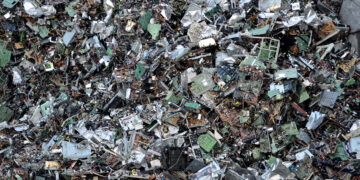
Trade tensions between the US and EU are reshaping ITAD and e-scrap markets, lifting demand for refurbished hardware while increasing price volatility, compliance pressure and regional risk. | Huguette Roe/shutterstock

The suspension of trade talks between the United States and the European Union in January has added a new layer of uncertainty to the electronics world. 

Nothing announced so far directly targets the sectors of IT asset disposition or electronics recycling, but the broader direction of policy is starting to shape how companies think about buying hardware, managing risk and moving materials across borders.

European lawmakers paused engagement with Washington after clashes over tariffs, access to strategic resources and US positions related to Greenland. That break in talks is a sign that trade policy and geopolitics are now tightly intertwined and that mix can easily spill over into hardware pricing and supply chains.

One of the clearest effects is on buyer behavior. The renewed focus on electronics and semiconductor tariffs is already changing how companies plan their purchases, even before new measures are finalized. Some enterprises rushed to buy equipment in late 2025 to get ahead of possible tariff hikes, effectively pulling forward refresh projects. 

Others are turning more seriously to refurbished hardware as a way to control costs when new systems may become more expensive or harder to source amid supply chain disruptions. That helps demand for secondary-market equipment, but it also creates more volatility for processors. When downstream prices move quickly, operators locked into fixed-price contracts or dependent on cross-border resale can see their margins squeezed.

Another important shift is how policymakers are treating critical materials. The US administration’s decision to frame certain minerals as national security assets, highlighted by disputes around Greenland, affects more than just mines and smelters. It also changes the context for urban mining and advanced recycling, because the metals recovered from e-scrap and batteries can now be seen as strategically important inputs. 

Electronics recycling is not being singled out by name, but the push for supply security makes domestic processing more attractive and raises expectations around how copper-rich streams, precious metals, battery materials and magnet-bearing components are handled and sold. Over time, that could bring more investment into compliant domestic plants and verified recycled feedstocks, while also increasing the odds of stricter material classifications, extra paperwork and less flexibility in export routes.

The pause in talks between Washington and Brussels also matters for cross-Atlantic flows of used equipment and recovered materials. With negotiations stalled, the risk of tit-for-tat measures landing in industrial or electronics-related categories goes up. For the stakeholders in the ITAD and recycling sectors that routinely move material between North America and Europe, this environment encourages a pivot toward more regional models. 

That can mean more friction in cross-border reuse and recycling, longer customs processes and more questions about where material will ultimately end up. It can also mean gradually shifting more processing and resale activity back inside each region. Doing that reduces exposure to abrupt trade actions, but it may also cut off access to some of the most efficient or historically profitable downstream outlets.

Trade tensions are feeding into a broader sense of caution in enterprise budgeting. Many large organizations are already trying to tighten capital spending and escalating disputes around US-EU relations give them one more reason to delay or stretch out hardware refreshes. In practical terms, this can slow the flow of devices into ITAD channels in the short term. 

At the same time, tighter budgets usually push companies to get more life out of the equipment they already own, shift devices to new users internally and rely more on secondary markets when they do need additional capacity. That combination leads to fewer assets arriving at processors, but higher expectations on the value recovered from each one and more attention to cost transparency and contract flexibility.

Compliance expectations are also rising. As advanced computing, semiconductors and critical materials are increasingly discussed as national security issues, enterprises are becoming more careful about where their retired equipment and recovered materials ultimately go. They want clearer chain-of-custody, better documentation and more visibility into downstream partners, especially when dealing with data center gear and high-performance components. 

For service providers, this can be an opportunity as well as a burden. Operators with strong traceability, detailed reporting and robust governance can turn regulatory friction into a selling point. Those without those capabilities may find that deals take longer to close or that they are quietly excluded from more sensitive asset streams.

All of this has implications for urban mining. There is no single, unified federal strategy that tells companies to use domestically recovered metals. Even so, the current trade and security posture gives urban mining a kind of indirect tailwind. When tariffs or geopolitical risks make imported raw and semi-processed materials look more expensive and more uncertain, the relative appeal of metals recovered from domestic e-scrap and batteries improves. 

At the same time, policy emphasis on bringing more manufacturing back onshore increases the potential demand for those recovered inputs. The support is structural rather than explicit, but the net effect is that investments in urban mining and advanced recycling now line up more clearly with national industrial and security goals.

Looking ahead, the picture is not one of collapse but of greater complexity. ITAD and recycling operators are likely to face uneven volumes, sharper price swings and stricter compliance demands, the best positioned companies are the ones capable of reassessing their exposure to cost and pricing risk, and able to tighten up documentation and traceability, while thinking carefully about how much of their business model depends on cross-border arbitrage. 

If they can align their secondary-market capabilities with cautious enterprise spending and evolving policy, they will be better prepared for a world where trade decisions are increasingly shaped by geopolitics as much as by economics.


Tags: Legislation & EnforcementTrade & Tariffs
TweetShare
David Daoud

David Daoud

David Daoud is a contributor to Resource Recycling and E-Scrap News, covering IT asset disposition, electronics recycling, and circular IT governance. He is the founder of and current Principal Analyst at Compliance Standards LLC, where he conducts independent research and advisory work on ITAD markets, sustainability and ESG compliance, data security, and lifecycle risk management. Daoud has analyzed enterprise IT trends since the late 1990s and was among the first analysts to examine ITAD as a distinct market segment during his time at IDC. He advises operators, OEMs, and investment teams on regulatory, technology, and market developments affecting the electronics lifecycle.

Related Posts

Spin-off lets Linca focus on battery mineral recovery

GAO: Policy, tech updates needed to bolster domestic mineral supply

byPaul Lane
July 30, 2026

Federal investigators say short- and long-term solutions are needed to decrease the nation’s reliance upon foreign-based minerals.

The State of Oregon seal at a park in Salem, Ore.

MRM bids to run Oregon EPR for second year 

byPaul Lane
July 28, 2026

The company won the competitive process for 2026, but was the only company to apply for the 2027 PRO post.

California releases deposit system update draft rules

Groups move to intervene in SB 343 lawsuit

byStefanie Valentic
July 27, 2026

Earth Island Institute and Californians Against Waste have filed to intervene in the federal lawsuit that halted enforcement of California's...

U.S. Capitol building in Washington, D.C.

House committees advance critical mineral bills

byPaul Lane
July 27, 2026

Congressional votes earlier this month advanced three bills that would expand the nation’s critical mineral recycling capabilities. A subcommittee within...

RecyClass hits 500 EU recyclability evals

RecyClass hits 500 EU recyclability evals

byAntoinette Smith
July 21, 2026

The most recent evaluations include Avery Dennison's RFID tag for PET bottles, ahead of the first PPWR enforcement in mid-August.

Former president of CRT processor sentenced to prison

Groups say injunction doesn’t settle labeling issues

byStefanie Valentic
July 17, 2026

Californians Against Waste and the National Stewardship Action Council say a federal injunction blocking SB 343 pauses enforcement but still...

Load More
Next Post

Eastman looks to recycling plant to drive growth

2026 Buyers’ Guide

Equipment, services and technology suppliers serving the recycling industry.

Browse the Guide

More Posts

State policy is redefining plastics recycling in the US

State policy is redefining plastics recycling in the US

February 19, 2026
California bill would set up EPR for batteries

California bill would set up EPR for batteries

May 12, 2022

In other news: May 2, 2016

May 2, 2016
Closeup of a printed circuitboard

Hardware demand puts new focus on parts harvesting

June 5, 2026

Recycled copper output climbs as market shows surplus

April 6, 2026
Top stories from March 2025

3 factors force e-scrap processing onshore

June 19, 2026

Alpla decries ‘painful impact’ of recycling market pressures

January 19, 2026
Top stories from August 2024

Top stories from August 2024

September 6, 2024
Phonecheck's phone rating and erasing machine.

AI robot grades, erases up to 55 phones an hour

December 7, 2022

‘Sword’ takes another big swipe at U.S. scrap exports

May 10, 2018
Load More

About & Publications

About Us

Staff

Archive

Magazine

Work With Us

Advertise
Jobs
Contact
Terms and Privacy

Newsletter

Get the latest recycling news and analysis delivered to your inbox every week. Stay ahead on industry trends, policy updates, and insights from programs, processors, and innovators.

Subscribe

Welcome Back!

Login to your account below

Forgotten Password?

Retrieve your password

Please enter your username or email address to reset your password.

Log In

Add New Playlist

No Result
View All Result
  • The Latest
  • Analysis
  • Recycling
  • E-Scrap
  • Plastics
  • Policy Now
  • Conferences
    • E-Scrap Conference
    • Plastics Recycling Conference
    • Resource Recycling Conference
    • Textiles Recovery Summit
  • Magazine
  • About Us
  • Advertise
  • Archive
  • Jobs
  • Staff
Subscribe
This website uses cookies. By continuing to use this website you are giving consent to cookies being used. Visit our Privacy and Cookie Policy.