




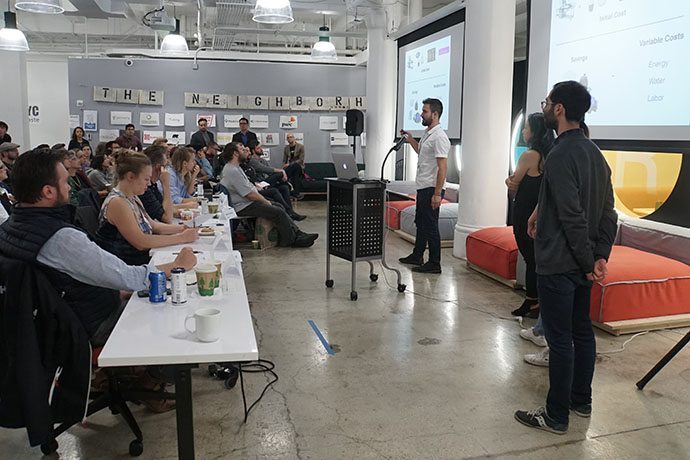
In late October, 80 New Yorkers teamed up to spend three days devising innovative ways to tackle one of the city’s oldest and most vexing challenges: waste. The event, held at Galvanize NYC in SoHo, was called Hack:Trash:NYC and brought together designers, environmental lawyers, waste experts, engineers and entrepreneurs who worked together to find solutions to reduce waste by increasing reuse.
The event was inspired by New York City’s 0x30 initiative, which has tasked the New York City Department of Sanitation (DSNY) to send zero waste to landfill by the year 2030.
To address this challenge, the DSNY has already developed a number of programs including the textile recycling program refasioNYC, the electronics recycling program e-cycleNYC, and a hazardous waste management program called SAFE Disposal. These initiatives, along with the city’s robust recycling and composting program, are shrinking the landfill portion of the waste pie.
There are limits, however, to what can be accomplished through improved diversion rates. Even improved management and recovery of the products and materials we consume does not address the fundamental fact that we consume more than we need.
Disposability has become the foundation on which our modern lifestyle is built, at least in the developed world. Mass production and advances in material science have produced inexpensive products that are far easier and less expensive to replace than repair. And the ease with which we expect to move through our daily lives is made possible by a wide range of single-use products and packages. Clearly, moving away from this paradigm is no simple feat.
Power of collaboration
According to the event organizers, Hack:Trash:NYC was developed on the principle that complex challenges require collaborative solutions. Bringing together a diverse group of people could encourage the innovation necessary to tackle the idea of increasing reuse in a large city like New York.
The Hack:Trash:NYC event kicked off with a keynote by Bridget Anderson, deputy commissioner for recycling and sustainability at DSNY. She highlighted the current state of reuse in New York City, current challenges and the city’s potential for reducing the amount of waste that goes to landfill.
“Our zero-waste approach encourages alternative solutions for the management of solid waste to prevent valuable resources from being disposed of in landfills,” Anderson noted. “At the Department of Sanitation, reuse plays an important role in meeting that goal.”
Eighty entrepreneurs, coders, designers, innovators and waste enthusiasts formed teams of two to five people, with a requirement for multi-disciplinary teams. Some teams arrived fully formed; others were looking to recruit a particular expertise. By the end of the night, everyone found a place and 17 teams were formed.
The first day was a marathon of brainstorming, concepting and consulting. Experts in waste, environmental law, policy, logistics and design were on hand to coach the teams and answer questions that bubbled up.

At the midpoint of the day, teams took the opportunity to present their nascent concepts to these experts. These “mini-pitches” offered valuable feedback to the participants who were able to refine concepts or, in some cases, pivot in different directions. Teams came back for a second round of “mini-pitches” that evening and the changes and improvements proved dramatic. Teams developed solutions focused on textiles, food waste, packaging, education, exchange services and a range of digital platforms.
Three winning concepts
On the second day, the teams finalized their pitches and submitted their slide decks before presenting their solutions in front of the judging panel: Bridget Anderson at DSNY; Margot Kane, chief investment and financial officer for the Closed Loop Fund; Mikal Hallstrup, founder and global CEO of Designit; Peter Raymond, principal at The New Bureau, and Aude Broos, strategist at Co:Collective. After some heated debate, three winners were chosen.
Fix.ly. This app-based business offers a repair concierge service for small goods such as shoes, accessories and small electronics. The app enables users to find a vetted repair shop for damaged products, schedule pick up and have the repaired item delivered back to the user in an agreed upon time frame.
Surplus Food Catering. This project combines efforts of two nonprofit groups, Rescuing Leftover Cuisine and RoHo Compost. The idea would see the organizations collect surplus food from New York food purveyors (such as caterers, grocers, agriculture groups and others) and prepare healthy meals in a rented commercial kitchen. The food would be distributed to the city’s food insecure populations at local events hosted by churches, gyms, and YMCAs.
The Milkmen. Through a partnership with the RXR, the management company of the Starret Lehigh building in Chelsea, this team is proposing a solution that creates a building-wide system of reusable containers that would be centrally washed and redelivered to foodservice vendors within the building. The team estimated a potential diversion from landfill of over 500,000 clamshell containers, 500,000 coffee cups and 15,000 trash bags.
The winning concepts each received a portion of cash prizes totaling $5,000 and highlighted the key obstacle to increasing reuse as a waste reduction strategy: Any increase in reuse will require a change in the way we make, use, share and even think about the food and products we consume. Demonstrating that these changes are possible (and profitable) on a small scale will be an essential step in demonstrating the feasibility of a return to reuse as a large-scale strategy toward waste reduction.
The Hack:Trash:NYC team partnered with three organizations with the goal of pushing the winning projects to the next stage. The social impact incubator The New Bureau, the strategy firm Co:Collective and the global design firm Designit were each paired with one of the winning teams in order to help refine the concepts and develop a roadmap for implementation.
Each team will have the opportunity to pitch their refined concepts to a venture capital roundtable, organized by Closed Loop Partners. Whether any of these projects will get funding is an open question, but the teams will certainly be exposed to the right questions they need to be asking in order to advance their projects.
Peter Schon is the vice chair of the Industrial Designer’s Society of America’s NYC chapter and is the cofounder of Redseed Product Development, a research, engineering and design consultancy focused on the development of early stage medical devices. Marisa Adler is senior consultant at Resource Recycling Systems (RRS).
The views and opinions expressed are those of the author and do not imply endorsement by Resource Recycling, Inc. If you have a subject you wish to cover in an op-ed, please send a short proposal to news@dev.resource-recycling.com for consideration.