




Resource Recycling
  • The Latest
  • Analysis
    • All
    • Certification Scorecard
    • Industry Announcements
    • Opinion
    SERI works to restore faith in certifications

    Building a defensible E-scrap evidence file

    tires

    The most important decision in tire recycling happens before the shredder

    Intel sign outside of company building.

    Intel’s CapEx tops $20B on server demand while PC volume shrinks

    Google sign on company building with blue sky and clouds above.

    Inside Alphabet’s Q2 results: More capital spending and cloud backlog

    Alpek closing Pennsylvania RPET plant

    Alpek seizing on war-related opportunity 

    Our top stories from March 2023

    Iron Mountain’s data center report: Strong on power, quiet on hardware

  • Conferences
    • Resource Recycling Conference
    • Plastics Recycling Conference
    • E-Scrap: The Longevity Conference
    • Textiles Recovery Summit
  • Publications
    • E-Scrap News
    • Plastics Recycling Update
    • Policy Now
    • Resource Recycling
    • Other Topics
      • All Topics
      • Brand Owners
      • Critical Minerals
      • Glass
      • Grant Watch / RFPs
      • Markets
      • Organics
      • Packaging
      • Research
      • Technology
      • Textiles
Subscribe
No Result
View All Result
Resource Recycling
  • The Latest
  • Analysis
    • All
    • Certification Scorecard
    • Industry Announcements
    • Opinion
    SERI works to restore faith in certifications

    Building a defensible E-scrap evidence file

    tires

    The most important decision in tire recycling happens before the shredder

    Intel sign outside of company building.

    Intel’s CapEx tops $20B on server demand while PC volume shrinks

    Google sign on company building with blue sky and clouds above.

    Inside Alphabet’s Q2 results: More capital spending and cloud backlog

    Alpek closing Pennsylvania RPET plant

    Alpek seizing on war-related opportunity 

    Our top stories from March 2023

    Iron Mountain’s data center report: Strong on power, quiet on hardware

  • Conferences
    • Resource Recycling Conference
    • Plastics Recycling Conference
    • E-Scrap: The Longevity Conference
    • Textiles Recovery Summit
  • Publications
    • E-Scrap News
    • Plastics Recycling Update
    • Policy Now
    • Resource Recycling
    • Other Topics
      • All Topics
      • Brand Owners
      • Critical Minerals
      • Glass
      • Grant Watch / RFPs
      • Markets
      • Organics
      • Packaging
      • Research
      • Technology
      • Textiles
Subscribe
No Result
View All Result
Resource Recycling
No Result
View All Result
Home E-Scrap

EU to enact chemical threshold for recycled plastic

byJared Paben
May 16, 2019
in E-Scrap
Row of E.U. flags outside the European Commission building.

European Union leaders appear to have settled on a limit for trace amounts of flame retardants in recycled plastics. A reclaimer called the limit “workable,” but activists say it’s not nearly restrictive enough.

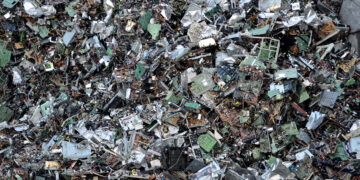
The European Commission seems set to agree that recycled plastics can contain decabromodiphenyl ether (decaBDE) at a level no higher than 500 parts per million, according to a press release from UK plastics reclaimer Axion Polymers. Last year, the European Union was considering a much stricter limit, 10 parts per million, which industry groups said would have effectively ended the recycling of plastics from electronics and electrical appliances.

Although decaBDE’s use has now been restricted to a limited number of applications, the chemical has been used as a flame retardant in electronics, automobiles and other durable goods. It’s one of a class of brominated flame retardants called polybrominated diphenyl ethers (PBDEs).

In September, E-Scrap News reported on the law that would have limited decaBDE to 10 parts per million in products, including ones made with recycled plastic. The limit was included in an overall proposed update to the EU’s persistent organic pollutants (POPs) laws.

At the time, the European Recycling Industries’ Confederation (EuRIC) and the European Electronics Recyclers Association (EERA) both said plastics reclaimers simply couldn’t achieve that number. EERA noted that housings of old computer monitors can contain brominated flame retardants at levels up to 150,000 parts per million. EERA asked elected leaders to impose a limit of 1,000 parts per million for recycled plastic.

The European Union has three law-making branches: the European Commission, European Parliament and the Council of the European Union. In February, the parliament and council reached a deal to limit the sum of all BDEs, including decaBDE, to no more than 500 parts per million in recycled-content products. Now, the commission appears to have concurred.

Industry and activist reactions

Axion Polymers, which is based in Manchester, England, noted the limit of 500 parts per million would be tougher to achieve than the threshold recycling stakeholders had asked for, but facilities with advanced sorting and processing technologies such as Axion’s could still achieve it.

“Professional companies that have spent time trying to inform and address the EU Parliament in the management of decaBDEs in recycled plastics will welcome the recast of the EU directive as a sensible way forward,” Keith Freegard, Axion’s associate consultant, said in the statement.

Advocates for eliminating PBDEs and other toxic chemicals criticized the EU’s direction.

“The proposed 500-ppm limit paves the way for a massive inflow of decaBDE from discarded electronics into recycled plastic products, including children’s products,” according to a March letter from seven different groups to EU leaders.

Last month, one of the groups, the Center for International Environmental Law (CIEL), issued a statement saying the proposed limit will allow the world’s worst chemicals to re-enter the market in concentrations far above safe levels.

“While we welcome efforts to move to a circular economy, a toxic chemical does not become less toxic when it is recycled,” stated Giulia Carlini, staff attorney at CIEL. “For the circular economy to be a success, extreme caution must be taken to ensure it does not come at the expense of human health and the environment.”

Photo credit: Ugis Riba/Shutterstock

A version of this story appeared in Plastics Recycling Update on May 15.

 

Tags: Europe
TweetShare
Jared Paben

Jared Paben

Related Posts

RecyClass hits 500 EU recyclability evals

RecyClass hits 500 EU recyclability evals

byAntoinette Smith
July 21, 2026

The most recent evaluations include Avery Dennison's RFID tag for PET bottles, ahead of the first PPWR enforcement in mid-August.

Funding round helps DEScycle growth effort

byPaul Lane
July 14, 2026

The British metal recovery company is preparing its first demonstration facility to begin processing later this year.

Our top stories from December 2019

Irish e-scrap processing volume continues to grow

byPaul Lane
June 22, 2026

WEEE Ireland reported record e-scrap recycling volumes for 2025, but company leadership claims faulty methodology had led to it falling...

Europe’s recyclers miss most of the critical materials

Europe’s recyclers miss most of the critical materials

byDavid Daoud
May 29, 2026

A major research project makes for sober reading for ITAD professionals.

A map of Europe with various pinned locations.

EU growth slows for circular plastics

byAntoinette Smith
May 19, 2026

Just when Europe should be accelerating its transition to a circular economy, the sector is slowing dramatically, said the president...

Aurubis smelter pipe system and chimney.

Aurubis sends positive signal for metals recovery markets

byDavid Daoud
May 18, 2026

The company’s performance is often seen as a bellwether for downstream appetite for complex electronic scrap and industrial recycling feedstock.

Load More
Next Post
Repair rift continues among Basel stakeholders

Repair rift continues among Basel stakeholders

2026 Buyers’ Guide

Equipment, services and technology suppliers serving the recycling industry.

Browse the Guide

More Posts

Low chip prices hurt processor’s resale revenues

Low chip prices hurt processor’s resale revenues

May 10, 2023

Certification Scorecard — Week of July 27, 2026

July 29, 2026
In Our Opinion: Coalitions: The EPR Differentiator

Inside NAW’s constitutional case against packaging EPR

July 6, 2026
RIT researchers develop AI-based textile recycling system

CA expects first textile EPR deadline

June 30, 2026

NERC forum explores textile reuse

June 30, 2026
Emerging technology holds the key to rare earth recovery

Emerging technology holds the key to rare earth recovery

June 1, 2026

PP cups now ‘widely recyclable’ with increased acceptance

February 3, 2026
Report: Battery ‘retirement tide’ nears

Report: Battery ‘retirement tide’ nears

March 13, 2025
Closeup of a lithium-ion battery.

Here are the rules on handling lithium-ion batteries

February 13, 2020
Our top stories from February 2025

Our top stories from February 2025

March 5, 2025
Load More

About & Publications

About Us

Staff

Archive

Magazine

Work With Us

Advertise
Jobs
Contact
Terms and Privacy

Newsletter

Get the latest recycling news and analysis delivered to your inbox every week. Stay ahead on industry trends, policy updates, and insights from programs, processors, and innovators.

Subscribe

Welcome Back!

Login to your account below

Forgotten Password?

Retrieve your password

Please enter your username or email address to reset your password.

Log In

Add New Playlist

No Result
View All Result
  • The Latest
  • Analysis
  • Recycling
  • E-Scrap
  • Plastics
  • Policy Now
  • Conferences
    • E-Scrap Conference
    • Plastics Recycling Conference
    • Resource Recycling Conference
    • Textiles Recovery Summit
  • Magazine
  • About Us
  • Advertise
  • Archive
  • Jobs
  • Staff
Subscribe
This website uses cookies. By continuing to use this website you are giving consent to cookies being used. Visit our Privacy and Cookie Policy.