


Resource Recycling
  • The Latest
  • Analysis
    • All
    • Certification Scorecard
    • Industry Announcements
    • Opinion

    Certification Scorecard — Week of April 6, 2026

    Closed Loop Partners acquires Sutter Metals, connecting electronics disposition to metals recovery

    Certification Scorecard — Week of March 30, 2026

    Industry announcements for January 2026

    Industry announcements for April 2026

    Certification scorecard – Week of March 23, 2026

    Certification Scorecard – Week of March 16, 2026

    Groups identify recovered plastics users in the Northeast

    Bale pricing for recycled plastics diverges

    Why global ITAD is stranded in the Gulf

    Why global ITAD is stranded in the Gulf

    Certification scorecard for the week of March 9, 2026

  • Conferences
  • Publications

    Other Topics

    Textiles
    Organics
    Packaging
    Glass
    Brand Owners

    Metals
    Technology
    Research
    Markets
    Grant Watch

    All Topics

Subscribe
No Result
View All Result
Resource Recycling
  • The Latest
  • Analysis
    • All
    • Certification Scorecard
    • Industry Announcements
    • Opinion

    Certification Scorecard — Week of April 6, 2026

    Closed Loop Partners acquires Sutter Metals, connecting electronics disposition to metals recovery

    Certification Scorecard — Week of March 30, 2026

    Industry announcements for January 2026

    Industry announcements for April 2026

    Certification scorecard – Week of March 23, 2026

    Certification Scorecard – Week of March 16, 2026

    Groups identify recovered plastics users in the Northeast

    Bale pricing for recycled plastics diverges

    Why global ITAD is stranded in the Gulf

    Why global ITAD is stranded in the Gulf

    Certification scorecard for the week of March 9, 2026

  • Conferences
  • Publications

    Other Topics

    Textiles
    Organics
    Packaging
    Glass
    Brand Owners

    Metals
    Technology
    Research
    Markets
    Grant Watch

    All Topics

Subscribe
No Result
View All Result
Resource Recycling
No Result
View All Result
Home E-Scrap

Data shows e-scrap disposal increase in one state

byJared Paben
December 23, 2021
in E-Scrap
Data shows e-scrap disposal increase in one state
Electronics collected for recycling in a bin.
Cascadia Consulting Group estimated Washington residents and businesses threw away 41,441 tons of electronics in the 2020-21 audit period. | Photographee.eu/Shutterstock

As COVID-19 took hold and e-scrap collection opportunities were canceled, the public began trashing a lot more of their electronics in Washington state, according to recently reported figures.

E-Scrap News recently crunched numbers laid out in a 2020-21 waste characterization report produced for the Washington state Department of Ecology. Conducted by Cascadia Consulting Group, the study analyzed what’s in garbage collected from Washington homes and businesses.

For electronics, the numbers were ugly.

“Unfortunately, as E-Cycle collection sites closed or sites restricted the size of TVs they could accept, this likely led to an increase in electronics thrown away,” according to a December Department of Ecology email to electronics recycling program stakeholders.

Based on waste sampling during the 2020-21 audit, Cascadia Consulting Group estimated residents and businesses threw away 41,441 tons of electronics, including TVs, computers and monitors, peripheral equipment, video game systems, audio equipment and other electronics. That was up from an estimated 34,223 tons during the prior audit in 2015-16, an increase of 21%.

E-Scrap News completed a rough estimate of per-capita electronics disposal using two-year average population estimates during the report years. The analysis found approximately 10.7 pounds per person were disposed of in 2020-21, up from 9.6 pounds per person five years earlier.

Washington’s extended producer responsibility (EPR) program for electronics is called E-Cycle Washington. The program covers TVs, desktop and laptop computers, monitors, tablets, e-readers and portable DVD players.

Through the first 11 months of 2021, a total of 14.29 million pounds (7,147 tons) of electronics were collected for recycling through the program. That was 103.2% of what was collected during the same period in 2020.

Which types of devices were trashed

The 2020-21 waste characterization report also broke electronics down into several subcategories. The following is the types of electronics disposed of, as a percentage of the total disposed electronics (story continues below chart):

The Department of Ecology noted that a 2009 waste characterization study found zero pounds of LCD TVs. The 2015-16 study estimated 353 tons were disposed of statewide, and the 2020-21 study estimated 8,003 tons were disposed of, or an increase of 2,167% from five years earlier.

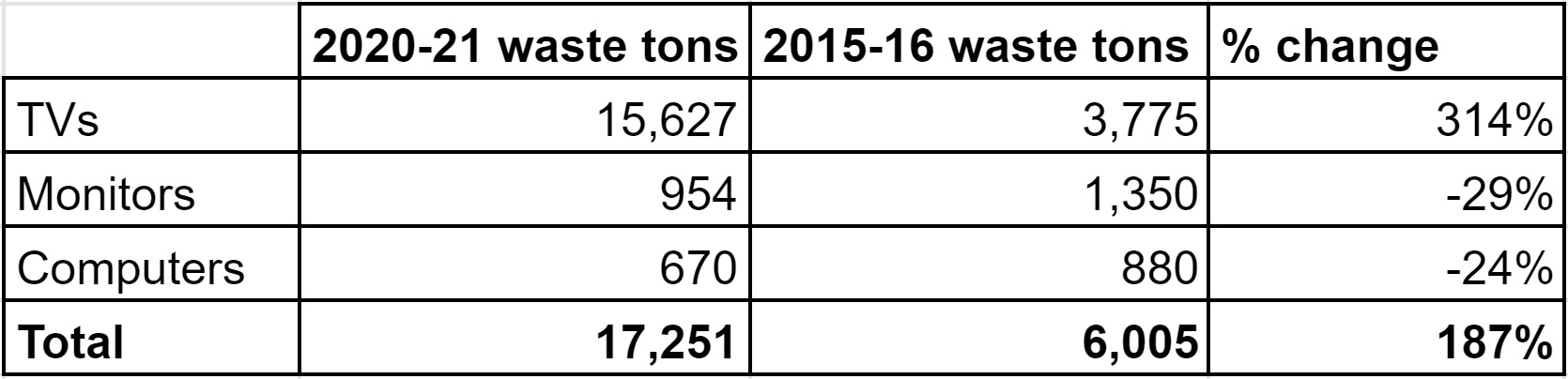
The Department of Ecology publishes data on TVs, monitors and computers collected for recycling. Using those same groupings, the following were the tons disposed of in 2015-16 and 2020-21 (story continues below chart):

But it’s also important to note that the statistical estimates are based on relatively small sample sizes and the error ranges are large. For example, the latest LCD TV data was plus/minus 6,136 tons at the 90% confidence level, which means that Cascadia Consulting Group is 90% certain that the true number of trashed LCD TVs in the statewide waste stream lies somewhere between 1,867 tons and 14,139 tons, which is a very wide span.

Batteries in the garbage

The waste characterization reports also included numbers for single-use and rechargeable dry-cell batteries, which represent not only wasted resources when thrown in the garbage but pose fire risks for collection trucks, transfer stations and landfills.

Again, keeping in mind the wide margins of error, the latest report estimated 1,885 tons of single-use batteries and 702 tons of rechargeable batteries were disposed of in Washington in 2020-21. That was up 82% and 556%, respectively, from the 2015-16 data.

The 2020-21 numbers equal about 0.49 pounds per person for single-use batteries (up from 0.29 pounds in 2015-16) and 0.18 pounds per person for rechargeable batteries (up from 0.03 pounds in 2015-16).
 

Ousei

Tags: CollectionResearch
TweetShare
Jared Paben

Jared Paben

Related Posts

Rice researchers use lemon juice to boost battery recycling

byScott Snowden
April 9, 2026

Rice researchers reported a battery recycling process that uses plasma and mild solvents to recover most metals from black mass...

Plastics Recyclers Have the Capacity to Recycle More. Now Let’s Use It.

Study finds most recycling occurs within 30 miles of access

byBrian Clark Howard
April 8, 2026

Researchers at the University at Buffalo also found that Americans produce similar volumes of plastic package waste regardless of economic...

Minnesota State Capitol

Minnesota watches Oregon as EPR implementation advances

byStefanie Valentic
April 6, 2026

Minnesota's Packaging Waste and Cost Reduction Act passed in 2024 and is still in early implementation, making the infrastructure decisions...

Waste Connection recycling cart in The Dalles, Oregon

First Oregon community expands curbside recycling with EPR funding

byBrian Clark Howard
April 1, 2026

The City of The Dalles in northern Oregon is now rolling out nearly 5,000 new 90-gallon recycling carts to customers...

Packaging sector sees shift from AI pilots to wider use

byScott Snowden
April 1, 2026

AI adoption is expanding across packaging operations as costs fall and use cases widen, though concerns around accountability, ROI and...

GFL closes 8th tuck-in of 2026 with Frontier deal

byStefanie Valentic
April 1, 2026

GFL Environmental has closed its eighth acquisition of 2026, picking up Texas-based Frontier Waste Solutions and adding 24 sites and...

Load More
Next Post

Our top stories from 2021

More Posts

Wineries help create model for film recycling

Wineries help create model for film recycling

April 7, 2026
With RPET in crisis, focus turns to solutions

With RPET in crisis, focus turns to solutions

April 2, 2026
PCA closing Richmond plant

PCA closing Richmond plant

April 2, 2026
End markets, policy key to RPET viability

End markets, policy key to RPET viability

April 8, 2026

Apparel retailer organization challenges SB 707 textile PRO selection

April 2, 2026
Oregon’s Recycling Modernization Act faces injunction

Why EPR’s biggest obstacle might not be legislation

April 6, 2026

Independents complement primary PRO in state EPR

April 6, 2026
UBC stakeholders report on recycling progress

Trump’s Section 232 tariff overhaul provides mixed results for recycling industry

April 7, 2026
WM rolling out curbside acceptance of PP cups 

APR releases first semiannual Design Guide update

April 3, 2026
Minnesota State Capitol

Minnesota watches Oregon as EPR implementation advances

April 6, 2026
Load More

About & Publications

About Us

Staff

Archive

Magazine

Work With Us

Advertise
Jobs
Contact
Terms and Privacy

Newsletter

Get the latest recycling news and analysis delivered to your inbox every week. Stay ahead on industry trends, policy updates, and insights from programs, processors, and innovators.

Subscribe

Welcome Back!

Login to your account below

Forgotten Password?

Retrieve your password

Please enter your username or email address to reset your password.

Log In

Add New Playlist

No Result
View All Result
  • The Latest
  • Analysis
  • Recycling
  • E-Scrap
  • Plastics
  • Policy Now
  • Conferences
    • E-Scrap Conference
    • Plastics Recycling Conference
    • Resource Recycling Conference
    • Textiles Recovery Summit
  • Magazine
  • About Us
  • Advertise
  • Archive
  • Jobs
  • Staff
Subscribe
This website uses cookies. By continuing to use this website you are giving consent to cookies being used. Visit our Privacy and Cookie Policy.