



Resource Recycling
  • The Latest
  • Analysis
    • All
    • Certification Scorecard
    • Industry Announcements
    • Opinion
    SERI works to restore faith in certifications

    Building a defensible E-scrap evidence file

    tires

    The most important decision in tire recycling happens before the shredder

    Intel sign outside of company building.

    Intel’s CapEx tops $20B on server demand while PC volume shrinks

    Google sign on company building with blue sky and clouds above.

    Inside Alphabet’s Q2 results: More capital spending and cloud backlog

    Alpek closing Pennsylvania RPET plant

    Alpek seizing on war-related opportunity 

    Our top stories from March 2023

    Iron Mountain’s data center report: Strong on power, quiet on hardware

  • Conferences
    • Resource Recycling Conference
    • Plastics Recycling Conference
    • E-Scrap: The Longevity Conference
    • Textiles Recovery Summit
  • Publications
    • E-Scrap News
    • Plastics Recycling Update
    • Policy Now
    • Resource Recycling
    • Other Topics
      • All Topics
      • Brand Owners
      • Critical Minerals
      • Glass
      • Grant Watch / RFPs
      • Markets
      • Organics
      • Packaging
      • Research
      • Technology
      • Textiles
Subscribe
No Result
View All Result
Resource Recycling
  • The Latest
  • Analysis
    • All
    • Certification Scorecard
    • Industry Announcements
    • Opinion
    SERI works to restore faith in certifications

    Building a defensible E-scrap evidence file

    tires

    The most important decision in tire recycling happens before the shredder

    Intel sign outside of company building.

    Intel’s CapEx tops $20B on server demand while PC volume shrinks

    Google sign on company building with blue sky and clouds above.

    Inside Alphabet’s Q2 results: More capital spending and cloud backlog

    Alpek closing Pennsylvania RPET plant

    Alpek seizing on war-related opportunity 

    Our top stories from March 2023

    Iron Mountain’s data center report: Strong on power, quiet on hardware

  • Conferences
    • Resource Recycling Conference
    • Plastics Recycling Conference
    • E-Scrap: The Longevity Conference
    • Textiles Recovery Summit
  • Publications
    • E-Scrap News
    • Plastics Recycling Update
    • Policy Now
    • Resource Recycling
    • Other Topics
      • All Topics
      • Brand Owners
      • Critical Minerals
      • Glass
      • Grant Watch / RFPs
      • Markets
      • Organics
      • Packaging
      • Research
      • Technology
      • Textiles
Subscribe
No Result
View All Result
Resource Recycling
No Result
View All Result
Home E-Scrap

Rice researchers use lemon juice to boost battery recycling

byScott Snowden
April 9, 2026
in E-Scrap

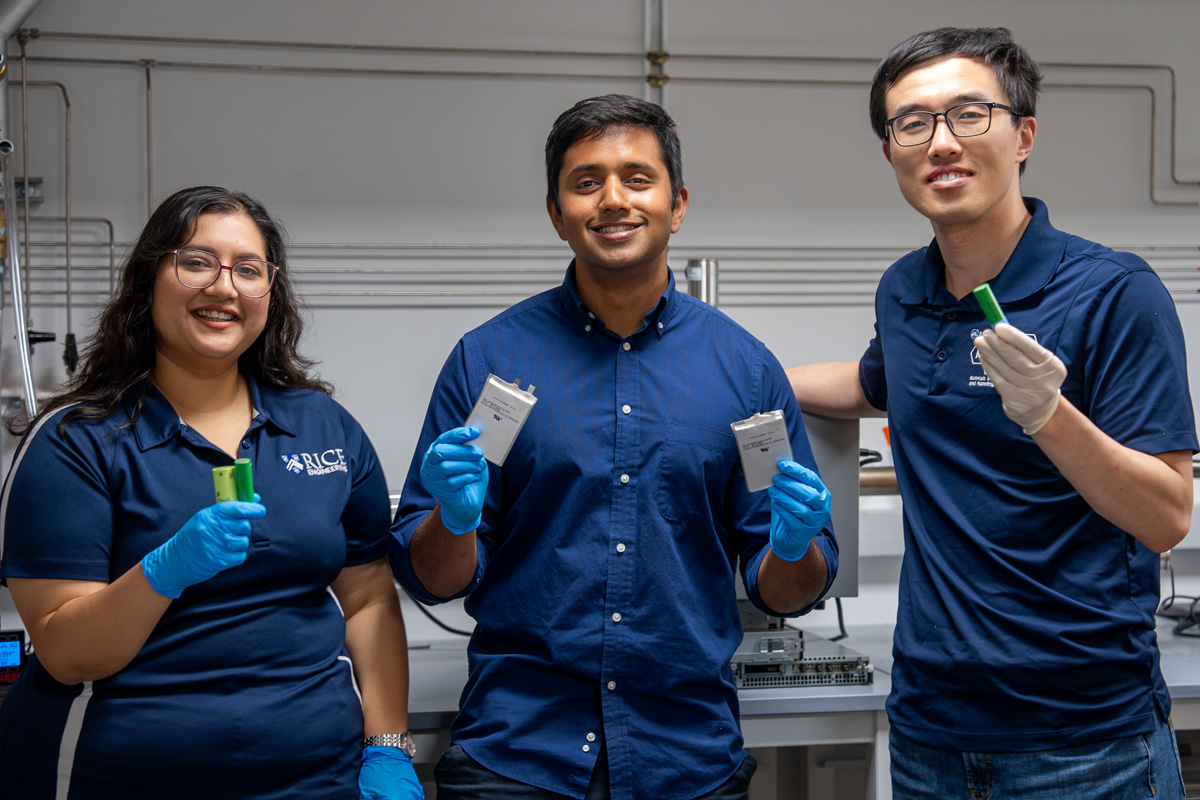
(L-R) Researchers Sohini Bhattacharyya, Gautam Chandrasekhar and Xiang Zhang | Jorge Vidal/Rice University)

Researchers at Rice University in Texas have developed a lithium-ion battery recycling process that uses a brief plasma treatment and mild solvents to recover most of the valuable materials in black mass while also regenerating graphite for reuse in new batteries.

The method uses a 15-minute microwave-induced plasma pretreatment before hydrometallurgical recovery. In their paper, the team reported about 85% selective lithium recovery in water and about 95% recovery of transition metals in citric acid at room temperature, while also producing regenerated graphite that could be reused as an anode material.

“We have a crisis with the critical minerals required to make lithium-ion batteries, like lithium, manganese, nickel and graphite,” said Gautam Chandrasekhar, a doctoral student in materials science and nanoengineering at Rice and a first author on the study. “We were trying to develop new technologies for recycling these batteries.”

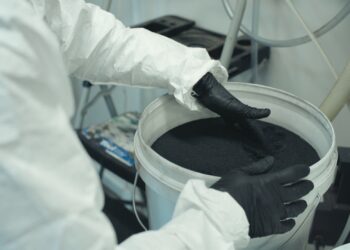
The work focuses on black mass, the shredded battery material that contains cathode metals as well as graphite from the anode and points to a possible lower-impact route for recovering minerals that remain under pressure in global supply chains.

Graphite recovery emerges as key factor

Conventional recycling routes can rely on high temperatures, strong acids or multiple processing steps and while metal recovery has drawn most of the attention, graphite often emerges too damaged for battery reuse. That matters because graphite is a major component of lithium-ion batteries by weight and, as researchers noted in a related review article, remains central to battery manufacturing even as supply and sustainability concerns intensify.

In the newly pioneered process, the plasma step changes the structure of the cathode material in ways that make downstream extraction easier in weaker solvents. Chandrasekhar said the group screened several environmentally friendly acids before settling on citric acid acquired from lemons.

“We were screening different environmentally friendly acids, and we figured out that citric acid works better,” he said.

After the metals are leached out, the remaining material consists largely of graphite, which the researchers found had been improved by the plasma treatment. According to Chandrasekhar, that result was especially striking because the team did not initially expect the recovered graphite to perform well when returned to a battery.

“What remains is graphite, which is regenerated, so we could use it again in batteries,” he said.

The group said the pretreatment could be added ahead of existing hydrometallurgical systems rather than requiring a wholly separate recycling route, a detail that could matter if the technology moves beyond the lab.

Scale-up and chemistry questions remain

Chandrasekhar said the team is already thinking about commercialization and scale-up, though he also described the current paper as an early step rather than a finished industrial solution.

“We are in the process of commercializing this technology,” he said. “There is a lot of room for improvement.”

That further work includes finding cheaper gas mixtures to generate the plasma and determining how the process performs at larger volumes. The paper reported that a hydrogen and nitrogen plasma mixture was the most effective among the gas compositions evaluated, and Chandrasekhar said cost-effective alternatives are now part of the next phase of development.

“We are looking at more cost-effective gas compositions to create the plasma,” he said.

He also cautioned against treating the results as universal across all lithium-ion battery chemistries. The black mass used in the study contained nickel manganese cobalt oxide and lithium cobalt oxide cathode materials and Chandrasekhar said the team has not yet tested the process on other widely used chemistries such as lithium iron phosphate or nickel cobalt aluminum oxide.

Even with that caveat, the work stands out for treating graphite as more than a residual material. Chandrasekhar said the remaining losses were largely tied to handling steps such as filtration rather than the creation of a separate unusable byproduct.

The research was carried out by Chandrasekhar, Sohini Bhattacharyya, Xiang Zhang and colleagues in the group of Pulickel Ajayan, Professor of Engineering at Rice. The team has patented the technology and is moving toward commercialization.

Tags: Critical MineralsResearch
TweetShare
Scott Snowden

Scott Snowden

Scott has been a reporter for over 25 years, covering a diverse range of subjects from sub-atomic cold fusion physics to scuba diving off the Great Barrier Reef. He's now deeply invested in the world of recycling, green tech and environmental preservation.

Related Posts

Innovation. Partnership. Circular value.

Innovation. Partnership. Circular value.

bySibanye-Stillwater
August 1, 2026

As industries around the world accelerate their transition towards a circular economy, precious metals recycling is evolving from a necessary...

Spin-off lets Linca focus on battery mineral recovery

GAO: Policy, tech updates needed to bolster domestic mineral supply

byPaul Lane
July 30, 2026

Federal investigators say short- and long-term solutions are needed to decrease the nation’s reliance upon foreign-based minerals.

U.S. Capitol building in Washington, D.C.

House committees advance critical mineral bills

byPaul Lane
July 27, 2026

Congressional votes earlier this month advanced three bills that would expand the nation’s critical mineral recycling capabilities. A subcommittee within...

Penn State professor Maryam Shahri speaks at the PROP conference in Lancaster, Pennsylvania July 23, 2026.

How to get more people to recycle

byBrian Clark Howard
July 24, 2026

Harness the power of behavioral marketing, panelists said at the PROP conference in Pennsylvania.

Spin-off lets Linca focus on battery mineral recovery

Spin-off lets Linca focus on battery mineral recovery

byPaul Lane
July 23, 2026

The New Zealand-based company will focus on getting its black mass retrieval technology ready for use in a demonstration facility...

May pricing bullish for most bales

Nth Cycle joins SPAC to IPO in US critical minerals push

byStefanie Valentic
July 22, 2026

Nth Cycle is merging with a SPAC to go public, joining a growing wave of critical minerals companies racing to...

Load More
Next Post
Wolframite ore, the primary ore of tungsten from Altai, Russia

Tungsten scrap export controls draw industry attention

2026 Buyers’ Guide

Equipment, services and technology suppliers serving the recycling industry.

Browse the Guide

More Posts

State policy is redefining plastics recycling in the US

State policy is redefining plastics recycling in the US

February 19, 2026
Closeup of a printed circuitboard

Hardware demand puts new focus on parts harvesting

June 5, 2026
Apple store

Apple leads on inputs, faces questions on ITAD

May 1, 2026
Illinois chemical recycling plant moving forward

Illinois chemical recycling plant moving forward

April 18, 2023
Analysis: circular design still elusive in laptops

PC shipments grew in Q1, but questions remain

April 23, 2026

In other news: May 2, 2016

May 2, 2016
Mexican Coke bottler to invest $1bn in ops this year

Mexican Coke bottler to invest $1bn in ops this year

March 25, 2026
Ten e-scrap projects receive federal prize funds

Recycling rates for rare earths could double by 2040

July 17, 2026

ITAD is moving past its adolescent phase: beyond end-of-life

June 10, 2026

Recycled copper output climbs as market shows surplus

April 6, 2026
Load More

About & Publications

About Us

Staff

Archive

Magazine

Work With Us

Advertise
Jobs
Contact
Terms and Privacy

Newsletter

Get the latest recycling news and analysis delivered to your inbox every week. Stay ahead on industry trends, policy updates, and insights from programs, processors, and innovators.

Subscribe

Welcome Back!

Login to your account below

Forgotten Password?

Retrieve your password

Please enter your username or email address to reset your password.

Log In

Add New Playlist

No Result
View All Result
  • The Latest
  • Analysis
  • Recycling
  • E-Scrap
  • Plastics
  • Policy Now
  • Conferences
    • E-Scrap Conference
    • Plastics Recycling Conference
    • Resource Recycling Conference
    • Textiles Recovery Summit
  • Magazine
  • About Us
  • Advertise
  • Archive
  • Jobs
  • Staff
Subscribe
This website uses cookies. By continuing to use this website you are giving consent to cookies being used. Visit our Privacy and Cookie Policy.