





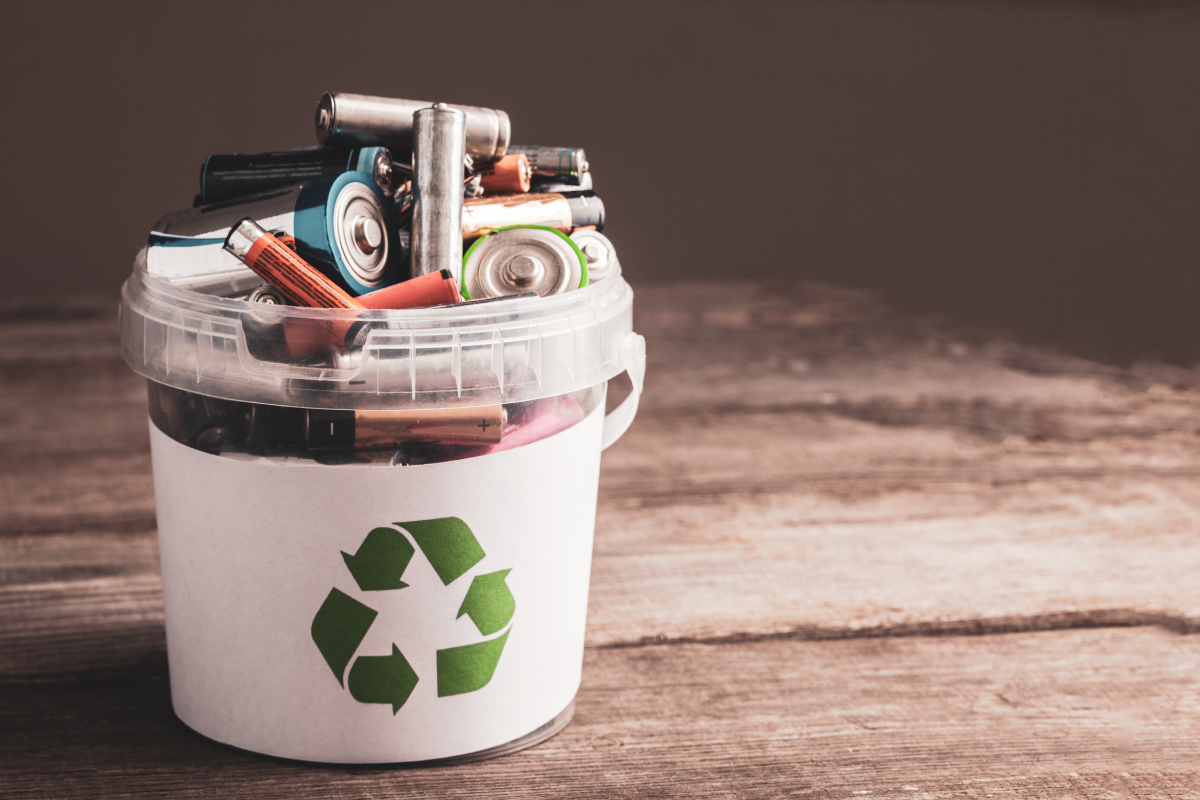
The U.S. EPA has held a series of expert working groups, aiming to find the most effective strategies to keep batteries out of the garbage and recycling streams. For a growing number of municipalities, including one major U.S. city, that is coming to mean offering the convenience of curbside collection.
The EPA’s “Battery Collection Best Practices and Battery Labeling Guidelines” project, spurred by the Bipartisan Infrastructure Law and authorized with $25 million in funding by Congress, will ultimately generate a toolkit for local governments to use when implementing battery collection programs, and a set of voluntary labeling guidelines for use in crafting battery labels. Both resources are due in 2026.
The agency kicked off its work sessions on collection and labeling in March, and has held seven sessions throughout the year, covering collection, storage, transport and labeling of small-format batteries, a category that includes the bulk of removable and embedded batteries in consumer electronics. A summary of these work sessions is available on the EPA’s website.
The EPA is now moving into examining mid-format batteries, which includes batteries in e-bikes and e-scooters. The first session, set for Sept. 12, will cover policies, practices and trends in managing these batteries.
The EPA is developing a report to Congress on battery practices, aiming for publication later this year.
“This report will identify existing best practices, describe the current state of battery collection, and lay out EPA’s next steps,” the agency wrote. “After the publication of this report, EPA will seek to capture and share new and innovative best practices to complement the report.”
As the federal agency continues to push the conversation forward in battery management, some municipalities are exploring how to increase battery collection convenience for residents.
A major municipality collects at the curb
In Portland, Oregon, haulers recently began accepting batteries at the curb, without requiring any special advance notice or registration by the household. The city announced the program in June.
The city is taking advantage of a quirk of its collection program to facilitate battery acceptance: Although it’s a single-stream recycling program, Portland has a “glass on the side” system, in which glass is collected in a smaller container separate from the blue bin. Besides keeping the city’s fiber stream cleaner than recycling programs where glass is commingled with other recyclables, the separate glass container provides a convenient existing receptacle that’s free of flammable materials, where batteries can be placed for collection.
Using the glass container also offered an operational advantage for the haulers whose drivers and trucks will be handling the batteries. Eben Polk, solid waste manager for the city, said one goal was to minimize the need for the driver to get out of the collection truck.
“We know they always have to get out of the truck to handle glass, so putting another material that they would also have to get out of the truck for into that category, is sort of a cost-saving option,” Polk said.
The service is open to residents of single-family homes, duplexes, triplexes and fourplexes. They are directed to place batteries in a one-quart bag and put them in the glass collection container at the curb.
There are additional directions based on battery chemistry. Alkaline batteries can be placed directly into the bag with no further prep work, but other batteries must have both ends taped with clear tape. That’s to avoid the terminals coming into contact with metal and potentially sparking a fire.
The city also limits the list of accepted batteries to exclude embedded batteries within electronics, as well as common household electronics batteries, like those in computers and cell phones.
Once collected from the curb, the batteries will be taken to any of the five MRFs in the Portland area, which have received expanded DEQ approval to accept batteries. The MRFs will facilitate getting the batteries to a battery processor to actually recycle the materials. How they’re processed varies by chemistry – alkaline batteries often get shredded and the resulting metal fractions get sent to a smelter for metals recovery, while there are a number of methods currently used to process lithium-ion batteries, often involving hydrometallurgy.
Other collection approaches and challenges
Before Oregon’s largest municipality adopted the approach, the glass-on-the-side system of battery collection was already employed in smaller municipalities near Portland for multiple years. Gresham, Oregon, began collecting batteries this way in July 2022, while municipalities in Clackamas County, Oregon, started up the service later that year.
A different common collection system is in place in Clark County, Washington, which is just across the Columbia River from Portland. There, hauler Waste Connections allows residents to place a clear plastic bag of household batteries on top of the lid of their recycling cart.
This approach, which is also common in municipalities across California, relies on the driver to spot the bag and manually place it in a separate part of the truck. In Clark County, Waste Connections drivers put the batteries in trays on the side of the trucks, the county noted in a detailed report outlining the program. The batteries are taken with other recyclables to the local MRF, where they’re sorted by hand as they’re removed from the truck, and arranged for transport to a battery recycling site.
The Clark County report, published in May 2020, outlined the numerous challenges and considerations involved in curbside collection, both in general and specific to Clark County’s method. Summarizing that curbside battery collection is “logistically challenging,” the report points to the rapid increase of end-of-life batteries, the inherent fire dangers, the diversity of battery types and chemistries, and constantly changing technology making it hard to adapt in the recycling sector, as key challenges to effective curbside battery collection.
The report also noted that Call2Recycle, a leading battery stewardship group that operates collection programs, noted in 2018 that given the many challenges, collecting batteries in curbside programs “is seldom wise.”
As one example of the logistical challenge, the report notes that “Clark County’s curbside battery recycling relies greatly on the drivers seeing batteries on the recycling carts from within the truck.”
“Recycling trucks use automated collection equipment to empty carts without needing the driver to exit the vehicle,” the report adds. “As a result, the driver can miss the batteries, causing them to fall onto the ground or in with the mixed recycling when the cart is emptied into the truck. Collecting batteries on mixed recycling lids in this way allows room for error, and places a burden on the driver who is already navigating many dynamics.”
Outreach is essential
The Clark County report suggested several options to improve battery collection, ranging from adding different storage compartments to trucks, to overhauling the program altogether. It noted that “any changes made to recycling programs will require support from outreach staff to ensure effective and positive communications with the public.”
Back in Portland, the city’s outreach team has taken a multi-pronged approach to educating residents about the new program.
“If someone just hears ‘battery recycling,’ they might be like, ‘Oh, it’s a blue bin thing, because recycling is the blue bin,'” said Lindsey Maser, communications and outreach coordinator for the City of Portland Bureau of Planning and Sustainability.
She explained the outreach team is making a concerted effort to emphasize “batteries with glass” when highlighting the program, hoping to build in that association from the beginning.
“The last thing we want is for people to get that bag of batteries and toss it in their blue bin, which is causing the problems in the first place,” Maser said.
Other outreach considerations in Portland include making clear that the service is not available in multifamily complexes, where glass is collected in roll-carts, and simply hammering home why it’s important to keep the batteries out of the garbage and single-stream bin.
The good news, Maser said, is that there is a substantial amount of existing educational outreach material available for municipalities to pull from, including resources from Call2Recycle, The Recycling Partnership and the ongoing U.S. EPA work sessions.