






Editor’s note: With 25 states and the District of Columbia covering 66% of the US population under e-scrap laws, jurisdictions continue to address collection and funding challenges as programs and technology evolve.
This EPR Update series in E-Scrap News examines the latest policy updates from four states navigating these regulatory shifts. Read part one here and part two here.
Battery recycling legislation is moving through several states, as evidenced at eSummit in Minneapolis in September.
Illinois
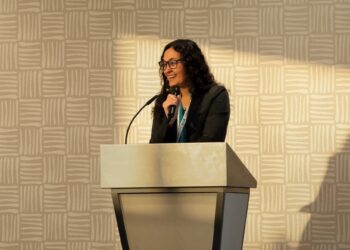
At the event, Jason Linnell of the National Center for Electronics Recycling (NCER) discussed an amendment to Illinois HB 3098 Consumer Electronics Recycling Act (CERA) at this year’s eSummit in Minneapolis. The 2025 CERA amendment modernizes the original electronics recovery law legislators first passed in 2017.
“It adds to the definition of covered devices to include home audio components and peripherals. So, a few new devices may be covered, not dramatic expansion like we’re seeing in other states, like in Oregon, or some of the things that are added in Hawai’i, but we do have some more products being added, and that again, contributes to the differences that we have among states and the products that are being covered,” he said.
Linnell added that the amendment also changes who is eligible for collection services. Over half of the collection volume is covered in Illinois and even more than half in South Carolina by private collection networks, providing services in counties that may not opt into the program, he said.
Illinois was one of the first to move away from weight-based targets to manufacturer responsibility for collected devices.
“The challenge in these programs, as we know, is that over the years, pounds have slowly been coming down in a number of programs, not due to having fewer collection sites or offering fewer services,” Linnell explained. “It’s the weight of the devices as they’re coming back in whether their average weights are lower or just differences in the types of devices that we’re seeing coming into the programs as the mix changes.”
To address this challenge, the state restructured its program to a manufacturing clearinghouse model which allows Illinois counties to opt-in rather than continuing to chase declining weight targets. Minimum collection site requirements are based on population density.
“In the beginning this program, up until now, has been just for households. It clearly defines household electronics as the items that are covered and only households or consumers could participate in these free programs. It changes that to something that we see in other states, which is anyone having seven or fewer covered devices at a time,” he said.
“That could be a small business, it could be a small school, it could be any type of entity. If you’re going to a collection site and you have seven or fewer covered devices, they’re not going to question whether you’re a household or whether what type of entity you are. We’ve seen that with the Oregon program since the beginning and many other states. It works relatively well to make sure that collection sites aren’t having to determine if you are really a household.”
A clearinghouse, or central body, coordinates with entities such as Manufacturers Recycling Management Company (MRM), Dynamic Lifecycle Innovations, ERI, Sims, and Reverse Logistics Group, holds contracts directly with manufacturers and manages relationships with collectors and recyclers. A group plan, containing pools of manufacturers, handles a specific portion of the collection obligations assigned by the clearinghouse. Coverage areas are assigned proportionately based on market share.
“Unlike Oregon, there’s a manufacturer registration fee that’s paid directly to the state. It’s one of the states that has a flat fee, I believe, not based on their size. But then the state does also have to review and approve the clearinghouse plan that we submit every July to the state for approval, showing all the counties who opted in the collection sites that are going to be in operation in the next year, or the collection events, and then all the manufacturers who are participating in the clearinghouse program,” Linnell said.
The pooled approach allows manufacturers to collectively meet the state’s convenience requirements more efficiently than if each operated independently, he said.
Linnell further alluded to Oregon’s E-cycles state program, which will include device categories such as game consoles that manufacturers will now be required to register.
Oregon
MRM’s Tricia Conroy discussed changes to Oregon’s E-Cycles program, scheduled to take effect in January 2026. MRM was among the companies that submitted producer responsibility organization (PRO) proposals to the state earlier this year, both of which were rejected.
Conroy said an expansion on the types of devices covered and accepted at collection sites as well as convenience requirements will modernize the program, which first launched in 2009.
“There’s much more emphasis on ensuring equitable service … one per 10,000 people. There’s much more specificity about equitable service in underserved communities. There’s more detailed geographic requirements now and there’s a fair financial compensation requirement for manufacturers,” she said.
The updated requirements formalize environmentally sound management practices for rural areas. The new rules now specify collection site locations and quantities that must be maintained.
“The biggest difference is that 95% of the residents must be within 15 miles of a collection site. I’m from Minnesota, so Greater Minnesota, that’s a challenge. And if you’ve been to Eastern Oregon, that’s a challenge. So that is one of the bigger changes that we’re seeing, there’s much more specificity in the number of sites needed per 10,000 people.”
Furthermore, the updates establish a formal mechanism for a leading PRO and the NCER will coordinate the state’s program going forward.
“It allows some competition in the marketplace, but also allows coordination. So the DEQ has one point of contact and control,” Conroy said. “The market manufacturers will still be responsible for their market share of each product category. That’s real similar to Illinois in the way that will be calculated … They are required to cover their market share of everything that comes in, and that’s going to be based on actual collections from previous years.
Conroy also spoke about additional requirements from manufacturers, saying there will be a greater emphasis on public education, GPS tracking and evaluation components for the DEQ.
“It changes their administrative requirements pretty significantly. They continue oversight of plants, but they have a much more stepped back role, sent to the coordinating body and PROs,” she said, adding, “They have substantially increased the number of the items that can be included and dropped off at collection locations.”
“Oregon has always required pretty detailed disclosure of the downstream markets for their materials. We’ve always had to provide a fair amount of information on the actual recycling downstreams and markets. And I think they expect now the PROs to do the following up on that,” Conroy said.