





Correction: This article was updated to omit an error about a Glencore smelter.
A UK-based startup is testing a different approach to extracting metals from electronic scrap, one that could influence how downstream recovery fits into the IT asset disposition and recycling chain.
DEScycle, which is commissioning a demonstration facility in Teesside in July, with a trial of Cisco-derived circuit boards running at demonstration scale, has developed a modular metals recovery process based on what it calls ionometallurgy, a chemistry-driven alternative to traditional smelting and hydrometallurgical systems.
The Cisco relationship runs deeper than a one-off trial. According to DEScycle co-founder and Chief Commercial Officer Fred White, the company first ran lab-scale tests on Cisco material before Cisco made an equity investment in the company’s 2024 Series A round. The current trials at DEScycle’s demonstration facility in Teesside repeat those tests at industrial scale, generating recovery data, techno-economic analysis, and sustainability traceability that Cisco will use to evaluate pulling recovered metals back into its own supply chain.
While pilot projects between OEMs and recycling technology firms are common, the underlying model DEScycle is pursuing is more structural. Rather than improving recovery yields within the existing smelter-based system, the company is attempting to bypass it.
A different approach to metals recovery
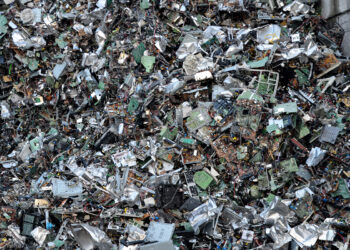
Today, most high-value fractions from e-scrap, particularly printed circuit boards, ultimately move through a global smelting network. Material is typically aggregated, traded, and commingled before entering large-scale facilities designed to process hundreds of thousands or millions of tons annually. That system has remained largely unchanged for decades.
DEScycle’s approach is built on a different premise. Its process uses deep eutectic solvents, a class of liquid salts, to selectively dissolve and recover metals at relatively low temperatures. According to the company, this enables separation of precious and critical metals without the high energy inputs or scale requirements associated with smelting.
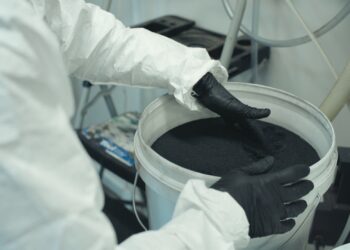
In an interview with Resource Recycling, White said the company has averaged metal recovery rates above 99% across three years of lab piloting, with complete metal dissolution occurring within 15 minutes and without added heat or pressure. The process is designed to separate metals sequentially, allowing for high-purity outputs rather than mixed concentrates.
Technically, the process uses a two-step leaching sequence: first dissolving all metals except gold, then dissolving gold in a separate step to yield a high-purity gold product. The remaining metals, silver, palladium, copper, tin, and iron, are then selectively recovered from solution in sequence. The DES chemistry is itself recovered and reused across cycles, which DEScycle cites as a significant operating-cost differentiator against acid-based hydrometallurgy and energy-intensive pyrometallurgical smelting.
More importantly, the footprint is radically smaller. A new copper smelter typically requires $2–3 billion in capital and 500,000 to 1 million square feet of land. DEScycle targets deployments in the low tens of millions of dollars, operating within a 30,000 to 40,000 square foot industrial building. That order-of-magnitude difference reshapes who can realistically build metals-recovery infrastructure and where it can sit — enabling co-location with upstream recyclers and ITAD operators rather than aggregation through the global smelting network.
DEScycle has raised approximately £15 million across a 2023 Pre-Series A round and a November 2024 Series A led by BGF and Vorwerk Ventures, with participation from Cisco Investments, Kadmos Capital, and Nesta. Mitsubishi Corporation joined as a strategic investor in 2025 and signed a preferred-partner agreement in March 2026 to explore deployment in Japan. That capital stack provides runway through demonstration-scale validation, though commercial deployment at the planned Gateshead facility — a 5,000-tonne-per-year plant developed with joint venture partner GAP Group — will require additional financing.
An opening created by smelter economics
The timing of DEScycle’s demonstration launch coincides with visible structural stress in the incumbent smelting industry. Chinese overcapacity has driven copper treatment and refining charges — the fees smelters earn for processing miners’ concentrate — to roughly zero, meaning smelters are now processing material essentially for free. That pressure has triggered a cascade of smelter distress through 2025: Mitsubishi announced the shutdown of a Japanese smelter, and multiple operators have required bailouts running into hundreds of millions of dollars.
The e-scrap market is structurally separate from copper concentrate smelting, but most e-scrap today is processed through copper-concentrate smelters as a secondary feed. When those smelters are under margin pressure, the economics of e-scrap processing also come under pressure. For an alternative technology entering the market, the window to demonstrate credible economics against a weakened incumbent is meaningfully wider than it would have been two years ago. As White framed it, “It doesn’t really make much sense building more of these smelters that aren’t economic anyway. Let’s build out this small-scale infrastructure, and we can do it faster and cheaper than smelting.”
Implications for ITAD and upstream recyclers
If the model proves viable beyond demonstration scale, it could influence how value is captured in the e-scrap chain.
Today, ITAD providers and recyclers typically depend on smelters as the final step for material recovery. That relationship comes with long payment cycles and limited visibility into how materials are ultimately processed once they leave the facility. White said DEScycle’s UK upstream partners currently wait roughly six months for payment from smelters. Under a co-located DEScycle model, he said, payment cycles would compress to approximately one month — tracked to when DEScycle itself is paid for the recovered metal outputs rather than to the smelter’s treatment schedule.
A distributed recovery model could change that dynamic in other ways as well. By processing material closer to the source, recyclers could potentially retain more value in-country and offer improved traceability on recovered metals. DEScycle’s system is designed to track materials through the recovery process and link outputs back to specific feedstock streams — an attribute that aligns with growing OEM interest in closed-loop supply chains and scope-3 emissions reporting.
The company is also explicitly targeting partnerships with ITAD firms and upstream processors, positioning its technology as a potential midstream replacement for smelting rather than a competing front-end recycling solution. White said the partnership model is oriented around derisking feedstock access, which he described as the principal commercial risk. The UK joint venture with GAP Group North East, one of the country’s largest WEEE recyclers, addresses this domestically; replicating that structure in Japan, Europe, and the United States is one of the company’s central scaling challenges.
A challenging path to scale
Despite the potential, the technology remains at an early stage. The Teesside facility represents a demonstration-scale operation, intended to validate performance at larger volumes and generate economic data. Moving from lab results to consistent industrial output remains a significant hurdle, particularly in a sector where process reliability and throughput determine commercial viability.
Cisco’s involvement provides both commercial validation and operational access to representative feedstock, which matters in a category where lab performance and industrial performance frequently diverge.
DEScycle is also entering a market dominated by large, established players, including global smelting companies that operate at massive scale and are deeply integrated into metals markets. Even if alternative processing methods prove technically effective, competing on cost, logistics, and buyer acceptance will be complex.
At the same time, the broader market context may provide an opening. Smelters have faced pressure from fluctuating treatment charges, overcapacity in some regions, and increasing regulatory scrutiny around environmental performance. Those factors have renewed interest in alternative recovery approaches, particularly ones that can operate at smaller scale and within domestic markets, a theme reinforced by critical-minerals policy frameworks now in effect across the US, UK, EU, and Japan.
Early signal, not a conclusion
For now, DEScycle’s work with Cisco is best viewed as an early signal rather than a definitive shift. Still, the concept addresses a long-standing constraint in the e-scrap system: the reliance on a centralized, capital-intensive smelting infrastructure that is itself under visible economic pressure. If distributed recovery technologies can deliver comparable economics and performance, they could reshape how value flows through the recycling chain. For ITAD providers and recyclers, that possibility is worth watching closely, and the next twelve months of demonstration-plant data, beginning in July, will be the primary evidence base for judging it.