Resource Recycling
  • The Latest
  • Analysis
    • All
    • Certification Scorecard
    • Industry Announcements
    • Opinion
    NJ’s PCR delay risks making its own excuse permanently true

    NJ’s PCR delay risks making its own excuse permanently true

    E-scrap magnet recycling company scales up

    Why only some rare-earth sources are economically viable

    e-Stewards to develop an ITAD-specific standard

    Certification scorecard — week of Sept. 21

    Who should pay for lithium-ion battery fire damage?

    America’s critical-materials buildout has a feedstock problem

    Certification scorecard – week of Sept. 14

  • Conferences
    • Resource Recycling Conference
    • Plastics Recycling Conference
    • E-Scrap: The Longevity Conference
    • Textiles Recovery Summit
  • Publications
    • E-Scrap News
    • Plastics Recycling Update
    • Policy Now
    • Resource Recycling
    • Other Topics
      • All Topics
      • Brand Owners
      • Critical Minerals
      • Glass
      • Grant Watch / RFPs
      • Markets
      • Organics
      • Packaging
      • Research
      • Technology
      • Textiles
Subscribe
No Result
View All Result
Resource Recycling
No Result
View All Result
Home E-Scrap

E-plastics recovery line opens in Canada

byPaul Lane
April 28, 2026
in E-Scrap, Plastics
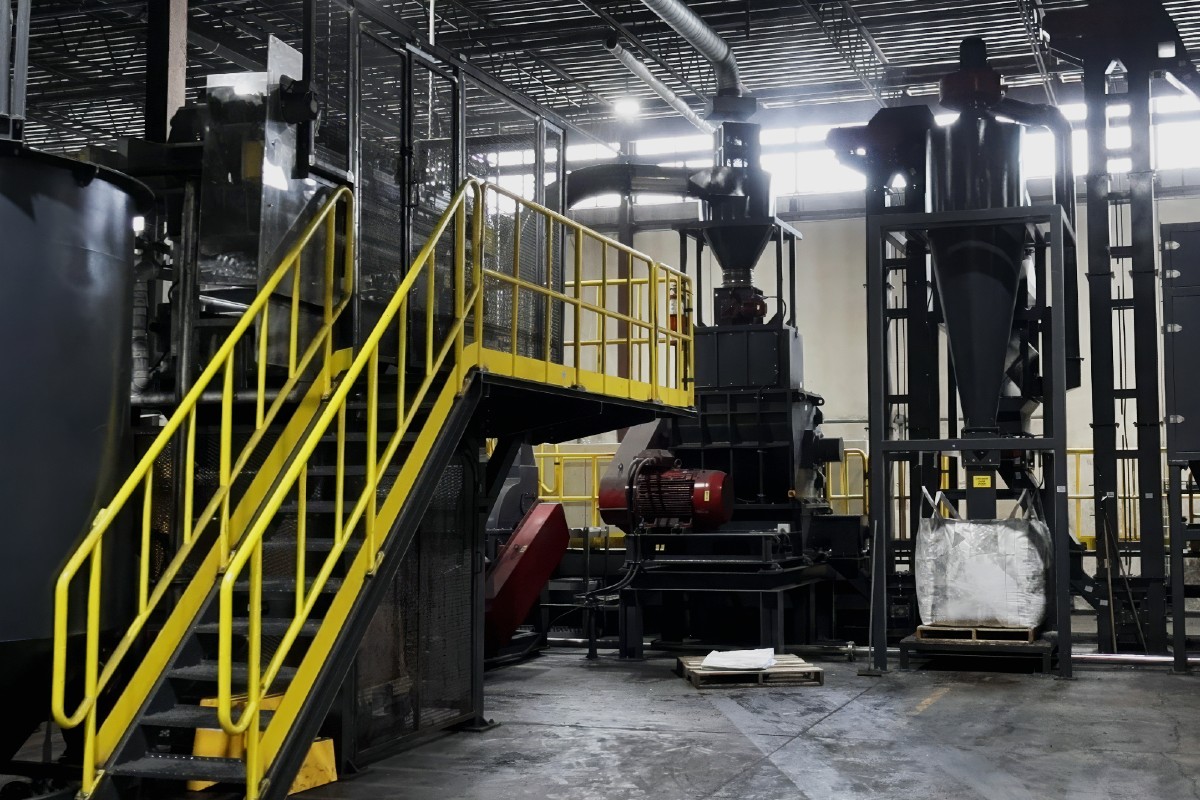
Float-sink technology at the Quantum Lifecycle Partners facility in Toronto, Canada enables the processing of e-plastics.

Float-sink technology at the Quantum Lifecycle Partners facility in Toronto, Canada enables the processing of e-plastics. Photo courtesy of Quantum LP

A multi-million-dollar investment will enable a Canadian electronics recycling company to put end-of-life plastics back to use.

Toronto-based Quantum Lifecycle Partners cut the ribbon on its advanced plastics recovery line April 28. The $4 million system integrates into the company’s $10 million electronics infrastructure to allow for mixed polymer recycling of hard-to-recycle plastics found in casings, housing and components recovered from consumer electronics.

The recovery line uses float-sink technology to recycle complex mixed plastics, according to Clayton Miller, the company’s vice president for recycling. The system shreds items and strips materials of bromine and impurities, leaving pure polymers that are converted into e-plastic flake that performs comparably to flakes from virgin feedstock.

“When it comes to end-of-life recycling, one of the more challenging pieces has always been plastics,” Miller said. “We were growing concerned and took steps to mitigate it.”

Making the flake contaminant-free was a key part of that process, he said. Removing brominated flame retardants that are used in some electronics ensures the product complies with standards set by the Basel Convention, which restricts the international transport of potentially hazardous materials; bromine falls onto that list due to its health and environmental impacts. That allows companies to buy the flake, pelletize and convert it into products of their choosing without worry, keeping more materials out of landfills.

Quantum’s feedstock comes from across Canada, as the company partners with municipalities and businesses to obtain electronics. The line has enough capacity to handle all the plastic Quantum generates internally, Miller said, and the company is buying shred outputs from other e-recyclers, allowing Quantum to upgrade its commodity output and act as a downstream processor.

The system can process around 4 metric tons an hour. It’s been operational for around three months without issue, Miller said, and is scalable to meet growing demand amid Ontario’s extended producer responsibility framework, which will require more manufacturers to seek domestic processing options. 

“This investment reflects our confidence in Ontario’s approach to electronics recycling – a competitive framework that rewards operators who perform, invest and innovate,” said Gary Diamond, Quantum president. 

But the potential reach extends beyond Canada, Miller said. The company is looking to get a test load from a New York state-based company to see how international processing goes.

“We see this as a North American solution,” said Miller, who noted the system can help producers close the loop on their materials. “It’s the kind of infrastructure that makes a genuinely circular economy for electronics more than an aspiration.”

The new line also helps Quantum live up to its sustainability goals. Calling Quantum a life cycle services company, Miller said it’s reusing and refurbishing more devices than it recycles, but there’s room to do more on all fronts – especially with e-recycling, a segment in which the U.S. Environmental Protection Agency estimates only 24% of materials are recycled; plastics from electronic items are recycled at roughly a 6% rate.

“Part of our evolution is to be more than a recycler. We want to help producers and companies navigate the entire life cycle. This is just another piece in that journey,” he said. “We think this plastics line is another example of us doing what we say we are going to do.”


Tags: CanadaE-PlasticsElectronicsHard-to-Recycle Materials
TweetShare
Paul Lane

Paul Lane

Paul Lane is an award-winning journalist who joined Resource Recycling in June 2026 after working for several years in corporate communications and at various local news outlets. He can be reached at paul.lane@dev.resource-recycling.com.

Related Posts

Cutting healthcare plastics could save $18B

Report provides path to reduce medical e-scrap

byPaul Lane
September 25, 2026

The European report found that circularity in medical devices is possible through several potential initiatives.

Bin to Better gets students involved in reuse, recycling

Bin to Better gets students involved in reuse, recycling

byPaul Lane
September 24, 2026

E-scrap among three focus areas for student-run, California-based environmental advocacy group.

E-scrap magnet recycling company scales up

Why only some rare-earth sources are economically viable

byDavid Daoud
September 24, 2026

Rare-earth recycling economics depend on several factors, and there is no single price or date that makes the process pencil...

Who should pay for lithium-ion battery fire damage?

byDavid Daoud
September 21, 2026

Fires continue to be a major threat to the recycling industry, even as states explore new policy solutions.

America’s critical-materials buildout has a feedstock problem

byDavid Daoud
September 18, 2026

As the US invests in critical-minerals capacity will facilities have enough material to process?

Google Pixel 6 phone

Google makes repairability part of design ethos

byBrian Clark Howard
September 16, 2026

The tech titan supports the right-to-repair movement in several key ways.

Load More
Next Post
Our top stories from April 2022

Peters-Michaud named CEO, Houghton chair of Sage Sustainable Electronics

2026 Buyers’ Guide

Equipment, services and technology suppliers serving the recycling industry.

Browse the Guide

More Posts

Apple store

Apple leads on inputs, faces questions on ITAD

May 1, 2026

In other news: May 2, 2016

May 2, 2016
Closeup of a printed circuitboard

Hardware demand puts new focus on parts harvesting

June 5, 2026
Data erasure firm expands wearable device capabilities

Apple hits 30% recycled content, debuts new recovery tech

April 17, 2026
Textile EPR and the definition of recycling

Textile Exchange reports progress in production

September 22, 2026

America’s critical-materials buildout has a feedstock problem

September 18, 2026
iFixit launches 2-week circuit board training course

Printed circuit board (PCB) recycling explained

September 9, 2026
Intel sign outside of company building.

Intel’s CapEx tops $20B on server demand while PC volume shrinks

July 29, 2026
Server resale values surge in AI-driven markets

Server resale values surge in AI-driven markets

January 22, 2026
SK Tes on track to meet 2030 ITAD goal

SK Tes on track to meet 2030 ITAD goal

August 27, 2026
Load More

About & Publications

About Us

Staff

Archive

Magazines

Work With Us

Advertise
Jobs
Contact
Terms and Privacy

Newsletters

Get the latest recycling news and analysis delivered to your inbox every week. Stay ahead on industry trends, policy updates, and insights from programs, processors, and innovators.

Subscribe

Welcome Back!

Login to your account below

Forgotten Password?

Retrieve your password

Please enter your username or email address to reset your password.

Log In

Add New Playlist

No Result
View All Result
  • The Latest
  • Analysis
  • Recycling
  • E-Scrap
  • Plastics
  • Policy Now
  • Conferences
    • E-Scrap Conference
    • Plastics Recycling Conference
    • Resource Recycling Conference
    • Textiles Recovery Summit
  • Magazines
  • About Us
  • Advertise
  • Archive
  • Jobs
  • Staff
Subscribe
This website uses cookies. By continuing to use this website you are giving consent to cookies being used. Visit our Privacy and Cookie Policy.