



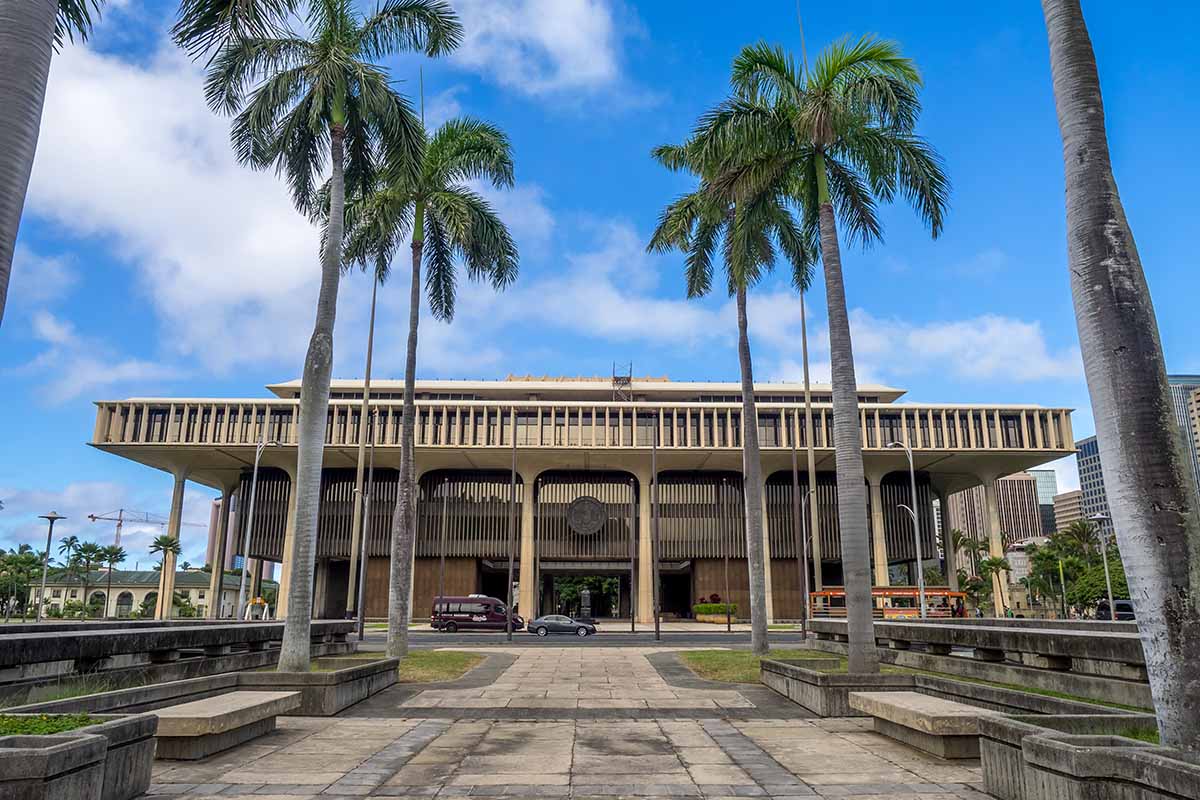
The third year of Hawaii’s extended producer responsibility (EPR) law for e-scrap has created another unexpected bump in the road, the latest issue in what the program’s critics call a flawed system.
To phrase it one way.
“No one knows anything,” said Jason Gruver, president of E-Opala, the state’s largest e-scrap program. “We’re building the plane as we’re flying it.”
The state’s electronic device recycling and recovery law requires electronics manufacturers to operate recycling programs at no cost to consumers. It requires manufacturers to register with the state and pay an annual fee before they can sell anything in Hawaii.
The first two years went well, but collectors now find the system has hit its reimbursement limit with one-third of this year remaining. Gruver has been president of Honolulu-based E-Opala since 2018. He said he was told the statewide cap for this year was 5 million pounds. But with no real-time tracking, there was no way to know if or when that goal would be hit.
Turns out, that limit has come and gone. He said he was told by downstream partners several weeks ago the yearly quota had been met. As of last month, he won’t get any state funds for items he’s collected. State law also forces him to hold items no longer than 90 days, meaning he has to find a solution or pay for the items to be moved.
“No one is reporting their progress,” he said. “We don’t know where we stand.”
The main issue is the lack of clarity around what to do after the limit is hit, according to Kevin Collins of E-Cycling Maui, Maui County’s e-recycling branch and one of 15 registered collectors under the state program. His program collects e-scrap at the ReThink Recycling Center in Maui.
“The public does not stop generating electronic waste simply because the program’s reimbursement allocation has been exhausted,” he said. “For material received after the reimbursement limit is reached, our practical choices become much more limited. We can store material for later shipment, absorb costs ourselves where feasible, charge customers for services that are outside or no longer adequately supported by the program, or limit acceptance of certain materials where permitted. On an island, storage and transportation are particularly important constraints because virtually all of this material ultimately has to be processed or shipped elsewhere.”
For Gruver, the main choices are about 2,500 miles east to the US mainland or about double that distance west to South Korea; for context, he said each container sent to the mainland costs about $6,000, with additional recycling fees tacked on in some cases. He does some of both while also sending some workable laptops to the Middle East. But those options are expensive and only allow for the offloading of so much material.
“If we would have known earlier in the year, we would have throttled back on some of our collections,” he said.
Real law, real consequences
Collectors are short on options until 2027. Gruver is confident he will get by, but his business had to lay off its events coordinator and two warehouse workers to counterbalance the funding drop.
Collins’ department is also looking at staffing reductions. He said E-Cycling Maui may also have to store everything that’s collected.
“During that period, we continue to carry the costs of our facility, baseyard, insurance, equipment, utilities, handling and administration,” he said. “We also have the additional burden of safely storing material that would otherwise be consolidated and shipped off-island for responsible recycling.”
Gruver said businesses like his have permission through the program to deny items from the public, but he feels rejecting items would cause more long-term damage to E-Opala’s reputation than it’s worth. The program also lacks clarity on whether items stored during the end of this year can count toward next year’s total, leaving him and other companies scrambling for answers.
That ultimately might just be kicking the can down the road, though, as there’s no word yet on limits under the program in 2027. And the law has a lot of other holes, Gruver said, among them the fact that it’s uncertain what is getting collected (he said manufacturers in the program have prioritized hitting their target weight totals over what’s going in) and the lack of oversight.
“We’ve never been inspected,” he said.
Program positives
The law has had an impact. State records show 4.75 million pounds of materials were collected in 2024, 98% of the goal for that year. That number increased 13.3% last year to 5.49 million pounds of electronics. The published goal for 2026 is 6.41 million pounds statewide, a 16.7% increase from 2025. Goals are set based on the volume of material collected two years prior; the 2026 goal is to collect at least 66% of the pounds of electronics sold in 2024.
The money has also been good, Gruver acknowledged. He said Hawaii’s program pays the third-highest reimbursement in the nation, and the revenue has helped expand his business from the small lots it focused on five years ago to topping the 2 million-pounds collected mark in the first half of this year.
Adam LeFebvre, information specialist with the Hawaii State Department of Health (DOH), which runs the program, said the department is investigating capacity concerns and talking with collectors to assess the situation.
“DOH is reaching out to additional collectors to determine whether they are experiencing similar capacity concerns,” he said. “In addition, many manufacturers offer mail-back recycling programs for electronic devices.”
Collins hopes any reviews of the program eliminate the issues seen by him and other collectors.
“The fundamental problem, in my view, is that a recycling program should not create a financial incentive for responsible collectors to stop collecting before the year is over,” he said. “When reimbursement stops while the waste stream continues, the costs do not disappear — they are simply shifted onto local collectors. For a small island operation, that can mean laying off employees while simultaneously paying to maintain the facility and store the very material those employees would otherwise be processing. That is not an efficient or sustainable way to operate an e-waste recycling system.”
There are also safety issues companies have to deal with. Gruver said E-Opala is one of the few companies in the state that can handle lithium-ion batteries. It’s big enough where he can get permits to process them on site, which he said he’s working on, but otherwise the safe shipping of batteries is cost-prohibitive for many collectors.
One suggestion Gruver provided would be to include an overcollection provision, such as the one that exists under Rhode Island’s e-scrap collection program. In Rhode Island, manufacturers can sell surplus pounds of product collected to other manufacturers struggling to hit their quotas, allowing for more overall collection.
Given E-Opala’s size and length of service, Gruver is confident he will find a way through the year. But he said other collectors, some of whom lack the capacity to adequately store materials and infrastructure to properly sort items, may have it even tougher.
“Unlike the state, we are thinking ahead,” he said. “We have a nice warehouse. We’re open to the public. We work with Goodwill and the Salvation Army to try and find places for these things… but we’re stuck. We can’t get rid of this stuff. As a private business with no subsidies, it’s going to be a major hiccup.”