





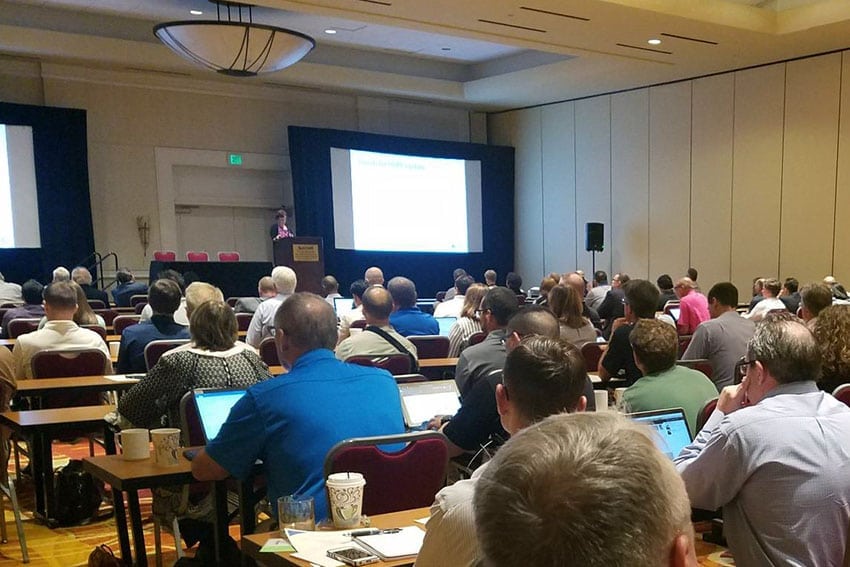
Several hundred members of the Association of Plastic Recyclers, along with many invitees, met last week in Houston to dive deep into the options and barriers to increased plastics recycling.
Steve Alexander, APR’s executive director, opened the meeting by discussing various issues currently affecting plastics recycling. First, he laid out the organization’s activities in terms of being aligned with developments in Europe.
“Plastics recycling is truly a global issue,” he said.
The association’s efforts include those focused on harmonizing the definition of plastics recycling and working toward testing harmonization.
“The second big issue we’re facing these days is the de-selection of some plastics packaging from curbside programs,” he said. “There’s a lot of misinformation out there and we’re struggling to get our message out that there are markets for much of this material, and we’ve been frustrated with our inability to get the media to hear our message.”
Kara Pochiro, APR’s communications director, told the audience that “we’re working on a communications plan to counter negative media. Trust us, we’re on it.” She noted APR is hiring a public relations firm to help address this issue.
Alexander also aimed criticism about continuing problems with packaging innovation that negatively affects materials recovery. “We need to continue to be involved at the beginning of the design stage,” he said.
One way to advance the group’s mission is their new effort to establish the Foundation for Plastics Recycling. This will aid APR by being “repositioned as a mission-oriented organization, rather than merely focusing on technical issues.”
Push toward global testing protocol harmonization
Eric Targgart of Custom Polymers summarized APR’s inaugural work in trying to develop global recyclability tests for plastics packaging.
The association has engaged with Plastics Recyclers Europe (the European version of APR) and the European PET Bottle Platform. Three separate committees are working, Targgart noted, although “we’re still in the dance mode and trying to learn from each other,” he said.
This initiative is all tied to the significant circular economy developments in plastics waste management in the European Union, spurred by the significant actions of the Ellen MacArthur Foundation. A draft definition of global recyclability has been written and APR is seeking agreement with its European partners.
APR’s life-cycle assessment project
Meanwhile, the association has underway a life-cycle assessment of recycled HDPE, PET and PET packaging, led by Beverly Sauer of Franklin Associates (FA).
“There’s a lot of demand for environmental data on the use of recovered resins,” she said.
FA is updating a major assessment completed earlier in the decade, using published data and input from 15 plastics reclaimers. This includes a first-ever environmental assessment of collecting, sorting and reclaiming post-consumer PP packaging.
The recycled resin life-cycle assessment data will be compared against data on virgin-resin use. All of the final data will then be placed in the public domain.
California on their mind
Bruce Magnani, who is from Houston Magnani & Associates and is APR’s lobbyist in Sacramento, Calif., provided the audience a summary of recent developments in America’s most populous state.
“California’s strategy to collect, sort and export [plastics] is under review,” he said.
A wide variety of strategies are being considered by state officials, including targeting single-use plastics, improving sorting processes and considering extended producer responsibility. In addition, a significant number of new legislative ideas have been introduced in the capitol, including recycling funding, plastic product bans and mandatory minimum recycled content in beverage containers.
Championing plastics recycling
APR’s Liz Bedard announced that the organization’s Recycling Demand Champions Campaign has five more members, in addition to the existing 13 champions. These firms have agreed to increase their use of post-consumer resin.
Also, the APR olefins and rigids committee is working with 46 store chains to get them to recover rigid plastics. APR will soon complete and issue a document laying out the best management practices for plastic sorting.
A look at film recovery
Sandi Childs, who manages APR’s film recycling project, noted that APR released a film-test protocol early this year, but it’s already under review. A revised version has been posted that incorporates input from the Sustainable Packaging Coalition, some APR members and several brand owners.
Also, APR is considering issuing a PE film critical guidance recognition program.
PCR verification project discussed
The association’s olefins and rigids committee is now looking at possibly having APR launch a post-consumer-resin-content-verification system as a response to brand-owner interest. A more detailed report will be presented at APR’s next meeting in October.
PET container design guidelines under review
APR’s PET technical committee is revising several sections of the group’s design guidelines, including language discussing crystallizable PET for thermoforming, pressure-sensitive labels, shrink-sleeve labels and dispensers.
Tracer and watermark sorting
New work is being undertaken in Europe by industry association Petcore focused on the use of markers in plastics and by Digimarc, focusing on digital watermarking.
These technologies are being monitored by APR to potentially aid sorting in single-stream recycling plants.
Can EVOH be recycled?
Kuraray America produces EVOH resin. Dave Hagen of Kuraray came before the group to talk about the resin’s recyclability.
EVOH is especially attractive because of its oxygen-barrier and chemical-resistance properties, and is thus used in many multi-layer applications, such as film for microwavable foods.
The low use of EVOH moderates concerns about its recyclability (a European assessment showed only 0.25 percent of the weight of recovered plastics bottles was EVOH). At high levels, EVOH affects the quality of regrind and Kuraray now markets a stabilizer and compatibilizer product that aids recycling processors.
PET direct-print technology is portrayed
Veronika Knoechel from Krones displayed the many marketing benefits of digitally printing directly on PET bottles.
Krones used APR’s critical guidance document in undertaking a recyclability test on bottles using direct printing. Kristina Hansen from Plastics Forming Enterprises summarized that test, focusing on waste water and flake-quality issues. Particles were found in the waste water but could be filtered out.
“The recycled flake passed all of APR’s test conditions,” said Hansen.
Problem containers continue to enter the stream
Kate Eagles from APR described how the organization is addressing problems in the PET bottle recycling stream, especially the inclusion of metals on containers and the use of trigger sprayers.
In addition, the APR problem-containers committee is looking into markets opportunities and barriers for colored PET.
Photo courtesy of APR