Resource Recycling
  • The Latest
  • Analysis
    • All
    • Certification Scorecard
    • Industry Announcements
    • Opinion
    NJ’s PCR delay risks making its own excuse permanently true

    NJ’s PCR delay risks making its own excuse permanently true

    E-scrap magnet recycling company scales up

    Why only some rare-earth sources are economically viable

    e-Stewards to develop an ITAD-specific standard

    Certification scorecard — week of Sept. 21

    Who should pay for lithium-ion battery fire damage?

    America’s critical-materials buildout has a feedstock problem

    Certification scorecard – week of Sept. 14

  • Conferences
    • Resource Recycling Conference
    • Plastics Recycling Conference
    • E-Scrap: The Longevity Conference
    • Textiles Recovery Summit
  • Publications
    • E-Scrap News
    • Plastics Recycling Update
    • Policy Now
    • Resource Recycling
    • Other Topics
      • All Topics
      • Brand Owners
      • Critical Minerals
      • Glass
      • Grant Watch / RFPs
      • Markets
      • Organics
      • Packaging
      • Research
      • Technology
      • Textiles
Subscribe
No Result
View All Result
Resource Recycling
No Result
View All Result
Home Plastics

Report surveys limited landscape of wind blade recycling

byJared Paben
May 28, 2020
in Plastics
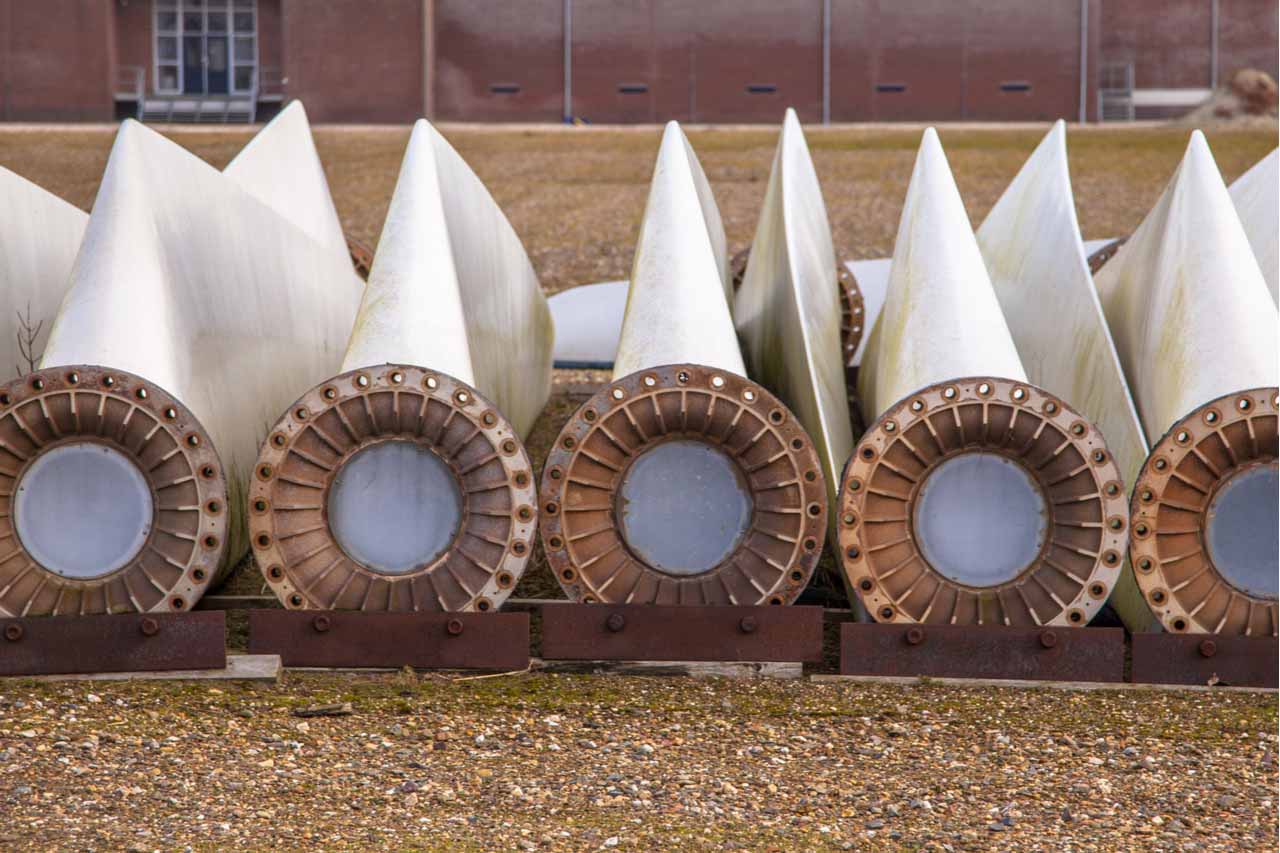
A recent report estimates up to 50,000 tons of blades per year will enter the end-of-life stream in the U.S. by 2023. | Rudmer Zwerver/Shutterstock

Groups representing electricity producers and composites manufacturers released a study exploring landfill diversion options for wind turbine blades.

The “Wind Turbine Blade Recycling: Preliminary Assessment” looked at three end-of-life options: pyrolysis, burning in a cement kiln, and grinding blades so the particles can be used as filler. The study was released by the Electric Power Research Institute (EPRI), which commissioned the American Composite Manufacturers Association (ACMA) to prepare it.

A lot of blades will be coming off-line in the coming years, with few large-scale, commercial recycling outlets available. The report estimates up to 50,000 tons of blades per year will enter the end-of-life stream in the U.S. by 2023.

Wind turbine blades are particularly challenging to recycle. By weight, 80% to 90% of the blade is a fiber-reinforced composite (either glass or carbon fiber), presenting size reduction challenges. And the polymers involved are thermosets, so they can’t be remelted and molded like thermoplastics. Most blades in the U.S. go to landfill disposal.

In terms of recycling the fiber-reinforced composite into new materials, the report looked at processes for mechanically size-reducing the composite and using the resulting chunks, needles or powder as a filler. The study noted the low-value material can be combined with other materials and used in decking, insulation and building panels.

The report laid out the challenges with that process: “The recyclate is mixed material, resulting in up to 40% waste such as paint and contaminants, which require solid waste disposal. Grinding can create a fine dust irritant, and shards create handling challenges. There is a large decrease in the mechanical properties of the recycled material (e.g., stiffness, strength). Moreover, it currently is not cost-effective and requires further investment to process.”

Last year, Plastics Recycling Update reported Global Fiberglass Solutions (GFS) expanded its capacity to recycle wind turbine blades at its Sweetwater, Texas plant. The company grinds the blades and combines the material with virgin or recycled plastics to create reinforced, filled thermoplastic pellets, which can be molded into a number of different products. Karl Englund of GFS was also interviewed by researchers preparing the EPRI report.

The EPRI report provided a high-level estimate of the costs and revenues associated with grinding and reusing the material. It found that grinding the composite to 1-3 centimeters in size costs about $90 to $120 a ton. Further grinding to fibers and powders costs another $100 to $150 a ton. Then, roughly 20% to 40% is waste that needs to go to disposal, with tip fees varying dramatically depending on geography. Finally, the recovered fibers and powders would be worth about $200 to $275 per ton.

“Thus, it is clear from these numbers that commercial profitability would be difficult in the regrind and re-use option, thus requiring user fees or subsidization,” the report concluded. That conclusion was contradicted by Englund, who told researchers the process is cheaper than landfill disposal, making it an attractive option.

Other treatment options

The EPRI report also discussed two end-of-life options in which the polymer is not recovered. It looked at grinding the material into one-inch or two-inch pieces and then subjecting it to a pyrolysis process, using what’s called a Thermolyzer technology from CHZ Technologies. That technology breaks the material down into char, which has recoverable carbon and glass fibers, and syngas, which can be burned for energy.

Additionally, the report explored grinding the material and putting it in a cement kiln, where the glass fibers would become part of the cement and the polymer would be burned, displacing the need for coal or natural gas.


 

Tags: Hard-to-Recycle MaterialsTechnology
TweetShare
Jared Paben

Jared Paben

Related Posts

Cutting healthcare plastics could save $18B

Report provides path to reduce medical e-scrap

byPaul Lane
September 25, 2026

The European report found that circularity in medical devices is possible through several potential initiatives.

Study assesses environmental cost of excess data storage

BAN paper says AI e-scrap estimates are low

byPaul Lane
September 17, 2026

The advocacy group said current estimates on the scrap resulting from data centers don’t account for the full picture of...

Google Pixel 6 phone

Google makes repairability part of design ethos

byBrian Clark Howard
September 16, 2026

The tech titan supports the right-to-repair movement in several key ways.

CommanderAI launches searchable hauler database

Inside the Circle: Put AI to work for the people who do the work

byBill Shireman
September 14, 2026

There is more than one way to use AI, and some ways are more valuable than others.

iFixit launches 2-week circuit board training course

Printed circuit board (PCB) recycling explained

byJavier Castilloand2 others
September 9, 2026

Recycling PCBs presents significant technical challenges because these waste streams combine metallic, non-metallic and electronic fractions with different characteristics and...

Inside the sneaker recycling boom

Report: AI opportunity robust in footwear recycling

byPaul Lane
September 8, 2026

BCC Research found AI’s usage in the footwear recycling space is growing but remains in the early stages, holding the...

Load More
Next Post

City finds alternative market for EnergyBag plastics

2026 Buyers’ Guide

Equipment, services and technology suppliers serving the recycling industry.

Browse the Guide

More Posts

Ten e-scrap projects receive federal prize funds

Recycling rates for rare earths could double by 2040

July 17, 2026

Microsoft confirms PC sales slump

August 4, 2026
Data erasure firm expands wearable device capabilities

Apple hits 30% recycled content, debuts new recovery tech

April 17, 2026

In other news: May 2, 2016

May 2, 2016

America’s critical-materials buildout has a feedstock problem

September 18, 2026
Intel sign outside of company building.

Intel’s CapEx tops $20B on server demand while PC volume shrinks

July 29, 2026
Closeup of a printed circuitboard

Hardware demand puts new focus on parts harvesting

June 5, 2026

AI and the changing economics of retired hardware

June 12, 2026
Apple store

Apple leads on inputs, faces questions on ITAD

May 1, 2026
Feds to develop repairable computer donation program

The whitebox blind spot in PC recycling

April 24, 2026
Load More

About & Publications

About Us

Staff

Archive

Magazines

Work With Us

Advertise
Jobs
Contact
Terms and Privacy

Newsletters

Get the latest recycling news and analysis delivered to your inbox every week. Stay ahead on industry trends, policy updates, and insights from programs, processors, and innovators.

Subscribe

Welcome Back!

Login to your account below

Forgotten Password?

Retrieve your password

Please enter your username or email address to reset your password.

Log In

Add New Playlist

No Result
View All Result
  • The Latest
  • Analysis
  • Recycling
  • E-Scrap
  • Plastics
  • Policy Now
  • Conferences
    • E-Scrap Conference
    • Plastics Recycling Conference
    • Resource Recycling Conference
    • Textiles Recovery Summit
  • Magazines
  • About Us
  • Advertise
  • Archive
  • Jobs
  • Staff
Subscribe
This website uses cookies. By continuing to use this website you are giving consent to cookies being used. Visit our Privacy and Cookie Policy.
-
00:00
00:00

Queue

Update Required Flash plugin
-
00:00
00:00