





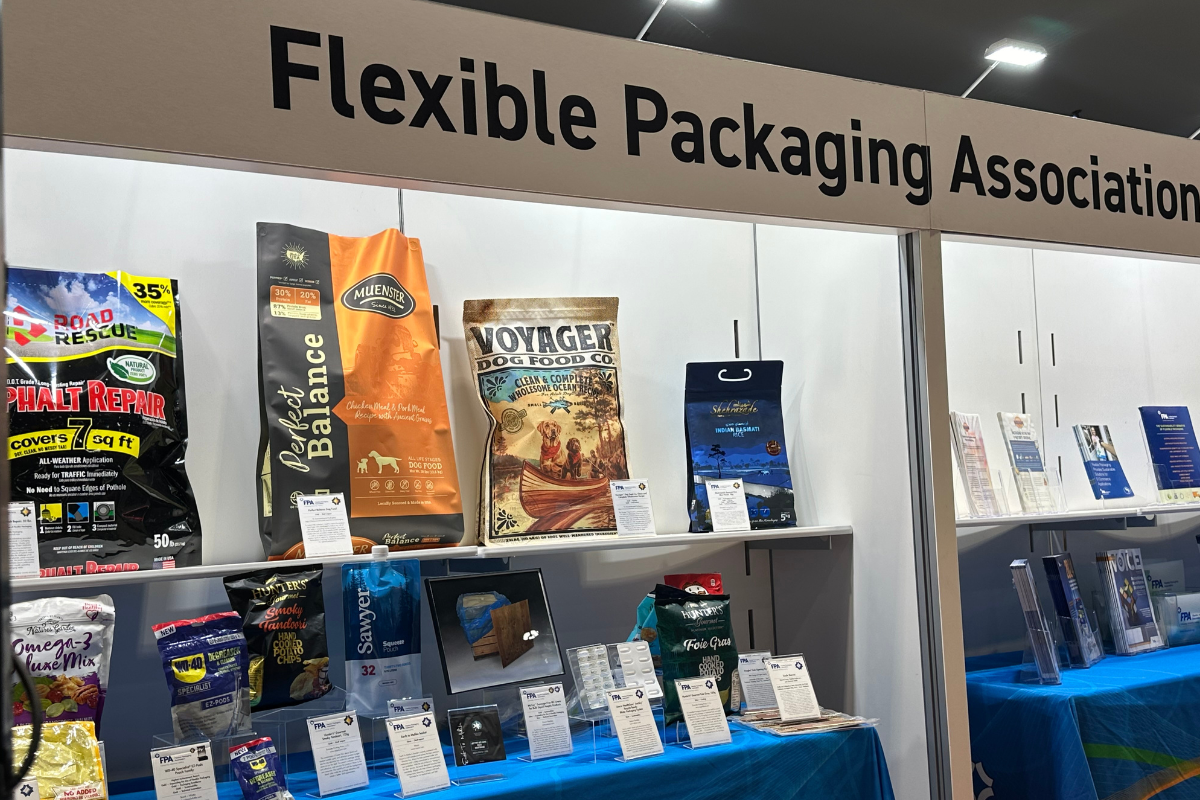
The broad theme of sustainability was a central focus at Pack Expo International in Chicago this week, encompassing package recyclability, PCR content and legislation.
“Sustainability is touching pretty much every aspect of packaging today,” said Jorge Izquierdo, vice president of market development for PMMI: The Association for Packaging and Processing Technologies, which presented the event.
“Sustainability is not just a buzzword anymore,” said Alison Zitzke, senior product manager at Wisconsin-based pallet manufacturer Orbis, in an interview with Plastics Recycling Update. She added that increasing regulations and demands from plastics end users are helping drive that shift from buzzword to action, a sentiment echoed throughout the event.
“Not a single customer isn’t saying ‘can I make it more recyclable?'” said Alex Hayden, senior vice president of R&D, sustainability and ESG at flexible packaging company TC Transcontinental, in a separate interview. He added that 80% of the company’s current R&D projects concern aspects of recycling.
In interviews, packaging suppliers discussed the barriers and challenges they face in incorporating PCR into their feedstock mix.
PCR costs pressure packaging firms
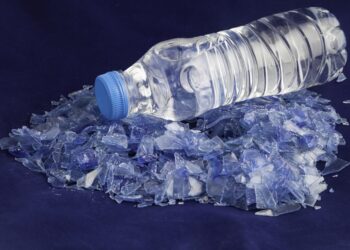
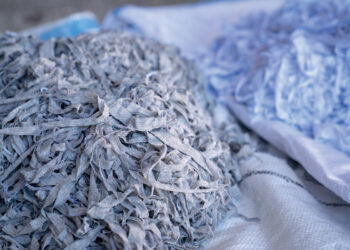
It’s little surprise that cost is a top concern for packaging suppliers. Prices for post-consumer feedstock bales – which especially for natural HDPE containers are on par with or sometimes even higher than virgin pellets – are among the numerous costs of using PCR.
Recovering and then compounding PCR to get it back to a moldable material can easily result in prices that are twice that of virgin resin, Zitzke said. Orbis, a subsidiary of Menasha Corporation, primarily uses HDPE and PP in its reusable pallets, and in 2019 it designed a pallet using 100% recycled content.
Some customers send their own scrap to Orbis to help reduce waste and lower cost, though this post-industrial material may not count toward PCR content targets. Some laws and self-set goals specify that material must be post-consumer to be included in the tally.
With chemically recycled plastic feedstocks, “from a cost standpoint, there’s a pretty hefty premium so it’s a challenge to get customers to pay, but that’s about as clean as it gets,” Hayden said, adding that the process is particularly well suited for food-contact applications due to the purity of the resulting resin.
Although TC Transcontinental produces a shrink film containing 50% PCR, and all its non-printed shrink films contain at least 10% PCR, the company’s PCR use comprised only 1.64% of total packaging volume – well away from its 2025 goal of 10%.
In its 2023 sustainability report, the company cited slower-than-anticipated demand for PCR from customers for the low adoption rate – which numerous packagers have attributed to the impossibility of competing with cheap virgin resins.
Better communicating the benefits could help make PCR incorporation more palatable from a cost standpoint, according to Raghu Chakravarthi, vice president of the Americas portfolio at Tetra Pak.
“We need to create more awareness that such things exist,” Chakravarthi said in an interview. “You have to do it one at a time, go to each customer, explain to them what’s happening and how it will impact them.”
In the past three years, he said, “we have seen a massive adoption of renewable content” once Tetra Pak customers see the benefit and can explain it to their own customers.
Although the primary material for Tetra Pak’s cartons is paper fiber, the company also uses bio-based polymers from Brazil-based Braskem for plastic components including closures for its aseptic containers, Chakravarthi said.
There are many environmental messages going out to consumers, he said, one of which is at the customer level. “Customers get bombarded with different logos, messages, they want a simple explanation. So we need to find a good way to get through to them,” Chakravarthi said. “In addition to knowing the benefit, consumers need to know what’s in it for them,”
Inconsistent stream causes quality to vary
Incoming PCR materials vary in quality when they come from commingled recycling programs, said Terry Patcheak, vice president of R&D, sustainability and program management at Amcor Rigid Packaging, during a session on packaging design for the future. This inconsistency has a negative impact on manufacturing and presents challenges especially for high-performance containers, he said.
TC Transcontinental’s Hayden said, “You might get one great truckload of material and the next one is different. That’s just a reflection of the sourcing they have to deal with.”
Such inconsistent supply quality can cause inefficiency in production processes.
“If we do have to make adjustments to our molding settings for a certain stream of material, that’s fine, but we want to make sure we continue to get that stream of material,” said Orbis’ Zitzke. Orbis’ plants are capable of adjusting settings, “but they don’t want to be changing their temperatures and their timing” to accommodate constantly shifting feedstock streams.
Brand owners must weigh tradeoffs
Packaging suppliers want to balance packaging demands with sustainability, but no single current design can satisfy consumer demands on cost-effectiveness, convenience, ease of use and attractiveness, while also leading to less waste, Amcor’s Patcheak said.
However, technology is moving toward 100% PCR content, he said, providing more clarity and less variability in quality, as well as increasing applications across products and processes.
Over his nearly 30 years in the packaging sector, Hayden said, “we’ve had all these polymers to choose from” to meet brand owners’ requirements at the best price. “Now it’s like saying you’ve got to do the same thing but do it with just polyethylene.”
Although there are more resin options to choose from, and new technologies have helped overcome some of these challenges, “it’s adding a handicap to your whole development process, and then do it at the same price – no one wants to pay more,” he said.
“It’s really important to us to make sure that product quality is going to come first,” Orbis’ Zitzke said, “so that’s sometimes where we run into issues.” Customers may not understand the complexity of incorporating PCR into a product as seemingly straightforward as a pallet, she said.
However, pallet buyback helps Orbis ensure the quality of its feedstock, to avoid damaging machinery, she said.
Some applications may require specific colors, Zitzke said, such as pallets whose color indicates a load containing allergens. “Today all of our recycled products are black, because we just take a mixed batch of whatever people are bringing back and we color over it,” she said. Orbis continues to work toward finding colored or colorable streams, she added.
Scope 3 comes into focus
Prior to the past couple years, end users’ sustainability goals might not have captured secondary or tertiary packaging, Zitzke said. For example, a customer’s focus might have stopped with wanting the water bottles or bags they produced to contain PCR, she said, whereas now they also want to account for the carbon footprint for items used in transport – such as pallets. To that end, Orbis relies largely on local toll grinders to help reduce logistics costs and minimize emissions, she added.
For TC Transcontinental, “we find that having an overarching greenhouse gas reduction target makes more sense and then having those end-of-life targets feeding into that,” Hayden said. “You can make PCR changes that are actually going in the wrong direction from a greenhouse gas emissions standpoint. Those are not things we want to do. So having an overarching target for greenhouse gases is sort of our North Star, and then educating customers which changes are positive.”
He added that Montreal-based TC Transcontinental’s near-term emissions reduction targets recently were approved by the Science-Based Targets Initiative.
This story has been updated to correct that Tetra Pak uses bio-based polymers, not chemically recycled feedstocks.