


Resource Recycling
  • The Latest
  • Analysis
    • All
    • Certification Scorecard
    • Industry Announcements
    • Opinion
    SERI works to restore faith in certifications

    Building a defensible E-scrap evidence file

    tires

    The most important decision in tire recycling happens before the shredder

    Intel sign outside of company building.

    Intel’s CapEx tops $20B on server demand while PC volume shrinks

    Google sign on company building with blue sky and clouds above.

    Inside Alphabet’s Q2 results: More capital spending and cloud backlog

    Alpek closing Pennsylvania RPET plant

    Alpek seizing on war-related opportunity 

    Our top stories from March 2023

    Iron Mountain’s data center report: Strong on power, quiet on hardware

  • Conferences
    • Resource Recycling Conference
    • Plastics Recycling Conference
    • E-Scrap: The Longevity Conference
    • Textiles Recovery Summit
  • Publications
    • E-Scrap News
    • Plastics Recycling Update
    • Policy Now
    • Resource Recycling
    • Other Topics
      • All Topics
      • Brand Owners
      • Critical Minerals
      • Glass
      • Grant Watch / RFPs
      • Markets
      • Organics
      • Packaging
      • Research
      • Technology
      • Textiles
Subscribe
No Result
View All Result
Resource Recycling
  • The Latest
  • Analysis
    • All
    • Certification Scorecard
    • Industry Announcements
    • Opinion
    SERI works to restore faith in certifications

    Building a defensible E-scrap evidence file

    tires

    The most important decision in tire recycling happens before the shredder

    Intel sign outside of company building.

    Intel’s CapEx tops $20B on server demand while PC volume shrinks

    Google sign on company building with blue sky and clouds above.

    Inside Alphabet’s Q2 results: More capital spending and cloud backlog

    Alpek closing Pennsylvania RPET plant

    Alpek seizing on war-related opportunity 

    Our top stories from March 2023

    Iron Mountain’s data center report: Strong on power, quiet on hardware

  • Conferences
    • Resource Recycling Conference
    • Plastics Recycling Conference
    • E-Scrap: The Longevity Conference
    • Textiles Recovery Summit
  • Publications
    • E-Scrap News
    • Plastics Recycling Update
    • Policy Now
    • Resource Recycling
    • Other Topics
      • All Topics
      • Brand Owners
      • Critical Minerals
      • Glass
      • Grant Watch / RFPs
      • Markets
      • Organics
      • Packaging
      • Research
      • Technology
      • Textiles
Subscribe
No Result
View All Result
Resource Recycling
No Result
View All Result
Home Recycling

Q&A: ‘Trashbot’ could be the future of public-space collection

byJared Paben
September 7, 2016
in Recycling

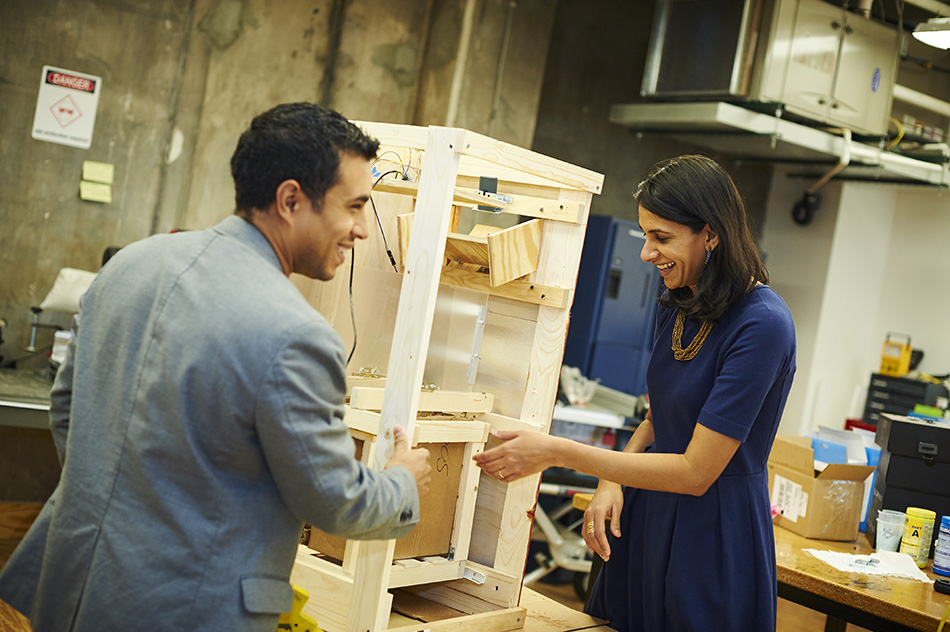
Charles-Yhap-and-Vaish-KrishnamurthyA startup is using robotics, artificial intelligence and the cloud to combat recycling contamination at one of its sources: public collection bins.

Pittsburgh-based CleanRobotics developed a robotic receptacle that automatically senses and sorts materials into either a landfill-bound garbage can or single-stream recycling bin. The Trashbot, as it’s called, uses a variety of sensors to keep non-recyclable materials out of the MRF-bound bin.

The cloud-connected devices can be programmed remotely to accept or reject different materials, depending on what’s desired in the local recycling stream. They also provide notifications when the receptacles are full, helping to improve collection efficiencies.

The company, nearly a year old, plans to target sustainably minded businesses needing nice-looking receptacles, said Charles Yhap, CleanRobotics’ co-founder. CleanRobotics is planning to start by charging around $1,000 for a Trashbot but eventually wants to move toward providing the hardware as a service and charging wireless connectivity subscription fees.

Yhap, the company’s chief operations officer, spoke with Resource Recycling to provide more details about the technology and efforts to get it into the marketplace.

Question: How exactly does the receptacle work?

Yhap: The CleanRobotics pilot is called Trashbot and, essentially, as a user, what you would do is you would walk up to it and throw an item of waste into one of the chambers. From the user’s point of view, you just see an opening. Toss it in and it senses it, makes a classification and then either sorts it into a landfill bin or a recycling bin. And that’s it. Then you just walk away and don’t have to think about it anymore.

Question: Is it programmable so that if one community wanted to exclude glass from its recycling program but another community wanted to include it you could program it to respond accordingly?

Yhap: Exactly right. Recycling rules and capabilities vary by locale. For us, there’s no education that’s required. It’s just a software update. The machine is cloud-connected so we can just push it to the relevant areas to accommodate recycling capabilities.

Question: What kind of sensors does it have to do the decision making?

Yhap: Right now, we have three sensors. We have a computer vision camera, a weight sensor and an inductance sensor. But most of the classification is happening with computer vision, which is just a red/green/blue camera. The way the machine works is it uses a machine-learning algorithm that improves over time. To start off with, a human being has to basically train the computer and then kind of code the types of materials. We’re working on developing another sensor that will also be able to give more specific resolution on the type of material that’s going in, in addition to the computer vision that’s just the regular camera. You can think of it as computer vision on steroids.

Question: So it has an element of artificial intelligence, then, if it’s able to learn on its own?

Yhap: Yes. So right now it has to be trained by a human and double-checked by a person, which right now is engineers. I’m going to be stepping in and doing that as well in the next week. But, eventually, it will be learning things on its own. And the more Trashbots we have out there the more data we have coming in, the better and more accurate it will get.

Question: What does commercialization look like right now? What’s its status?

Yhap: We were accepted to a hardware accelerator in China. We went in January, myself and two engineers, and we built one prototype. We came back from China with the prototype. We just finished piloting it at a large tech company in Pittsburgh. The pilot actually went way better than we expected. We expected the sorting accuracy to be around 60 percent. It came back at 81 percent after just very basic training. So we’re very excited about those promising results. The next step is to implement the redesign we have with the current prototype to make it better, faster, more robust, and then pilot that and get some more user feedback at the Pittsburgh International Airport and the David L. Lawrence Convention Center. Then, after implementing those lessons, (we’ll) make version 2.5 or 3.0 and go to market with that. But we are taking pre-orders.

Question: How did you first develop this?

Yhap: The idea was actually my co-founder’s (company CEO Vaish Krishnamurthy). Have you ever been to Whole Foods and you’re on your way out and you see these places to put your trash? Both of us are very environmentally conscious and we care about recycling, we care about doing things right, but you go up to the hot bar and on your way out you’re trying to figure out where to put your trash. It just takes so long and it’s so confusing.

Question: Are you looking for feedback from the recycling industry?

Yhap: We’re always looking to speak with folks in the industry: recyclers, commodity purchasers, haulers. If anyone is interested in speaking with us, we love learning and getting more information on folks’ experiences and pain points and ways that we might be able to make this recycling value chain more profitable and more cost effective and better for the environment. We’re eager to speak with anyone and everyone. We’re also hiring, so that’s one thing to put out there, too.

Tags: CollectionQ&ATechnology
TweetShare
Jared Paben

Jared Paben

Related Posts

Intel sign outside of company building.

Intel’s CapEx tops $20B on server demand while PC volume shrinks

byDavid Daoud
July 29, 2026

As a result ITAD firms should plan for two separate asset cycles.

Greyparrot positions waste intel as key to effective EPR

Greyparrot secures $27m for growing AI waste data

byAntoinette Smith
July 28, 2026

The AI waste intelligence firm has now raised a total of $60 million to help expand its Analyzer network and...

Google sign on company building with blue sky and clouds above.

Inside Alphabet’s Q2 results: More capital spending and cloud backlog

byDavid Daoud
July 28, 2026

The tech giant spent $44.9 billion in a single quarter building AI infrastructure, with major implications for the ITAD space.

Wisconsin opens e-recycling grant process

byPaul Lane
July 28, 2026

Funds are available for collection programs as the state touts growth in electronic recycling in its latest annual report.

Our top stories from March 2023

Iron Mountain’s data center report: Strong on power, quiet on hardware

byDavid Daoud
July 24, 2026

The company’s 2025 Sustainability Overview tells a story both in the data it presents and in the data it omits.

MTA loses track of recycling, costing NYC Transit $800,000

byStefanie Valentic
July 23, 2026

A new MTA inspector general report finds NYC Transit lost nearly $800,000 after years of mishandled recycling and the contractor...

Load More
Next Post

Republic details recycling numbers and goals

2026 Buyers’ Guide

Equipment, services and technology suppliers serving the recycling industry.

Browse the Guide

More Posts

Cascade Asset Management sees higher sales volumes

Sorted: Restoring mineral supplies, one junk drawer at a time

July 20, 2026

PureCycle resin used in auto bumper prototype

July 6, 2026
Industry announcements for January 2026

Industry announcements for June 2026

June 1, 2026
Wolframite ore, the primary ore of tungsten from Altai, Russia

Tungsten scrap export controls draw industry attention

April 9, 2026
Global recycling patent trends may reflect legislative push

Global recycling patent trends may reflect legislative push

November 25, 2025
Colgate-Palmolive launches 100% PCR bottle

Federal institute funds plastics recycling research

December 8, 2021

Top stories from February 2025

March 4, 2025
SERI works to restore faith in certifications

Building a defensible E-scrap evidence file

August 6, 2026
Spin-off lets Linca focus on battery mineral recovery

GAO: Policy, tech updates needed to bolster domestic mineral supply

July 30, 2026

Wisconsin opens e-recycling grant process

July 28, 2026
Load More

About & Publications

About Us

Staff

Archive

Magazine

Work With Us

Advertise
Jobs
Contact
Terms and Privacy

Newsletter

Get the latest recycling news and analysis delivered to your inbox every week. Stay ahead on industry trends, policy updates, and insights from programs, processors, and innovators.

Subscribe

Welcome Back!

Login to your account below

Forgotten Password?

Retrieve your password

Please enter your username or email address to reset your password.

Log In

Add New Playlist

No Result
View All Result
  • The Latest
  • Analysis
  • Recycling
  • E-Scrap
  • Plastics
  • Policy Now
  • Conferences
    • E-Scrap Conference
    • Plastics Recycling Conference
    • Resource Recycling Conference
    • Textiles Recovery Summit
  • Magazine
  • About Us
  • Advertise
  • Archive
  • Jobs
  • Staff
Subscribe
This website uses cookies. By continuing to use this website you are giving consent to cookies being used. Visit our Privacy and Cookie Policy.