




Resource Recycling
  • The Latest
  • Analysis
    • All
    • Certification Scorecard
    • Industry Announcements
    • Opinion
    SERI works to restore faith in certifications

    Building a defensible E-scrap evidence file

    tires

    The most important decision in tire recycling happens before the shredder

    Intel sign outside of company building.

    Intel’s CapEx tops $20B on server demand while PC volume shrinks

    Google sign on company building with blue sky and clouds above.

    Inside Alphabet’s Q2 results: More capital spending and cloud backlog

    Alpek closing Pennsylvania RPET plant

    Alpek seizing on war-related opportunity 

    Our top stories from March 2023

    Iron Mountain’s data center report: Strong on power, quiet on hardware

  • Conferences
    • Resource Recycling Conference
    • Plastics Recycling Conference
    • E-Scrap: The Longevity Conference
    • Textiles Recovery Summit
  • Publications
    • E-Scrap News
    • Plastics Recycling Update
    • Policy Now
    • Resource Recycling
    • Other Topics
      • All Topics
      • Brand Owners
      • Critical Minerals
      • Glass
      • Grant Watch / RFPs
      • Markets
      • Organics
      • Packaging
      • Research
      • Technology
      • Textiles
Subscribe
No Result
View All Result
Resource Recycling
  • The Latest
  • Analysis
    • All
    • Certification Scorecard
    • Industry Announcements
    • Opinion
    SERI works to restore faith in certifications

    Building a defensible E-scrap evidence file

    tires

    The most important decision in tire recycling happens before the shredder

    Intel sign outside of company building.

    Intel’s CapEx tops $20B on server demand while PC volume shrinks

    Google sign on company building with blue sky and clouds above.

    Inside Alphabet’s Q2 results: More capital spending and cloud backlog

    Alpek closing Pennsylvania RPET plant

    Alpek seizing on war-related opportunity 

    Our top stories from March 2023

    Iron Mountain’s data center report: Strong on power, quiet on hardware

  • Conferences
    • Resource Recycling Conference
    • Plastics Recycling Conference
    • E-Scrap: The Longevity Conference
    • Textiles Recovery Summit
  • Publications
    • E-Scrap News
    • Plastics Recycling Update
    • Policy Now
    • Resource Recycling
    • Other Topics
      • All Topics
      • Brand Owners
      • Critical Minerals
      • Glass
      • Grant Watch / RFPs
      • Markets
      • Organics
      • Packaging
      • Research
      • Technology
      • Textiles
Subscribe
No Result
View All Result
Resource Recycling
No Result
View All Result
Home Recycling

How one state is addressing uneaten food

Dan LeifbyDan Leif
October 24, 2017
in Recycling
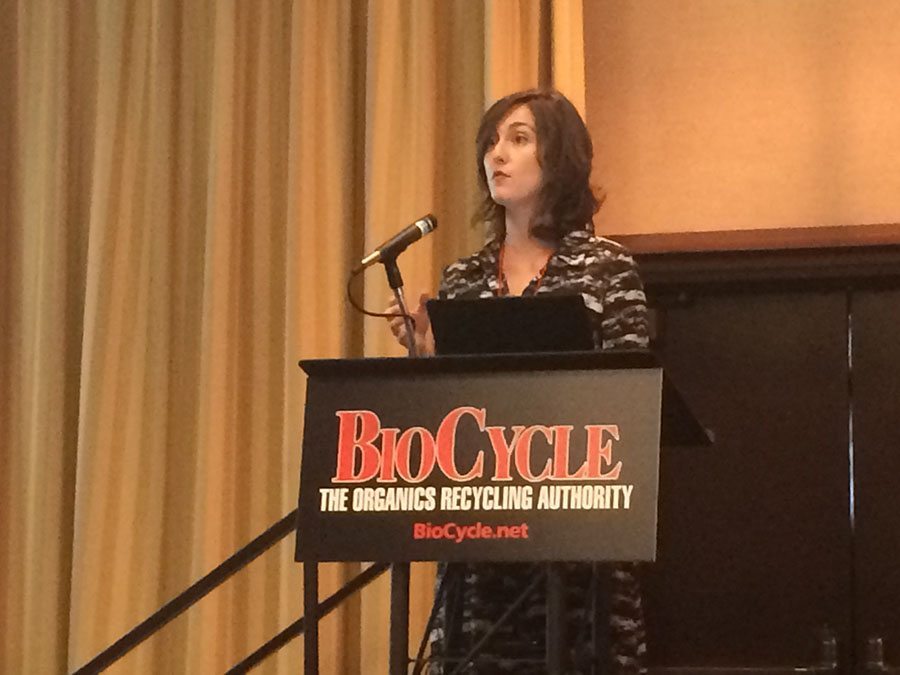
Ashley Zanolli of Oregon DEQ speaks at REFOR 2017.

In recent years, efforts out of Oregon have helped set the national pace on topics such as sustainable materials management and recycling metrics. Now, the state is beginning to do the same when it comes to food waste – or, more precisely, wasted food.

At the annual BioCycle Renewable Energy From Organics Recycling (REFOR) event held last week in Portland, Ore., three officials from the Beaver State took to the stage to discuss their ongoing work to intensively study how much potentially edible food is sent to disposal by residents and commercial generators and how those tonnages can be cut down by making adjustments upstream.

The state refers to leftovers and other loads of prepared but uneaten food as wasted food. The term food waste, on the other hand, is a broader category that also includes the inedible portions, such as egg shells and other residuals.

Oregon’s Department of Environmental Quality (DEQ) sees the task of more specifically classifying these different organics subsections as a big part of moving the needle on waste diversion as a whole.

“What we really wanted to do at DEQ was change the conversation,” said Elaine Blatt, senior policy and program analyst at DEQ. “We’re looking to get more of a focus on prevention.”

Building on “Vision” initiative

Reports from Oregon DEQ are cited regularly in industry presentations and conversations across North America. The agency’s “2050 Vision” document has emerged as an influential policy framework, offering an example of how a jurisdiction can try to account for the full life cycle of different materials when making waste decisions.

On the food front, the state earlier this year finalized a formal strategy geared toward limiting wasted food. The plan, which aims to support goals laid out in the 2050 Vision, identifies nine areas in which the state can nibble away at the tonnages of edible food going to disposal.

DEQ points to statistics that lay out the enormity of the wasted food situation. According to the department’s strategy document, between 25 and 40 percent of food produced or imported for consumption in the U.S. is never actually eaten and $218 billion is spent nationally growing, processing, distributing and preparing food that ends up in the waste stream.

In a presentation at REFOR, DEQ’s Ashley Zanolli compared the cost of wasted food to an iceberg. A relatively small amount appears above the surface as disposal fees. But the bulk of the financial impact lurks unseen, with expenses going into growing, transportation and preparation.

“When we only focus on disposal, we’re selling ourselves short,” noted Zanolli, who formerly worked on food waste issues for the U.S. EPA.

A big part of Zanolli’s work at DEQ to date has been a study to better understand both residential and commercial behaviors that lead to wasted food. Such research is one of the nine bullet points noted in the larger food strategy.

The state is currently in the process of finishing a statewide survey to residents, and DEQ staff also undertook qualitative interviews with 32 Oregonians to dive deeper into the specific ways individuals handle food.

Additionally, the state is working on case studies of 15 different commercial and institutional outlets to understand and articulate realities of wasted food in the food-service realm.

“Ideally, the case studies we’re doing in Oregon can be a launch pad for other jurisdictions,” Zanolli said.

Governor’s office taking note

Regardless of how much attention DEQ’s work gets from leaders elsewhere, top decision-makers in Oregon itself seem committed to addressing the issue.

In its opening keynote session, the REFOR event featured Ruchi Sadhir, the energy policy advisor to Oregon Gov. Kate Brown.

In her talk, Sadhir said the average Oregon family spends $1,600 annually on food that never gets eaten.

“The biggest gains can be made when we can reduce this on the front end,” she noted. “We have to be tireless, and we can’t do it alone.”
 

Tags: Organics
TweetShare
Dan Leif

Dan Leif

Dan Leif is the managing editor at Resource Recycling, Inc., which publishes Resource Recycling, Plastics Recycling Update and E-Scrap News. He has been with the company since 2013 and has edited different trade publications since 2006. He can be contacted at dan@dev.resource-recycling.com.

Related Posts

Compliance push drives new Republic organics facility

byStefanie Valentic
June 18, 2026

Republic Services started construction on a 140-acre organics facility in San Bernardino designed to expand Southern California's composting capacity under...

California extends compostable labeling law

California bills crack down on false recycling, compostable claims

byStefanie Valentic
May 29, 2026

Three bills targeting recycling and compostables labeling have cleared key hurdles as California's session deadline nears.

California extends compostable labeling law

Report finds path forward for compostable packaging

byKeith Loria
April 28, 2026

A new report by Closed Loop Partners’ Composting Consortium examined five years of research, field testing and cross-industry collaboration and...

Wisconsin outlines steps to cut landfill food waste

Wisconsin outlines steps to cut landfill food waste

byScott Snowden
March 18, 2026

Wisconsin officials say food makes up about 20% of landfill material. A new state evaluation maps the policy, collection and...

Nebraska awards $7m in recycling grants

byAntoinette Smith
February 18, 2026

The grants will help fund waste and litter reduction projects, recycling programs, and costs to collect scrap tires, HHW, electronic...

Wisconsin food waste amounts to 1,033 pounds per resident each year

byStefanie Valentic
January 28, 2026

Wisconsin's nearly 6 million residents discard 1,033 pounds of food per person annually, creating the state's largest waste stream and...

Load More
Next Post

Small steps, big difference

2026 Buyers’ Guide

Equipment, services and technology suppliers serving the recycling industry.

Browse the Guide

More Posts

Innovation. Partnership. Circular value.

Innovation. Partnership. Circular value.

August 1, 2026
SERI works to restore faith in certifications

Building a defensible E-scrap evidence file

August 6, 2026
Copper prices fall to lowest point since spring

EMR recycling plant to reopen in NJ after fire, legal battle

July 21, 2026
RecyClass hits 500 EU recyclability evals

RecyClass hits 500 EU recyclability evals

July 21, 2026
Cascade Asset Management sees higher sales volumes

Sorted: Restoring mineral supplies, one junk drawer at a time

July 20, 2026
Tech giant pens detailed ‘plastic-free packaging’ guide

What Google’s latest report means for ITAD

July 8, 2026
Canada EV battery reuse pilot to start

Canada EV battery reuse pilot to start

July 8, 2026
Wolframite ore, the primary ore of tungsten from Altai, Russia

Tungsten scrap export controls draw industry attention

April 9, 2026
Apple accused of hampering battery replacement

Apple’s MacBook Neo: iFixit’s best MacBook score in 14 years, but the residual value ceiling is real

March 17, 2026
Global recycling patent trends may reflect legislative push

Global recycling patent trends may reflect legislative push

November 25, 2025
Load More

About & Publications

About Us

Staff

Archive

Magazine

Work With Us

Advertise
Jobs
Contact
Terms and Privacy

Newsletter

Get the latest recycling news and analysis delivered to your inbox every week. Stay ahead on industry trends, policy updates, and insights from programs, processors, and innovators.

Subscribe

Welcome Back!

Login to your account below

Forgotten Password?

Retrieve your password

Please enter your username or email address to reset your password.

Log In

Add New Playlist

No Result
View All Result
  • The Latest
  • Analysis
  • Recycling
  • E-Scrap
  • Plastics
  • Policy Now
  • Conferences
    • E-Scrap Conference
    • Plastics Recycling Conference
    • Resource Recycling Conference
    • Textiles Recovery Summit
  • Magazine
  • About Us
  • Advertise
  • Archive
  • Jobs
  • Staff
Subscribe
This website uses cookies. By continuing to use this website you are giving consent to cookies being used. Visit our Privacy and Cookie Policy.