




Resource Recycling
  • The Latest
  • Analysis
    • All
    • Certification Scorecard
    • Industry Announcements
    • Opinion
    SERI works to restore faith in certifications

    Building a defensible E-scrap evidence file

    tires

    The most important decision in tire recycling happens before the shredder

    Intel sign outside of company building.

    Intel’s CapEx tops $20B on server demand while PC volume shrinks

    Google sign on company building with blue sky and clouds above.

    Inside Alphabet’s Q2 results: More capital spending and cloud backlog

    Alpek closing Pennsylvania RPET plant

    Alpek seizing on war-related opportunity 

    Our top stories from March 2023

    Iron Mountain’s data center report: Strong on power, quiet on hardware

  • Conferences
    • Resource Recycling Conference
    • Plastics Recycling Conference
    • E-Scrap: The Longevity Conference
    • Textiles Recovery Summit
  • Publications
    • E-Scrap News
    • Plastics Recycling Update
    • Policy Now
    • Resource Recycling
    • Other Topics
      • All Topics
      • Brand Owners
      • Critical Minerals
      • Glass
      • Grant Watch / RFPs
      • Markets
      • Organics
      • Packaging
      • Research
      • Technology
      • Textiles
Subscribe
No Result
View All Result
Resource Recycling
  • The Latest
  • Analysis
    • All
    • Certification Scorecard
    • Industry Announcements
    • Opinion
    SERI works to restore faith in certifications

    Building a defensible E-scrap evidence file

    tires

    The most important decision in tire recycling happens before the shredder

    Intel sign outside of company building.

    Intel’s CapEx tops $20B on server demand while PC volume shrinks

    Google sign on company building with blue sky and clouds above.

    Inside Alphabet’s Q2 results: More capital spending and cloud backlog

    Alpek closing Pennsylvania RPET plant

    Alpek seizing on war-related opportunity 

    Our top stories from March 2023

    Iron Mountain’s data center report: Strong on power, quiet on hardware

  • Conferences
    • Resource Recycling Conference
    • Plastics Recycling Conference
    • E-Scrap: The Longevity Conference
    • Textiles Recovery Summit
  • Publications
    • E-Scrap News
    • Plastics Recycling Update
    • Policy Now
    • Resource Recycling
    • Other Topics
      • All Topics
      • Brand Owners
      • Critical Minerals
      • Glass
      • Grant Watch / RFPs
      • Markets
      • Organics
      • Packaging
      • Research
      • Technology
      • Textiles
Subscribe
No Result
View All Result
Resource Recycling
No Result
View All Result
Home Recycling

Expert: Major MRF investments are needed

Colin StaubbyColin Staub
July 10, 2018
in Recycling

The recycling industry must make large-scale facility investments to adapt to the fast-changing world of materials recovery, according to a longtime MRF consultant.

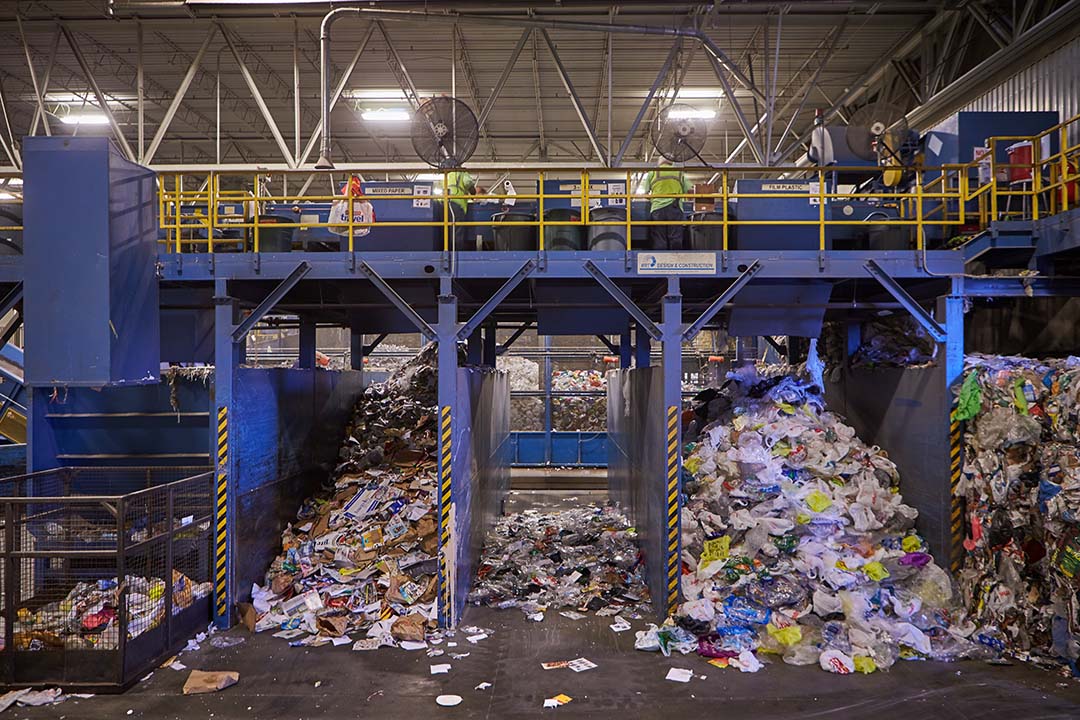
Nathiel Egosi, president of RRT Design & Construction, offered his thoughts during “Past, Present and Future of MRF Equipment,” a presentation hosted by the National Recycling Coalition (NRC) and Pennsylvania Recycling Markets Center.

The discussion of materials recovery facility (MRF) equipment and infrastructure comes amid a particularly daunting time for the recycling industry.

“Market liquidity in 2018 can only be described as awful,” Egosi said. “I don’t know any other way to say it politely.”

He noted MRF operators bear responsibility for some of the current strife. For example, Egosi described the practice of dressing a bale – that is, making it look clean from the outside and hiding the contamination in the center.

“This technique, used over the last 10 years, is what’s caused inspectors to be on-site now,” he said.

During the webinar, Egosi described some of the difficulties MRFs face today, and he offered his take on the huge investments that need to be made in order to improve the situation.

U.S. MRF challenges

MRFs are positioned to feel the brunt of the impact from two of the biggest issues facing the industry today. Contamination pushes up against the MRF on the input end, and material markets push back when bales are sold.

“The MRF sits in the middle, feeling the pressure from both sides,” said Egosi, whose company designs and builds processing facilities.

Changes in the material mix present significant challenges, as well. There’s less fiber in the stream than in years past, largely because of the decline in newsprint. And the fiber that remains has changed: OCC makes up a larger portion of the fiber stream than ever before. But due to the increase in e-commerce, the boxes defining the OCC mix are substantially smaller, which has an impact on the equipment required to sort it.

Overall, Egosi said, recycling companies are handling a lighter and more complex ton of recyclables.

Many facilities require huge investments to keep up, but such expenditures need to come with sound ROI strategies. MRFs are also hampered by a lack of confidence in their operations from the decision-making bodies (city council or other governing committee) that oversee them, Egosi said.

Recycling companies frequently rely on revenues to offset MRF operation costs, Egosi noted, and “that confuses what should really be a fee-based structure for a MRF operation.” Converting from a revenue-based to a fee-based structure is one of the top actions Egosi identified that would improve MRF economics.

Technology of tomorrow

Huge investments need to be made to advance the sortation industry, Egosi said, and there is a lot of room for advancement. He presented figures indicating 70 percent of discarded material in the U.S. goes straight to disposal, and that of the remainder that is processed for recycling, 50 percent of it is processed “poorly.”

Equipment will be a major focus for those investments. Optical sorters will continue to play a valuable role in the MRFs of the future, particularly for sorting fiber and flexible packaging, Egosi said. Robots can be useful, and they’ll be used more commonly in the next decade, but as a complement to optical sorters, according to Egosi. They work well as a quality control measure at the end of the line.

He expressed skepticism about the quality or utility of equipment claimed in advertisements. There are “lots of nice ads and interesting pieces of equipment that are very useful, but the justifications are weak to support some of this equipment.”

Egosi noted the reliability of some newer equipment is often low and there are “lots of unsubstantiated claims” about the machinery.

For example, he pointed out that robotic machinery is unit-based, such as a robotic arm pulling certain materials off the sort line. That means it’s performing a number of picks in a given time, not processing a specified weight. Converting a robot’s processing capacity to weight depends on the density of the material being sorted. Despite that distinction, robotic technology has been marketed with tons-per-hour claims, he said, which is not necessarily an accurate measurement of robot capacity.

Still, robotic technology is a “game changer” for the MRF industry, Egosi said.

As for whether facilities using the latest equipment can produce a bale with 0.5 percent contamination, in line with China’s new standards for many scrap material imports, Egosi said it depends.

“You can make one bale that gets there and the next one doesn’t,” he said. Getting near that level requires a “tremendous amount of investment,” Egosi said, potentially including more workers as well as additional optical sorters and other machinery. He noted the addition of more optical sorters has the best potential to produce a fiber product closer to the 0.5 percent.

But although lots of facilities are taking these steps, “it’s questionable whether anybody is really accomplishing the half a percent day in and day out, anywhere,” Egosi said.
 

NovoTec

TweetShare
Colin Staub

Colin Staub

Colin Staub was a reporter and associate editor at Resource Recycling until August 2025.

Related Posts

SERI works to restore faith in certifications

Building a defensible E-scrap evidence file

byMarcio Villanova
August 6, 2026

A pickup record confirms movement, but buyers need distinct evidence for custody, media sanitization, treatment, downstream disposition and unresolved exceptions.

tires

The most important decision in tire recycling happens before the shredder

byPaul Downey, Pliteq
August 3, 2026

Contamination gets the attention, but classification is the bottleneck that actually decides who wins.

Innovation. Partnership. Circular value.

Innovation. Partnership. Circular value.

bySibanye-Stillwater
August 1, 2026

As industries around the world accelerate their transition towards a circular economy, precious metals recycling is evolving from a necessary...

GFL raises 2026 guidance as Q2 revenue climbs 16.3%

byStefanie Valentic
July 30, 2026

GFL Environmental Inc. (NYSE: GFL) (TSX: GFL) reported second-quarter revenue of $1.95 billion, up 16.3% from $1.68 billion a year...

Spin-off lets Linca focus on battery mineral recovery

GAO: Policy, tech updates needed to bolster domestic mineral supply

byPaul Lane
July 30, 2026

Federal investigators say short- and long-term solutions are needed to decrease the nation’s reliance upon foreign-based minerals.

WM’s Q2 recycling and renewable energy EBITDA jumps

byStefanie Valentic
July 29, 2026

WM's recycling and renewable energy businesses drove nearly 33% EBITDA growth in Q2, even as commodity prices softened and the...

Load More
Next Post

U.S. and China enact opposing tariffs

2026 Buyers’ Guide

Equipment, services and technology suppliers serving the recycling industry.

Browse the Guide

More Posts

Certification Scorecard — Week of July 27, 2026

July 29, 2026
From claims to custody: PCR procurement grows up

From claims to custody: PCR procurement grows up

July 10, 2026
In Our Opinion: Coalitions: The EPR Differentiator

Inside NAW’s constitutional case against packaging EPR

July 6, 2026

NERC forum explores textile reuse

June 30, 2026
Report: Battery ‘retirement tide’ nears

Report: Battery ‘retirement tide’ nears

March 13, 2025
Our top stories from February 2025

Our top stories from February 2025

March 5, 2025

EPA seeking industry help in shaping new grants

May 25, 2022

Fiber pricing remains steady, mixed news for plastics

April 15, 2025

WM’s Q2 recycling and renewable energy EBITDA jumps

July 29, 2026

Facility fires on pace to match 2025

July 29, 2026
Load More

About & Publications

About Us

Staff

Archive

Magazine

Work With Us

Advertise
Jobs
Contact
Terms and Privacy

Newsletter

Get the latest recycling news and analysis delivered to your inbox every week. Stay ahead on industry trends, policy updates, and insights from programs, processors, and innovators.

Subscribe

Welcome Back!

Login to your account below

Forgotten Password?

Retrieve your password

Please enter your username or email address to reset your password.

Log In

Add New Playlist

No Result
View All Result
  • The Latest
  • Analysis
  • Recycling
  • E-Scrap
  • Plastics
  • Policy Now
  • Conferences
    • E-Scrap Conference
    • Plastics Recycling Conference
    • Resource Recycling Conference
    • Textiles Recovery Summit
  • Magazine
  • About Us
  • Advertise
  • Archive
  • Jobs
  • Staff
Subscribe
This website uses cookies. By continuing to use this website you are giving consent to cookies being used. Visit our Privacy and Cookie Policy.