




Resource Recycling
  • The Latest
  • Analysis
    • All
    • Certification Scorecard
    • Industry Announcements
    • Opinion
    NJ’s PCR delay risks making its own excuse permanently true

    NJ’s PCR delay risks making its own excuse permanently true

    E-scrap magnet recycling company scales up

    Why only some rare-earth sources are economically viable

    e-Stewards to develop an ITAD-specific standard

    Certification scorecard — week of Sept. 21

    Who should pay for lithium-ion battery fire damage?

    America’s critical-materials buildout has a feedstock problem

    Certification scorecard – week of Sept. 14

  • Conferences
    • Resource Recycling Conference
    • Plastics Recycling Conference
    • E-Scrap: The Longevity Conference
    • Textiles Recovery Summit
  • Publications
    • E-Scrap News
    • Plastics Recycling Update
    • Policy Now
    • Resource Recycling
    • Other Topics
      • All Topics
      • Brand Owners
      • Critical Minerals
      • Glass
      • Grant Watch / RFPs
      • Markets
      • Organics
      • Packaging
      • Research
      • Technology
      • Textiles
Subscribe
No Result
View All Result
Resource Recycling
  • The Latest
  • Analysis
    • All
    • Certification Scorecard
    • Industry Announcements
    • Opinion
    NJ’s PCR delay risks making its own excuse permanently true

    NJ’s PCR delay risks making its own excuse permanently true

    E-scrap magnet recycling company scales up

    Why only some rare-earth sources are economically viable

    e-Stewards to develop an ITAD-specific standard

    Certification scorecard — week of Sept. 21

    Who should pay for lithium-ion battery fire damage?

    America’s critical-materials buildout has a feedstock problem

    Certification scorecard – week of Sept. 14

  • Conferences
    • Resource Recycling Conference
    • Plastics Recycling Conference
    • E-Scrap: The Longevity Conference
    • Textiles Recovery Summit
  • Publications
    • E-Scrap News
    • Plastics Recycling Update
    • Policy Now
    • Resource Recycling
    • Other Topics
      • All Topics
      • Brand Owners
      • Critical Minerals
      • Glass
      • Grant Watch / RFPs
      • Markets
      • Organics
      • Packaging
      • Research
      • Technology
      • Textiles
Subscribe
No Result
View All Result
Resource Recycling
No Result
View All Result
Home Recycling

Carton robot boosts capture, reduces MRF residue

byJared Paben
May 30, 2023
in Recycling
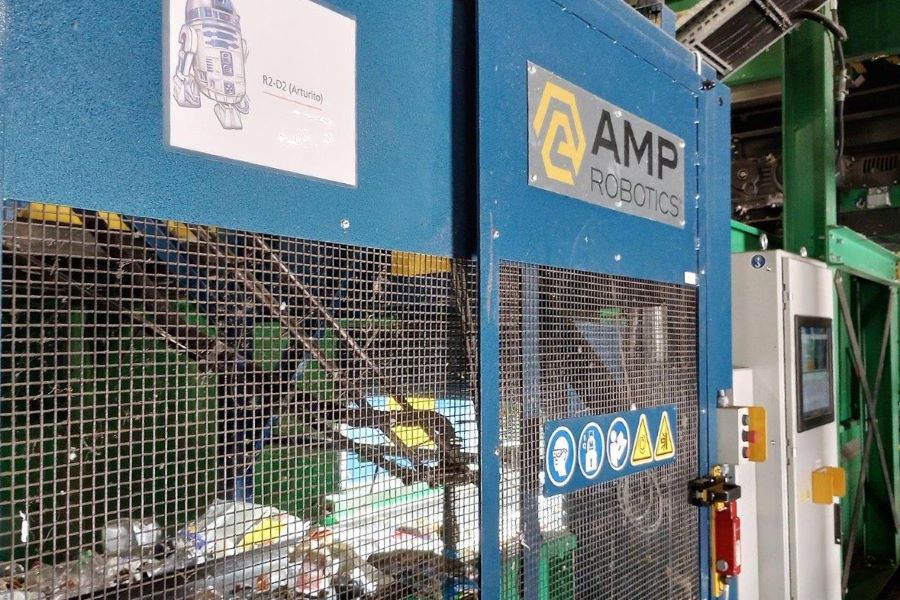
An AMP Robotics unit, nicknamed Arturito, is allowing the city of Dallas to accept cartons at curbside. | Courtesy of FCC Environmental

A recently installed carton-sorting robot at FCC Environmental Services’ Dallas MRF has reduced residue by about 11%, one reason the unit is “going to have a pretty big financial impact for us,” a company manager said. 

Bruce Magnuson, senior general manager for Texas recycling operations at FCC, described to Resource Recycling how the grant-funded robot is already yielding numerous financial and materials diversion benefits. He also described how the company paired the sorting technology with a unique materials handling strategy to overcome challenges in recovering a relatively low-volume commodity. 

“We’re just really pleased with it so far, and we’re really pleased we can increase the amount of recyclables we’re capturing and reduce the residue,” Magnuson said.

The AMP Robot was installed at the Dallas MRF in the third week of March, he said. According to a press release, funding for the unit came from a grant provided jointly by the Carton Council of North America (CCNA), the Foodservice Packaging Institute (FPI) and the NextGen Consortium, which is an effort led by Closed Loop Partners that focuses on reducing single-use foodservice packaging waste. 

From mixed paper to carton bales

FCC’s Dallas MRF sorts residential recyclables collected from the city and its neighboring communities. Prior to installation of the robot, the recycling program didn’t officially include cartons, but residents would often put them in the bin anyway. 

At the MRF, if a carton or plastic-lined cup followed other fiber over the sorting screens, it would end up in mixed-paper bales. That’s where a lot of MRFs, if they’re not producing carton-specific grades, sort and sell their cartons. But if the item fell through the screens, it would be disposed of along with other residue. 

Now, the AMP Generation 4.3 robot is picking cartons and paper cups from the MRF’s ‘last chance’ line, along with any PET bottles that have liquid in them and were not sorted by optical sorters. 

Magnuson, a former MRF manager at Waste Management (WM), said the unit performs much faster than the earlier-generation unit WM used at its Houston MRF.  The system normally operates at about 40-60 picks per minute but can work at up to 100 picks per minute, depending on material volumes and separation on the conveyor belts, he said.

Magnuson at at May 25, 2023, ribbon cutting for the AMP robot at FCC Environmental’s Dallas MRF.

The AMP unit is FCC’s first robot in Dallas, although the company’s Houston MRF uses a RoBB-AQC robot provided by Bollegraaf/Van Dyk Recycling Systems, he noted.

The robot has allowed the Dallas government, which collects recyclables for single-family and duplex homes in the city, to explicitly accept cartons from nearly half a million households. FCC now accepts the materials from other nearby communities served by the MRF, as well.   

“It was a big opportunity for the site to try to reduce this out of the waste stream,” Magnuson said. 

The Carton Council has been involved in trying to support carton recycling in Dallas before. Over a decade ago, the nonprofit group worked with the city government to help the recyclables processor that held the city contract at that time find end markets for the materials. After winning the 15-year city contract (with the possibility of a decade of extensions) in 2015, FCC built its Dallas MRF, which officially opened in early 2017.

Financial benefits become clear

So far, the robot has driven down residue tonnages by about 11%, Magnuson said.

The MRF is now producing carton-specific bales for sale to a paper mill, Magnuson said. The reduced disposal costs and increased commodity sales revenues are such that payback for the robot would be about six months or so, he estimated. 

“It would have been cost effective to do it even without a grant,” said Magnuson, who noted that FCC incurred other minimal electrical and air supply expenses related to the installation. 

Some MRFs don’t accept cartons because they lack the bunker space to dedicate to a relatively low-volume commodity such as cartons/cups. Space was initially a concern for FCC, too, Magnuson acknowledged.

To solve the bunker-space problem, FCC has the robot drop materials into a tip hopper, which staff empty a few times a shift into a 30-yard open top container, he explained. That container fills up every couple of days or so, at which point staff members bale the material, getting a couple of bales each time, he said. 

Given the capabilities of the robot, Magnuson said, he’s not concerned the system will be unable to keep up once residents begin to widely recognize the materials are now accepted. 

“At this point I’m not really worried from a capacity standpoint,” he said. “If we get to that point, I guess it would be a good problem to have and we’ll figure it out.” 
 

Tags: Industry GroupsMRFsPaper FiberTechnology
TweetShare
Jared Paben

Jared Paben

Related Posts

Analysis: Undersupply of PCR is ‘stifling’ brand goals

US lawmakers urge protection of domestic RPET

byAntoinette Smith
September 25, 2026

In a letter to the US Trade Representative, five representatives asked the USTR to consider trade remedies and support verification...

Oregon state capitol building with state flag and blue sky.

NAW appeals Oregon EPR ruling

byStefanie Valentic
September 25, 2026

NAW is challenging an Oregon judge's ruling in favor of the state's extended producer responsibility law.

Cutting healthcare plastics could save $18B

Report provides path to reduce medical e-scrap

byPaul Lane
September 25, 2026

The European report found that circularity in medical devices is possible through several potential initiatives.

APR reports success for 2026 recycling tours 

APR reports success for 2026 recycling tours 

byAntoinette Smith
September 23, 2026

In May, more than 2,500 visitors toured 41 facilities in the US and Mexico, during APR's second annual Recycling in...

Recyclers reeling from NJ PCR extension

Recyclers reeling from NJ PCR extension

byAntoinette Smith
September 23, 2026

The recent three-year extension for exemptions to the state's PCR mandates elicited frustration and confusion among recyclers.

Textile EPR and the definition of recycling

Textile Exchange reports progress in production

byPaul Lane
September 22, 2026

The organization said the industry has made some sustainability progress, but there’s much room for improvement.

Load More
Next Post

The latest news on glass recycling

2026 Buyers’ Guide

Equipment, services and technology suppliers serving the recycling industry.

Browse the Guide

More Posts

Oregon state capitol building with state flag and blue sky.

NAW appeals Oregon EPR ruling

September 25, 2026
Bin to Better gets students involved in reuse, recycling

Bin to Better gets students involved in reuse, recycling

September 24, 2026
Analysis: Undersupply of PCR is ‘stifling’ brand goals

US lawmakers urge protection of domestic RPET

September 25, 2026
Bipartisan reps introduce bill on recycling claims

House passes bill to ease lithium-ion battery storage rules

September 24, 2026
Calif. Governor Gavin Newsom at podium.

Newsom signs battery EPR expansion, vetoes SB 54 fund bill

September 24, 2026
Recyclers reeling from NJ PCR extension

Recyclers reeling from NJ PCR extension

September 23, 2026
Cutting healthcare plastics could save $18B

Report provides path to reduce medical e-scrap

September 25, 2026
Alpek closing Pennsylvania RPET plant

Alpek seizing on war-related opportunity 

July 27, 2026
E-scrap magnet recycling company scales up

Why only some rare-earth sources are economically viable

September 24, 2026
Jeff Fielkow and the startup that’s building the US packaging EPR system

Jeff Fielkow and the startup that’s building the US packaging EPR system

September 10, 2026
Load More

About & Publications

About Us

Staff

Archive

Magazines

Work With Us

Advertise
Jobs
Contact
Terms and Privacy

Newsletters

Get the latest recycling news and analysis delivered to your inbox every week. Stay ahead on industry trends, policy updates, and insights from programs, processors, and innovators.

Subscribe

Welcome Back!

Login to your account below

Forgotten Password?

Retrieve your password

Please enter your username or email address to reset your password.

Log In

Add New Playlist

No Result
View All Result
  • The Latest
  • Analysis
  • Recycling
  • E-Scrap
  • Plastics
  • Policy Now
  • Conferences
    • E-Scrap Conference
    • Plastics Recycling Conference
    • Resource Recycling Conference
    • Textiles Recovery Summit
  • Magazines
  • About Us
  • Advertise
  • Archive
  • Jobs
  • Staff
Subscribe
This website uses cookies. By continuing to use this website you are giving consent to cookies being used. Visit our Privacy and Cookie Policy.