





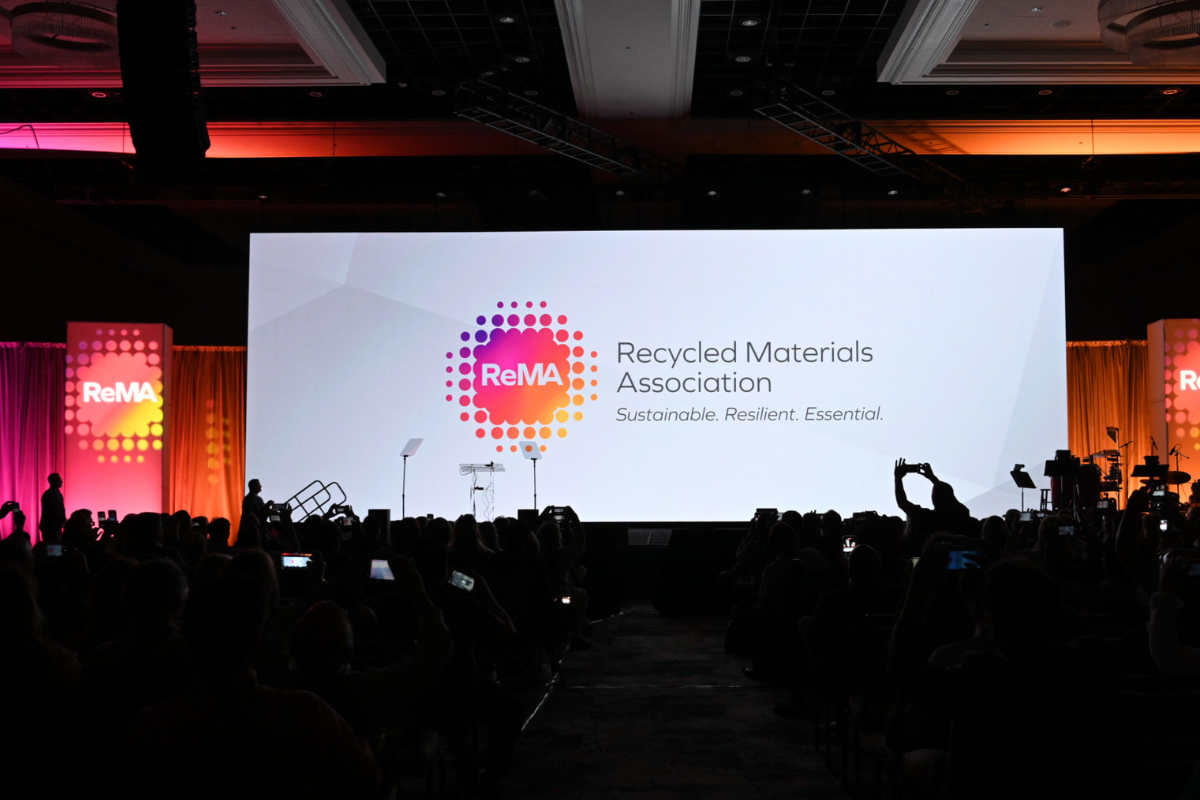
Companies from across the materials recovery spectrum gathered at Mandalay Bay in Las Vegas last week for the ISRI2024 conference, which culminated in the long-running trade association unveiling a new name.
The Institute of Scrap Recycling Industries announced at the end of the April 15-18 conference that it will now be known as the Recycled Materials Association, or ReMA. In a presentation about the name change, leaders at the industry association said ISRI’s rebranding had its roots in a 2012 focus group convened by ISRI to gauge public perceptions of recycling.
“It was a pretty eye-opening event, and revealed to many of us that the public saw us in a very different way than we saw ourselves,” said Brian Henesey, the organization’s outgoing chairman, during the closing session of the conference.
The public image of recycling has evolved substantially since then and has taken an increasingly negative turn in recent years, said Michael Maslansky, CEO of Maslansky + Partners, which assisted with the rebrand. At the same time, government regulators were taking a stronger interest in recycling and brands increasingly came into the recycling space, sometimes overshadowing recycling operators themselves, Maslansky said.
“This industry was not getting the credit that it deserved,” he said. By 2022, ISRI’s leadership decided to explore a name change. One of the key goals was to focus on the outcome of recycling – material production – rather than the first step in the process, scrap recycling. The group also sought to respond to a public perception that scrap equates with junk, even if industry stakeholders don’t hold that same association.
In addition to the name change, ReMA has a new tagline: “Sustainable. Resilient. Essential.” In a statement on the rebrand, the organization said these terms reflect the environmental aspects of recycling, its contribution to a resilient economy and its importance in providing staple products used in everyday life.
Besides the rebrand, the four-day conference featured an array of sessions highlighting paper, plastics, electronics and metals recycling.
Evolving trends in the fiber market
During a session highlighting paper markets, multiple speakers touched on how the recycled fiber landscape has changed over time. A few of those changes are in the amount of recycled content inclusion in new products and which products are driving demand.
Jose Gonzalez, a director at AFRY Management Consulting, said the share of recycled fiber in paper product production has grown from 30% in 1980 up to 55% in 2020. “Recycled fibers have become the most important raw material in papermaking,” he said.
He predicted that percentage will continue to grow, in part because of the growth of demand in product grades with high recycled content. AFRY projects global growth in containerboard, carton and tissue demand over the next decade. Global averages for recycled content are 83% for containerboard, 52% for cartonboard and 33% for tissue.
Those figures vary widely by geography, with North America averaging only 51% recovered fiber in containerboard. Still, “recycled grades are expected to hold their position due to lower price and pressure to increase the usage of recycled materials,” Gonzalez said.
Together, these grades today account for about 67% of recovered fiber demand, Gonzalez said, and they will grow to 75% of recovered fiber demand by 2035.
Another shift in the recycled fiber landscape comes in where recycled fiber moves after collection. Johnny Gold, a paper specialist at the Davis Index, noted that the tons of paper that used to go to China have shifted in the years since China restricted imports of many recyclables. India and southeast Asian countries have increased imports of U.S. fiber.
“Most importantly, though, more tons are staying right here in the United States and North America,” Gold said.
That’s been accompanied by U.S. mills making investments to increase the amount of recycled material they can use. The most recent major example is the Pratt Industries mill in Henderson, Kentucky, which opened in September. It uses 100% recycled fiber feedstock and has a capacity to produce 1,500 tons per day. Other large examples include new mills from Graphic Packaging in Waco, Texas, and Kalamazoo, Michigan.
“The U.S. paper mills are doing their job,” Gold said.
There’s one recycled fiber shift that has not settled out yet, he noted: adjusting to OCC moving into the residential stream and away from back-of-house at large retail locations. Significant investments by MRF operators are underway, including $1 billion in infrastructure upgrades by WM alone, but that the impact on paper recovery is still emerging, Gold said.
“With the continued increase in e-commerce, we as a country need to do a better job … in the recovery of good, clean fiber,” Gold said. “There are still way too many tons going back to landfills or waste-to-energy plants.”
Among recycling sectors, plastics face a unique challenge
In a discussion of plastics recycling trends, speakers touched on factors challenging the industry and emphasized the need for government intervention.
Nina Bellucci Butler, CEO of Stina Inc., presented some takeaways from the annual U.S. Post-consumer Plastic Recycling Data Dashboard. The latest edition, covering 2022, was released in March. It showed the amount of plastics collected for recycling dropped by 70 million pounds in 2022.
The consulting firm has compiled the annual plastics recycling report for 15 years now, and looking at the results over time, “we can see we are not making the progress we should be making,” Butler said. For instance, the weight of plastic collected for recycling has fluctuated over the last decade, but in 2022 it was flat compared with 2013.
There is a positive trend in where recovered plastic is being processed. The 2022 report indicated the share of material going to domestic processors has increased: Similar to the paper market shuffling after China’s import restrictions, the plastics sector faced a few years in flux as a massive quantity of post-consumer plastic was shut out from export to China.
Then, in 2019, scrap plastic exports faced another hurdle with changes to the Basel Convention that added new regulations for shipping mixed plastics. Last year, scrap plastic exports hit a record low.
All of these factors helped keep more material in the U.S.: 94.7% of collected post-consumer plastic went to North American processors in 2022, versus 69.4% in 2013.
“That’s a positive trend that we’re seeing an overall increase in how much is being purchased, despite all of the headwinds that recyclers face,” Butler said.
Those headwinds include massive new virgin resin capacity coming online globally, U.S. reclaimers facing domestic supply shortfalls and looking to Canada for bales, and a surge in RPET imports making it difficult for domestic reclaimers to compete.
Scott Saunders, general manager of KW Plastics, said all of those trends will continue to challenge the plastics recycling sector. In particular, the onslaught of virgin material in the market will keep making it difficult for recycled resin to compete. Those factors are here for the foreseeable future, and the question is how the industry adapts.
Saunders identified two key tools to strengthen plastics recycling. First, he called for a focus on starting up more curbside programs. Growth in processing can only do so much without capturing more material at the household level to begin with.
“Unless that is expanded, the rate of recycling cannot grow,” Saunders said.
He was also blunt about the economics of plastics recycling and the need for policy intervention.
“It is not profitable to collect a plastic container from the home without something, something spurring that along,” Saunders said. That means either the consumer is paying a fee for curbside recycling or a deposit on the product at point of sale, or the producer is paying the cost to recycle the product.
The latter policy, extended producer responsibility, is in development in four U.S. states. That policy is in its infancy, he noted, and it remains to be seen how it will play out for plastics reclaimers. But policy in some form is a must, Saunders said, noting that fact sets reclaimers apart from other recycling sectors, like metals, where processors can rely on the economic value of the recovered material to make the process profitable.
“It takes some interaction between a government entity and the consumer, and that is where we’re totally different from the rest of the ISRI membership,” he said.