



Resource Recycling
  • The Latest
  • Analysis
    • All
    • Certification Scorecard
    • Industry Announcements
    • Opinion
    SERI works to restore faith in certifications

    Building a defensible E-scrap evidence file

    tires

    The most important decision in tire recycling happens before the shredder

    Intel sign outside of company building.

    Intel’s CapEx tops $20B on server demand while PC volume shrinks

    Google sign on company building with blue sky and clouds above.

    Inside Alphabet’s Q2 results: More capital spending and cloud backlog

    Alpek closing Pennsylvania RPET plant

    Alpek seizing on war-related opportunity 

    Our top stories from March 2023

    Iron Mountain’s data center report: Strong on power, quiet on hardware

  • Conferences
    • Resource Recycling Conference
    • Plastics Recycling Conference
    • E-Scrap: The Longevity Conference
    • Textiles Recovery Summit
  • Publications
    • E-Scrap News
    • Plastics Recycling Update
    • Policy Now
    • Resource Recycling
    • Other Topics
      • All Topics
      • Brand Owners
      • Critical Minerals
      • Glass
      • Grant Watch / RFPs
      • Markets
      • Organics
      • Packaging
      • Research
      • Technology
      • Textiles
Subscribe
No Result
View All Result
Resource Recycling
  • The Latest
  • Analysis
    • All
    • Certification Scorecard
    • Industry Announcements
    • Opinion
    SERI works to restore faith in certifications

    Building a defensible E-scrap evidence file

    tires

    The most important decision in tire recycling happens before the shredder

    Intel sign outside of company building.

    Intel’s CapEx tops $20B on server demand while PC volume shrinks

    Google sign on company building with blue sky and clouds above.

    Inside Alphabet’s Q2 results: More capital spending and cloud backlog

    Alpek closing Pennsylvania RPET plant

    Alpek seizing on war-related opportunity 

    Our top stories from March 2023

    Iron Mountain’s data center report: Strong on power, quiet on hardware

  • Conferences
    • Resource Recycling Conference
    • Plastics Recycling Conference
    • E-Scrap: The Longevity Conference
    • Textiles Recovery Summit
  • Publications
    • E-Scrap News
    • Plastics Recycling Update
    • Policy Now
    • Resource Recycling
    • Other Topics
      • All Topics
      • Brand Owners
      • Critical Minerals
      • Glass
      • Grant Watch / RFPs
      • Markets
      • Organics
      • Packaging
      • Research
      • Technology
      • Textiles
Subscribe
No Result
View All Result
Resource Recycling
No Result
View All Result
Home Resource Recycling Magazine

Community Spotlight: How one SoCal beach town takes on diversion challenges

Colin StaubbyColin Staub
September 4, 2017
in Resource Recycling Magazine

It’s known for its laid back surfing and skating culture, but Santa Monica, Calif. has been serious when it comes to recycling.

The Southern California community, which started its program 26 years ago, has notched a 79 percent diversion rate. And it’s pushing for 95 percent by 2030. That lofty goal is one component of a wider sustainability strategy Santa Monica has adopted to reduce its environmental impact.

But the coastal community is surrounded by Los Angeles on three sides and draws millions of tourists each year, which means it also faces some daunting outreach and education challenges when it comes to pushing for further diversion.

City hauls all streams

Recycling in Santa Monica dates back to 1991, when leaders divided the city into more than 100 recycling zones and deposit points were established in each neighborhood. Back in the early days, Santa Monica followed a source-separation model with residents sorting newspaper, plastics, metals and glass.

Santa Monica’s recycling mascot, Curby, helps on outreach.

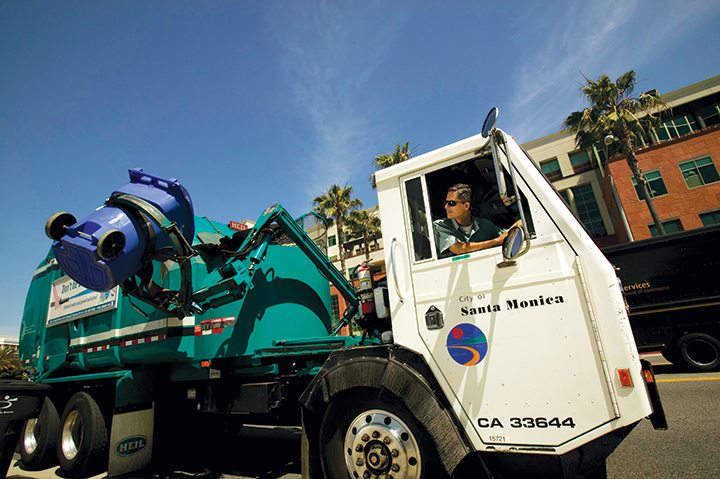
Single-family homes separated each material into buckets, which recycling truck drivers would collect by hand. In 1999, the recycling trucks became automated and the program switched to blue recycling containers, with the recycling zones still in place. Four years later, the municipality switched to a single-stream program, which is the mechanism in place today.

The recycling zones, however, were eliminated in favor of city-operated collection from all properties. Now, employees of the Public Works Department collect recyclables from all single-family homes, multi-family buildings and commercial businesses.

“It’s kind of a unique structure,” acknowledged Chanel Kincaid, zero waste coordinator for the city.

Residents receive curbside carts that accept plastics Nos. 1-5 and 7, as well as aluminum, glass, paper, cardboard and even bundled plastic bags. Recycling is collected weekly and is funded through the utility fees residents pay for garbage collection. Recyclables are transported directly to a MRF in the area while compost and waste go to a transfer station.

Influx challenges lead to innovative thinking

The program has encountered some difficulties. Outreach, in particular, poses problems due to the city’s popularity as a tourist attraction and economic center. The city’s contamination rate runs an average of 17.5 percent, taking all the streams into account.

Santa Monica has about 50,000 households, three-quarters of which are designated as multi-family. All told, nearly 93,000 people live in the city – but that doesn’t tell the whole story as far as recycling collection goes. Thousands of people commute into Santa Monica for work each day, and even more come to visit.

Public education is tackled through a broad range of platforms. The city sends a quarterly newsletter, posts social media updates, publishes an e-newsletter and hosts monthly waste reduction events. It also dispatches “Curby,” the city’s recycling mascot, to community events.

“We try to make it fun for the residents, and also informational,” Kincaid explained.

And then there’s the Santa Monica Pier, which brings in millions of visitors and tourists each year. This means a lot of attendees who don’t know the city’s recycling rules and could damage diversion through contamination.

“The pier is tricky, to be honest,” Kincaid said. Collection is problematic as many trucks can’t drive directly onto the pier, so materials must be transported back to the shore using other means.

Kincaid said the city is working to come up with innovative methods of recovery, given the location constraints and high traffic.

“To meet our diversion goals we need to get that material and divert as much as possible,” she said.

Off the pier, organics recovery is an area of particular focus in multiple pilot programs, since more than 40 percent of the material being landfilled is organics, Kincaid said.

Thanks in part to its bustling pier, Santa Monica welcomes 8.4 million tourists annually, which can lead to inconsistencies in what ends up in recycling bins.

One pilot program, titled “To Rot or Not,” was based on a wet-dry program but aimed to recover a cleaner organics stream than what is usually generated by a mixed-waste collection. Another initiative is a multi-family organics collection pilot program and includes establishing resident liaisons who will have a role in managing the programs for the buildings they live in.

Local ordinances

California often leads the way in regulation, imposing restrictions and bans that eventually work their way into laws in other states and municipalities. But within California there are cities that are early adopters of ordinances that are later widened into state laws. Santa Monica was among the early implementers of a polystyrene (PS) food-service packaging ban, which was passed in 2007, the same year San Francisco and Oakland adopted similar measures.

Santa Monica was early in implementing a wider sustainability plan as well, bringing one into effect in 1994. The plan sets sustainability benchmarks, some of which are recycling-related, that the city will strive to hit by certain dates. Right now, the plan aims for 85 percent diversion by 2020.

More recently, the city has enacted a solid-waste-specific zero waste plan, which aims for 95 percent diversion by 2030. The effort is multi-pronged, touching on reuse, outreach, extended producer responsibility, the EPA waste management hierarchy and more.

This article originally appeared in the August issue of Resource Recycling. Subscribe today for access to all print content.

Tags: Local Programs
TweetShare
Colin Staub

Colin Staub

Colin Staub was a reporter and associate editor at Resource Recycling until August 2025.

Related Posts

Compudopt names new CEO

Compudopt names new CEO

byPaul Lane
July 24, 2026

Allison Kotarski will lead the Texas-based nonprofit, which gets refurbished electronics into new hands.

Utah highway project to reuse pavement

Utah highway project to reuse pavement

byAntoinette Smith
July 2, 2026

The state Department of Transportation is using cold in-place recycling to repurpose existing roadway, save millions and reduce emissions.

CalRecycle updates EPR covered materials list

CalRecycle awards $41m in grants, loans

byIsabella Burke
June 22, 2026

The funding from the state recycling agency is aimed at expanding recycling access, supporting workforce development and increasing textile recycling...

NYC, Mack Trucks unveil winning artwork

NYC, Mack Trucks unveil winning artwork

byAntoinette Smith
June 4, 2026

The five new hand-painted waste collection trucks feature themes of honor, resilience and care, and will operate in the city's...

Extruder pushes out natural HDPE pellets at KW Plastics in Troy, Alabama.

Rare look inside the world’s largest plastics recycler

byBrian Clark Howard
May 13, 2026

KW Plastics in Troy, Alabama is a leading recycler of PP and HDPE—here’s a glimpse behind the gates.

Bill to update New Jersey e-scrap program heads to governor

New Jersey recyclers talk EPR

byBrian Clark Howard
April 9, 2026

At the Association of New Jersey Recyclers’ spring meeting industry representatives discussed the state and future of the sector.

Load More
Next Post
Meet the Speakers: Linda Li, Re-Teck

Meet the Speakers: Linda Li, Re-Teck

2026 Buyers’ Guide

Equipment, services and technology suppliers serving the recycling industry.

Browse the Guide

More Posts

State policy is redefining plastics recycling in the US

State policy is redefining plastics recycling in the US

February 19, 2026
Closeup of a printed circuitboard

Hardware demand puts new focus on parts harvesting

June 5, 2026
Apple store

Apple leads on inputs, faces questions on ITAD

May 1, 2026
Analysis: circular design still elusive in laptops

PC shipments grew in Q1, but questions remain

April 23, 2026

Recycled copper output climbs as market shows surplus

April 6, 2026

In other news: May 2, 2016

May 2, 2016

Umicore highlights strength in recycling, catalysis

February 20, 2026
California bill would set up EPR for batteries

California bill would set up EPR for batteries

May 12, 2022
Ten e-scrap projects receive federal prize funds

Recycling rates for rare earths could double by 2040

July 17, 2026

ITAD is moving past its adolescent phase: beyond end-of-life

June 10, 2026
Load More

About & Publications

About Us

Staff

Archive

Magazine

Work With Us

Advertise
Jobs
Contact
Terms and Privacy

Newsletter

Get the latest recycling news and analysis delivered to your inbox every week. Stay ahead on industry trends, policy updates, and insights from programs, processors, and innovators.

Subscribe

Welcome Back!

Login to your account below

Forgotten Password?

Retrieve your password

Please enter your username or email address to reset your password.

Log In

Add New Playlist

No Result
View All Result
  • The Latest
  • Analysis
  • Recycling
  • E-Scrap
  • Plastics
  • Policy Now
  • Conferences
    • E-Scrap Conference
    • Plastics Recycling Conference
    • Resource Recycling Conference
    • Textiles Recovery Summit
  • Magazine
  • About Us
  • Advertise
  • Archive
  • Jobs
  • Staff
Subscribe
This website uses cookies. By continuing to use this website you are giving consent to cookies being used. Visit our Privacy and Cookie Policy.