




Resource Recycling
  • The Latest
  • Analysis
    • All
    • Certification Scorecard
    • Industry Announcements
    • Opinion
    NJ’s PCR delay risks making its own excuse permanently true

    NJ’s PCR delay risks making its own excuse permanently true

    E-scrap magnet recycling company scales up

    Why only some rare-earth sources are economically viable

    e-Stewards to develop an ITAD-specific standard

    Certification scorecard — week of Sept. 21

    Who should pay for lithium-ion battery fire damage?

    America’s critical-materials buildout has a feedstock problem

    Certification scorecard – week of Sept. 14

  • Conferences
    • Resource Recycling Conference
    • Plastics Recycling Conference
    • E-Scrap: The Longevity Conference
    • Textiles Recovery Summit
  • Publications
    • E-Scrap News
    • Plastics Recycling Update
    • Policy Now
    • Resource Recycling
    • Other Topics
      • All Topics
      • Brand Owners
      • Critical Minerals
      • Glass
      • Grant Watch / RFPs
      • Markets
      • Organics
      • Packaging
      • Research
      • Technology
      • Textiles
Subscribe
No Result
View All Result
Resource Recycling
  • The Latest
  • Analysis
    • All
    • Certification Scorecard
    • Industry Announcements
    • Opinion
    NJ’s PCR delay risks making its own excuse permanently true

    NJ’s PCR delay risks making its own excuse permanently true

    E-scrap magnet recycling company scales up

    Why only some rare-earth sources are economically viable

    e-Stewards to develop an ITAD-specific standard

    Certification scorecard — week of Sept. 21

    Who should pay for lithium-ion battery fire damage?

    America’s critical-materials buildout has a feedstock problem

    Certification scorecard – week of Sept. 14

  • Conferences
    • Resource Recycling Conference
    • Plastics Recycling Conference
    • E-Scrap: The Longevity Conference
    • Textiles Recovery Summit
  • Publications
    • E-Scrap News
    • Plastics Recycling Update
    • Policy Now
    • Resource Recycling
    • Other Topics
      • All Topics
      • Brand Owners
      • Critical Minerals
      • Glass
      • Grant Watch / RFPs
      • Markets
      • Organics
      • Packaging
      • Research
      • Technology
      • Textiles
Subscribe
No Result
View All Result
Resource Recycling
No Result
View All Result
Home Recycling

Rethinking Europe’s cup-return model for US venues

Stefanie ValenticbyStefanie Valentic
September 10, 2026
in Recycling, Resource Recycling Magazine
Rethinking Europe’s cup-return model for US venues

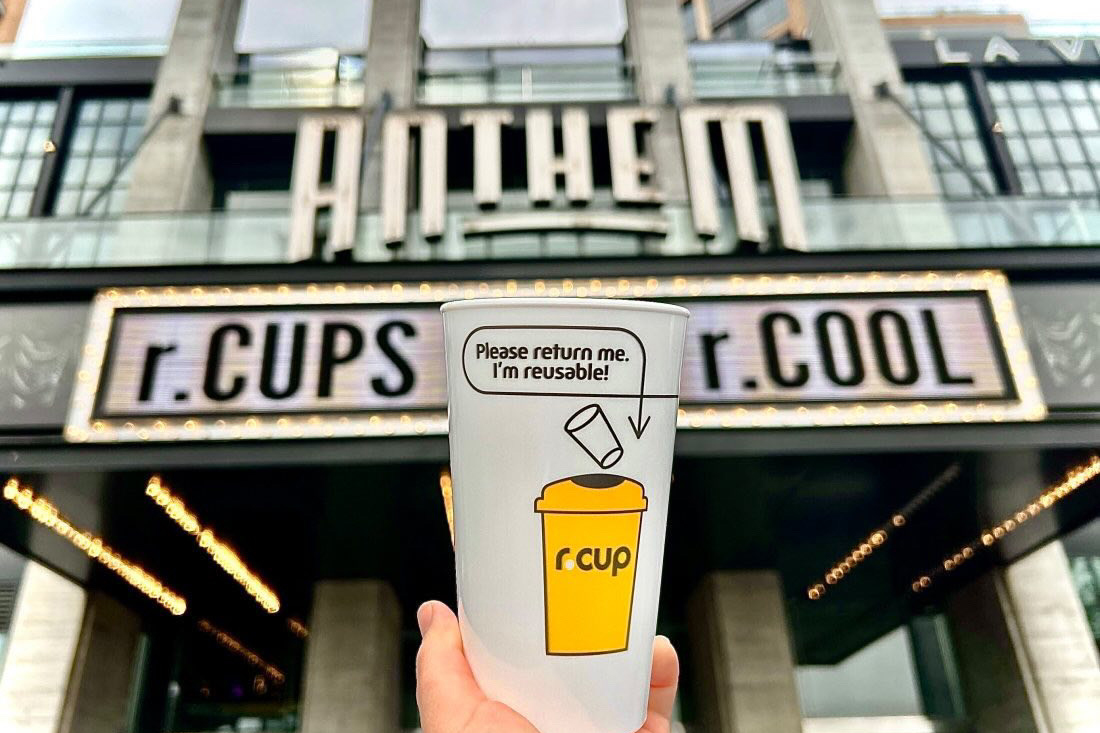
Courtesy IMP / r.World

Reusable cup and foodware programs are expanding across US venues, arenas and festivals, but the systems driving them look little like their European counterparts, according to Michael Martin, CEO and founder of r.World.

The company, which provides reusable cup, foodware and packaging systems for live events, was founded after Martin encountered reusable cup programs at U2 shows in Europe. The Minnesota-based company launched in 2017 as r.Cup, rebranding to r.World in 2023.

Tottenham Hotspur Stadium’s reusable cup program, which employs the kind of closed-loop system common across European venues, saves more than 1.25 million cups a year by washing and recirculating them rather than sending them to landfill after a single use. But Martin said that model broke down almost immediately when applied to US venues, geography and consumer behavior.

“What I brought back was not just the idea of a reusable cup,” Martin said. “It was the realization that America needed to move upstream from recycling and composting and begin building a true reuse economy.”

The global reusable packaging market was valued at $135.8 billion in 2024 and is projected to reach $190.1 billion by 2030, growing at a 5.9% CAGR, according to Grand View Research. North America holds the largest share of that market, and food and beverage is the top end-use segment.

The first pain point in Martin’s US rollout: deposits. In Europe, paying a small fee for a cup and getting it back on return is baked into the culture, a way of life. While r.World tried it, the results weren’t the same.

“When we tried that in the US, consumers just thought they had purchased the cup to keep,” Martin said.

Concessionaires hated the hassle of cash-handling. Large events saw bottlenecks at exit points as people lined up for refunds. In response, r.World scrapped the deposit model for most live events and rebuilt around design and behavior instead, a “utilitarian look” for cups and foodware, stripped of the souvenir appeal that makes people pocket a nice item on the way out.

The fix worked. Martin said r.World now regularly sees return rates above 90%, with some venues landing in the mid-to-high 90s.

And scalability matters: a single NFL game generates over 80,000 pounds of waste per stadium, totaling more than 44 million pounds across a season, and other estimates put a typical game’s waste at roughly 35 tons, a figure that can balloon by up to 50% for the Super Bowl, according to industry experts. Sporting events overall generate an estimated 39 million pounds of trash per year in the US, the volume r.World and competitors are trying to divert one cup at a time.

While deposits haven’t disappeared entirely, Martin said they still work on corporate campuses and university settings in closed, repeat-visitor environments where r.World hits 99% returns. But for stadiums, festivals and touring shows, the company leans on something closer to behavioral design than financial incentive.

“The goal isn’t to rely on incentives or penalties,” Martin said. “It’s to build a system where doing the right thing is easy, and people feel good about being part of it.”

Geography is the second speed bump. While Europe’s density supports centralized wash facilities and shorter transport runs, the US doesn’t offer that luxury. r.World’s answer is regional wash hubs built around metro density, and more venues and corporate partners in a given market translates to more wash volume and better logistics economics.

Venue type matters too. Stadiums and arenas were r.World’s starting point because they’re controlled: predictable foot traffic, trainable staff, guests who can’t leave with product in hand. Festivals and touring productions are harder with different sites, different crews and temporary infrastructure that has to be rebuilt and customized event to event. r.World now runs recurring programs at venues including Crypto.com Arena, the St. Paul Saints, Vans Warped Tour and Camp Flog Gnaw. Martin said return rates tend to climb over a season as fans and staff get more comfortable with the system.

What surprised him most wasn’t consumer resistance, but it was the absence of it.

“I’ve been more surprised by the optimism than the resistance,” Martin said. “In pretty much all cases, the hesitation is on the operational side, not the consumer side.”

Martin sees US reuse infrastructure following a similar arc to Europe’s shared, pooled systems across multiple brands and venues, but says the market has to build density and trust first through closed-loop, single-operator programs.

“Our goal isn’t to create isolated programs but to build the national reuse infrastructure,” Martin said, “and we’re doing it city by city.”

This story first appeared in the August 2026 issue of Resource Recycling Magazine.

Tags: Repair & Reuse
TweetShare
Stefanie Valentic

Stefanie Valentic

Stefanie Valentic is an award-winning journalist who has covered the waste and recycling industry for more than five years. Throughout her career, she has led editorial teams and served as a keynote speaker, moderator and panelist at numerous trade shows and conferences.

Related Posts

Cutting healthcare plastics could save $18B

Report provides path to reduce medical e-scrap

byPaul Lane
September 25, 2026

The European report found that circularity in medical devices is possible through several potential initiatives.

Van filled with rolled carpeting for recycling or disposal.

California carpet recycling rate reaches 37%

byBrian Clark Howard
September 17, 2026

The state’s recycling rate rose for the sixth year in a row, despite challenging market conditions.

Google Pixel 6 phone

Google makes repairability part of design ethos

byBrian Clark Howard
September 16, 2026

The tech titan supports the right-to-repair movement in several key ways.

The barrier isn’t tech. It’s leadership.

The owner should decide: iFixit’s Matt Zieminski on repair

byUriah Kiser, Resource Recycling Podcast
September 15, 2026

On this episode of the Resource Recycling Podcast, Uriah Kiser talks with Matt Zieminski, Vice President of Partnerships at iFixit,...

Report shows $5B in materials saved from landfills

Reinvigorating reuse

byPaul Lane
September 10, 2026

Legislation may help spark renewed interest in reusing consumer items.

Revino gets grant to expand reusable wine bottles into CA

byIsabella Burke
August 5, 2026

The Oregon-based startup will use the funding to build a commercial bottle-washing facility in Lompoc, California.

Load More
Next Post
California’s circular experiment: A new environmentalism emerges

California’s circular experiment: A new environmentalism emerges

2026 Buyers’ Guide

Equipment, services and technology suppliers serving the recycling industry.

Browse the Guide

More Posts

Recyclers reeling from NJ PCR extension

Recyclers reeling from NJ PCR extension

September 23, 2026
Oregon state capitol building with state flag and blue sky.

NAW appeals Oregon EPR ruling

September 25, 2026
Colorado’s EPR programs move from planning to practice

Colorado’s EPR programs move from planning to practice

September 17, 2026
Bin to Better gets students involved in reuse, recycling

Bin to Better gets students involved in reuse, recycling

September 24, 2026

Who should pay for lithium-ion battery fire damage?

September 21, 2026

SB 54 plan for cartons, film draws warning

September 15, 2026
Industry announcements for January 2026

Industry announcements for September 2026

August 31, 2026
Calif. Governor Gavin Newsom at podium.

Newsom signs battery EPR expansion, vetoes SB 54 fund bill

September 24, 2026
Bipartisan reps introduce bill on recycling claims

House passes bill to ease lithium-ion battery storage rules

September 24, 2026
US packaging is evolving. The recycling system isn’t ready

US packaging is evolving. The recycling system isn’t ready

September 16, 2026
Load More

About & Publications

About Us

Staff

Archive

Magazines

Work With Us

Advertise
Jobs
Contact
Terms and Privacy

Newsletters

Get the latest recycling news and analysis delivered to your inbox every week. Stay ahead on industry trends, policy updates, and insights from programs, processors, and innovators.

Subscribe

Welcome Back!

Login to your account below

Forgotten Password?

Retrieve your password

Please enter your username or email address to reset your password.

Log In

Add New Playlist

No Result
View All Result
  • The Latest
  • Analysis
  • Recycling
  • E-Scrap
  • Plastics
  • Policy Now
  • Conferences
    • E-Scrap Conference
    • Plastics Recycling Conference
    • Resource Recycling Conference
    • Textiles Recovery Summit
  • Magazines
  • About Us
  • Advertise
  • Archive
  • Jobs
  • Staff
Subscribe
This website uses cookies. By continuing to use this website you are giving consent to cookies being used. Visit our Privacy and Cookie Policy.