





Resource Recycling
  • The Latest
  • Analysis
    • All
    • Certification Scorecard
    • Industry Announcements
    • Opinion
    SERI works to restore faith in certifications

    Building a defensible E-scrap evidence file

    tires

    The most important decision in tire recycling happens before the shredder

    Intel sign outside of company building.

    Intel’s CapEx tops $20B on server demand while PC volume shrinks

    Google sign on company building with blue sky and clouds above.

    Inside Alphabet’s Q2 results: More capital spending and cloud backlog

    Alpek closing Pennsylvania RPET plant

    Alpek seizing on war-related opportunity 

    Our top stories from March 2023

    Iron Mountain’s data center report: Strong on power, quiet on hardware

  • Conferences
    • Resource Recycling Conference
    • Plastics Recycling Conference
    • E-Scrap: The Longevity Conference
    • Textiles Recovery Summit
  • Publications
    • E-Scrap News
    • Plastics Recycling Update
    • Policy Now
    • Resource Recycling
    • Other Topics
      • All Topics
      • Brand Owners
      • Critical Minerals
      • Glass
      • Grant Watch / RFPs
      • Markets
      • Organics
      • Packaging
      • Research
      • Technology
      • Textiles
Subscribe
No Result
View All Result
Resource Recycling
  • The Latest
  • Analysis
    • All
    • Certification Scorecard
    • Industry Announcements
    • Opinion
    SERI works to restore faith in certifications

    Building a defensible E-scrap evidence file

    tires

    The most important decision in tire recycling happens before the shredder

    Intel sign outside of company building.

    Intel’s CapEx tops $20B on server demand while PC volume shrinks

    Google sign on company building with blue sky and clouds above.

    Inside Alphabet’s Q2 results: More capital spending and cloud backlog

    Alpek closing Pennsylvania RPET plant

    Alpek seizing on war-related opportunity 

    Our top stories from March 2023

    Iron Mountain’s data center report: Strong on power, quiet on hardware

  • Conferences
    • Resource Recycling Conference
    • Plastics Recycling Conference
    • E-Scrap: The Longevity Conference
    • Textiles Recovery Summit
  • Publications
    • E-Scrap News
    • Plastics Recycling Update
    • Policy Now
    • Resource Recycling
    • Other Topics
      • All Topics
      • Brand Owners
      • Critical Minerals
      • Glass
      • Grant Watch / RFPs
      • Markets
      • Organics
      • Packaging
      • Research
      • Technology
      • Textiles
Subscribe
No Result
View All Result
Resource Recycling
No Result
View All Result
Home Recycling

In Our Opinion: Policy leaders should embrace the Zero Waste Hierarchy

byGary Liss and Jamie Kaminski
July 29, 2025
in Recycling
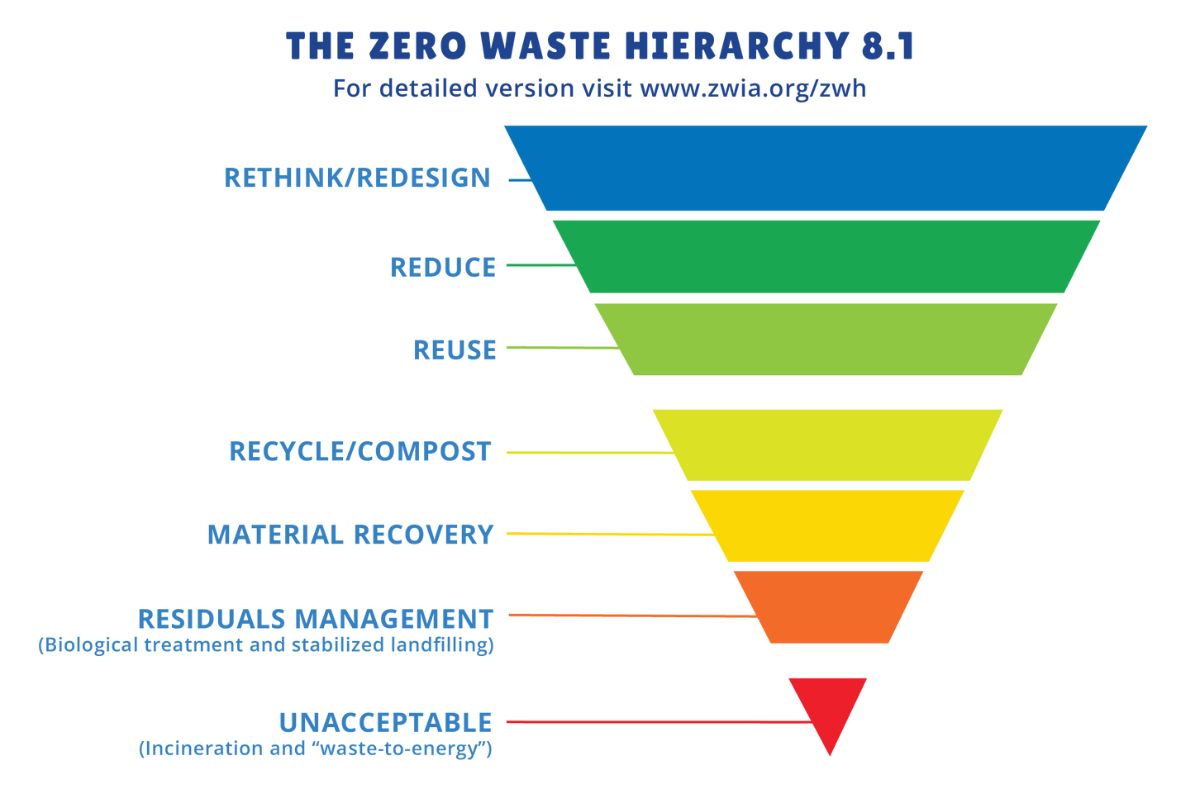
The Zero Waste Hierarchy was recently updated with refined definitions, a new guiding principle and more. | Photo courtesy Zero Waste International Alliance

Waste hierarchies have become essential tools for setting policy direction at every level of government. By clearly communicating which strategies are most environmentally and socially preferable, they help guide decisions on infrastructure investment, program design, and regulatory priorities.

The USEPA’s 2023 Wasted Food Scale is a recent example of this approach in action. For the first time, the EPA placed incineration (with or without energy recovery) on the same level as landfilling, a notable departure from earlier hierarchies that often ranked energy recovery above disposal. This change aligns with findings in the EPA’s 2023 report, From Field to Bin: The Environmental Impacts of U.S. Food Waste Management Pathways, which concluded that landfilling, incineration, and sending food waste down the drain have the largest environmental impacts and offer the least potential for circularity.

By recognizing that waste prevention, food donation, and upcycling as far more beneficial, the EPA has taken a meaningful step toward more accurate and effective policy direction. The Wasted Food Scale, as EPA notes, “reflects the latest science and changes in technologies and operational practices for wasted food management pathways.”

This kind of recalibration, one that clarifies what truly supports environmental progress, is exactly what’s needed more broadly in waste policy. And it’s why a growing number of governments, organizations, and institutions are now turning to the Zero Waste Hierarchy.

Recently updated as Version 8.1, the Zero Waste Hierarchy offers a comprehensive framework for managing all discarded materials, in a way that aligns with the latest environmental, economic, and health priorities. It places emphasis on rethinking, redesigning, and reducing waste upstream, and provides detailed guidance on acceptable and unacceptable practices throughout the lifecycle of materials.

The Zero Waste Hierarchy makes a clear break from frameworks that still include energy recovery technologies like incineration, pyrolysis, and gasification. These practices are fundamentally at odds with Zero Waste principles because they destroy resources, generate harmful emissions, and undermine efforts to build truly circular systems. By explicitly rejecting these approaches, the hierarchy reinforces the need to invest in solutions that preserve material value and prevent waste at the source.

By expanding its focus beyond materials to include equity and lifecycle considerations, the Zero Waste Hierarchy offers governments and institutions a more complete framework for decision-making.

The Zero Waste Hierarchy Version 8.1 strengthens the Hierarchy’s practical value for policymakers, institutions, and communities by incorporating clearer terminology, deeper ethical guidance, and thoughtful flexibility for regional implementation.

Key updates in the Zero Waste Hierarchy Version 8.1 include:

  • Refined Definitions: Updated terminology for circular economy, composting, and closed-loop systems to ensure consistency and support clear implementation.
  • New Guiding Principle – Do No Harm: This principle encourages organizations to evaluate the full lifecycle impacts of materials and prioritize choices that reduce harm to people and the environment.
  • Stronger Language for Do Not Export Harm: Expanded language ensures materials aren’t sent to regions with weaker health or environmental standards or where they are unwanted.

The Zero Waste Hierarchy and its updates were developed through the collective input and expertise of Zero Waste organizations and leaders worldwide, including Zero Waste Canada, Zero Waste British Columbia, Zero Waste USA, Zero Waste Europe, the Global Alliance for Incinerator Alternatives, and the Energy Justice Network. Additionally, the draft update was shared with the global Zero Waste network for review and comments to ensure comprehensive insights and enhancement, including over 500 Zero Waste International Alliance (ZWIA) members and 60 ZWIA affiliates worldwide.

ZWIA is a global organization committed to advancing Zero Waste principles through the development of tools, policies, and networks that promote sustainability and social justice. ZWIA leads the evolution of Zero Waste definitions and standards, offering resources to guide communities and organizations toward meaningful change.

Just as the EPA’s Wasted Food Scale reflects the agency’s responsiveness to current research and operational realities, the Zero Waste Hierarchy reflects where the broader field of sustainable materials management and circular economy are headed. These frameworks represent complementary steps along the same path.

ZWIA is calling on all levels of government to build on this momentum by updating their waste hierarchies to follow or align with the Zero Waste Hierarchy. This shift enables more strategic policymaking, steers investment away from systems with limited long-term value, and accelerates the transition to approaches that conserve resources, protect public health, and reduce emissions. As more jurisdictions update their approaches to strengthen circular economy outcomes, many are recognizing that the Zero Waste Hierarchy provides greater clarity and precision.  

The full 14-page Version 8.1 of the Zero Waste Hierarchy can be found at zwia.org/zwh.

Gary Liss is Chair of the Zero Waste Certifications Committee of ZWIA, Vice President of Zero Waste USA, Lifetime Honorary Board Member of the National Recycling Coalition, and Principal of Zero Waste Associates.

Jamie Kaminski is Chair of the Zero Waste Hierarchy Working Group at ZWIA, a Board Member of Zero Waste Canada, and President of HSR Zero Waste. He leads work for ZWIA on policy development and implementation of the Zero Waste Hierarchy, helping guide communities, businesses, and institutions toward more effective waste prevention and materials management strategies.


TweetShare
Gary Liss and Jamie Kaminski

Gary Liss and Jamie Kaminski

Related Posts

SERI works to restore faith in certifications

Building a defensible E-scrap evidence file

byMarcio Villanova
August 6, 2026

A pickup record confirms movement, but buyers need distinct evidence for custody, media sanitization, treatment, downstream disposition and unresolved exceptions.

tires

The most important decision in tire recycling happens before the shredder

byPaul Downey, Pliteq
August 3, 2026

Contamination gets the attention, but classification is the bottleneck that actually decides who wins.

Innovation. Partnership. Circular value.

Innovation. Partnership. Circular value.

bySibanye-Stillwater
August 1, 2026

As industries around the world accelerate their transition towards a circular economy, precious metals recycling is evolving from a necessary...

GFL raises 2026 guidance as Q2 revenue climbs 16.3%

byStefanie Valentic
July 30, 2026

GFL Environmental Inc. (NYSE: GFL) (TSX: GFL) reported second-quarter revenue of $1.95 billion, up 16.3% from $1.68 billion a year...

Spin-off lets Linca focus on battery mineral recovery

GAO: Policy, tech updates needed to bolster domestic mineral supply

byPaul Lane
July 30, 2026

Federal investigators say short- and long-term solutions are needed to decrease the nation’s reliance upon foreign-based minerals.

WM’s Q2 recycling and renewable energy EBITDA jumps

byStefanie Valentic
July 29, 2026

WM's recycling and renewable energy businesses drove nearly 33% EBITDA growth in Q2, even as commodity prices softened and the...

Load More
Next Post

Women in Circularity: Charlotte Boesch

2026 Buyers’ Guide

Equipment, services and technology suppliers serving the recycling industry.

Browse the Guide

More Posts

Innovation. Partnership. Circular value.

Innovation. Partnership. Circular value.

August 1, 2026
SERI works to restore faith in certifications

Building a defensible E-scrap evidence file

August 6, 2026
RecyClass hits 500 EU recyclability evals

RecyClass hits 500 EU recyclability evals

July 21, 2026
What the NAND flash crunch means for remarketing, refurbishment and residual values

Telamon acquires ITAD consultancy Retire-IT

July 9, 2026
Tech giant pens detailed ‘plastic-free packaging’ guide

What Google’s latest report means for ITAD

July 8, 2026
Battery fire risk isn’t going away. Insurance is responding

Battery fire risk isn’t going away. Insurance is responding

February 24, 2026

Our top stories from October 2021

November 3, 2021
Intel sign outside of company building.

Intel’s CapEx tops $20B on server demand while PC volume shrinks

July 29, 2026
Arca stresses investment amid headwinds

Arca stresses investment amid headwinds

July 29, 2026
tires

The most important decision in tire recycling happens before the shredder

August 3, 2026
Load More

About & Publications

About Us

Staff

Archive

Magazine

Work With Us

Advertise
Jobs
Contact
Terms and Privacy

Newsletter

Get the latest recycling news and analysis delivered to your inbox every week. Stay ahead on industry trends, policy updates, and insights from programs, processors, and innovators.

Subscribe

Welcome Back!

Login to your account below

Forgotten Password?

Retrieve your password

Please enter your username or email address to reset your password.

Log In

Add New Playlist

No Result
View All Result
  • The Latest
  • Analysis
  • Recycling
  • E-Scrap
  • Plastics
  • Policy Now
  • Conferences
    • E-Scrap Conference
    • Plastics Recycling Conference
    • Resource Recycling Conference
    • Textiles Recovery Summit
  • Magazine
  • About Us
  • Advertise
  • Archive
  • Jobs
  • Staff
Subscribe
This website uses cookies. By continuing to use this website you are giving consent to cookies being used. Visit our Privacy and Cookie Policy.