




Resource Recycling
  • The Latest
  • Analysis
    • All
    • Certification Scorecard
    • Industry Announcements
    • Opinion
    NJ’s PCR delay risks making its own excuse permanently true

    NJ’s PCR delay risks making its own excuse permanently true

    E-scrap magnet recycling company scales up

    Why only some rare-earth sources are economically viable

    e-Stewards to develop an ITAD-specific standard

    Certification scorecard — week of Sept. 21

    Who should pay for lithium-ion battery fire damage?

    America’s critical-materials buildout has a feedstock problem

    Certification scorecard – week of Sept. 14

  • Conferences
    • Resource Recycling Conference
    • Plastics Recycling Conference
    • E-Scrap: The Longevity Conference
    • Textiles Recovery Summit
  • Publications
    • E-Scrap News
    • Plastics Recycling Update
    • Policy Now
    • Resource Recycling
    • Other Topics
      • All Topics
      • Brand Owners
      • Critical Minerals
      • Glass
      • Grant Watch / RFPs
      • Markets
      • Organics
      • Packaging
      • Research
      • Technology
      • Textiles
Subscribe
No Result
View All Result
Resource Recycling
No Result
View All Result
Home E-Scrap

How three OEMs approach product sustainability

Dan LeifbyDan Leif
November 17, 2022
in E-Scrap
Speakers at a panel at the 2022 E-Reuse Conference.
The “Driving Circularity” panel included (from left) Paul Walker of Samsung, Scott Shackelford of Google, Drew Tosh from Dell and Corey Dehmey of SERI. | Dan Leif/Resource Recycling, Inc.

Leaders from Dell, Google and Samsung laid out details this week on how their companies are building strategies around repair, device longevity and more.

The tech company representatives were brought together for a panel at the 2022 E-Reuse Conference, held Nov. 14 through Nov. 16 in Denver. All said they are focusing on efforts that move well beyond simply collecting end-of-life products for recycling.

For instance, Drew Tosh, director of experience design strategy at Dell Technologies, noted his team recently completed a two-year initiative called Project Luna. The goal: design a notebook computer that carries as little carbon impact as possible.

The work isn’t resulting in a new computer model sold to consumers. Instead, the initiative served to spark innovations that can be integrated across the Dell product portfolio in different ways.

The advances include a motherboard that’s 75% smaller, a fanless system that reduces overall power needs, a “keystone” innovation that locks components in place without adhesives, and 10 times fewer screws than current laptop models.

“It’s making a lot of teams at Dell question what they’ve been doing for the past 20 years,” Tosh said.

Carbon connection

Corey Dehmey, the executive director of SERI and the panel’s moderator, set the table for the “Driving Circularity Through the Electronics Lifecycle” panel by sharing data on the carbon-related benefits that come from keeping devices in use longer.

He noted that if an individual user were to replace their laptop every five years instead of every four years over a 20-year period, CO2-equivalent emissions related to that person’s hardware would drop by 15%.

“Multiply that to a company that has 50,000 or 100,000 employees and its ITAD program,” Dehmey said. “To get in front of the problem, we have to make better decisions throughout the life cycle, all the time.”

The notion of a longer product life span is central to a new software initiative from Google called Chrome OS Flex, a cloud-based operating system that helps extend the lives of older devices.

The initiative comes as the search giant continues to place a larger focus on its Pixel hardware line.

“[Flex OS] increases performance for more efficient utilization,” said Scott Shackelford, Google’s hardware technical program manager on device repairability. “It’s Google’s environmentally friendly way of reducing e-waste generation by using what’s already in our possession.”

The Flex OS updates just as frequently as the company’s Chrome browser, essentially giving the device a system-wide tune-up.

Part of Google’s goal is to address devices that are in “hibernation,” a term Shackelford used to describe electronics that are no longer being used but are still in possession by their owners.

Flex could allow an individual to continue using the product even if its original OS is no longer being supported or is causing slowdowns. It also could allow for longer use in secondhand markets.

“One of the reasons Google went all-in on this is that we know our users come from all backgrounds,” Shackelford said. “Taking something that was maybe in storage and could now run for another three to five years would open new pathways.”

Tosh of Dell said the OS development from Google dovetails well with some of the longevity targets his team put together during Project Luna.

“I’m really excited about Flex,” Tosh said. “Our goal was to get to nine years of life from the motherboard and display. Some of the products were limited by Windows’ capability.”

‘It’s all about choice’

Samsung, meanwhile, has been engaging in work to more effectively get used devices out of drawers and closets and into the recycling and repair streams.

Paul Walker, the company’s senior director for customer service in North America, said the manufacturer has built a network of 1,700 retailer collection points for used devices.

Some of the expansion of that collection network is tied to Samsung’s recent launch of an independent service provider program, which gives repair companies not authorized by Samsung access to critical parts and tools. Technicians in the program must be certified to the WISE standard from wireless industry group CTIA.

That effort rolled out along the same time as Samsung’s partnership with iFixit to open the door to more self-repair for consumers.

Walker said Samsung has put a priority on evolving the way it thinks about repair and collection.

“We’ve moved from a monolithic returns model to one that’s all about choice,” he said. “It allows us to get a product back and reuse it from those points of access.”

Walker added that an important next step is working to help consumers understand that no one wins when an old device is collecting dust.

“You put it in the drawer and you forget about it,” he said. “It’s difficult to convey there is value in your drawer. There is some responsibility in that drawer. And thirdly, you can move that device to somebody else. As an industry, I don’t think we’ve done enough on public awareness.”

 

Tags: ManufacturersRepair & Reuse
TweetShare
Dan Leif

Dan Leif

Dan Leif is the managing editor at Resource Recycling, Inc., which publishes Resource Recycling, Plastics Recycling Update and E-Scrap News. He has been with the company since 2013 and has edited different trade publications since 2006. He can be contacted at dan@dev.resource-recycling.com.

Related Posts

Cutting healthcare plastics could save $18B

Report provides path to reduce medical e-scrap

byPaul Lane
September 25, 2026

The European report found that circularity in medical devices is possible through several potential initiatives.

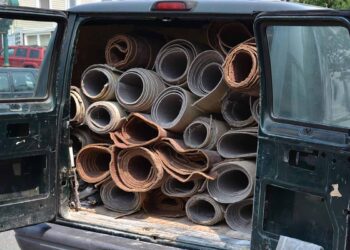
Van filled with rolled carpeting for recycling or disposal.

California carpet recycling rate reaches 37%

byBrian Clark Howard
September 17, 2026

The state’s recycling rate rose for the sixth year in a row, despite challenging market conditions.

Google Pixel 6 phone

Google makes repairability part of design ethos

byBrian Clark Howard
September 16, 2026

The tech titan supports the right-to-repair movement in several key ways.

The barrier isn’t tech. It’s leadership.

The owner should decide: iFixit’s Matt Zieminski on repair

byUriah Kiser, Resource Recycling Podcast
September 15, 2026

On this episode of the Resource Recycling Podcast, Uriah Kiser talks with Matt Zieminski, Vice President of Partnerships at iFixit,...

Report shows $5B in materials saved from landfills

Reinvigorating reuse

byPaul Lane
September 10, 2026

Legislation may help spark renewed interest in reusing consumer items.

Rethinking Europe’s cup-return model for US venues

Rethinking Europe’s cup-return model for US venues

byStefanie Valentic
September 10, 2026

Reusable cup and foodware programs are expanding across US venues, arenas and festivals, but the systems driving them look little...

Load More
Next Post

News from AIMPLAS, REMADE Institute and more

2026 Buyers’ Guide

Equipment, services and technology suppliers serving the recycling industry.

Browse the Guide

More Posts

Intel sign outside of company building.

Intel’s CapEx tops $20B on server demand while PC volume shrinks

July 29, 2026
Ten e-scrap projects receive federal prize funds

Recycling rates for rare earths could double by 2040

July 17, 2026
Feds to develop repairable computer donation program

The whitebox blind spot in PC recycling

April 24, 2026

In other news: May 2, 2016

May 2, 2016

America’s critical-materials buildout has a feedstock problem

September 18, 2026
Data erasure firm expands wearable device capabilities

Apple hits 30% recycled content, debuts new recovery tech

April 17, 2026
E-scrap magnet recycling company scales up

Why only some rare-earth sources are economically viable

September 24, 2026
Textile EPR and the definition of recycling

Textile Exchange reports progress in production

September 22, 2026

Microsoft confirms PC sales slump

August 4, 2026

AI and the changing economics of retired hardware

June 12, 2026
Load More

About & Publications

About Us

Staff

Archive

Magazines

Work With Us

Advertise
Jobs
Contact
Terms and Privacy

Newsletters

Get the latest recycling news and analysis delivered to your inbox every week. Stay ahead on industry trends, policy updates, and insights from programs, processors, and innovators.

Subscribe

Welcome Back!

Login to your account below

Forgotten Password?

Retrieve your password

Please enter your username or email address to reset your password.

Log In

Add New Playlist

No Result
View All Result
  • The Latest
  • Analysis
  • Recycling
  • E-Scrap
  • Plastics
  • Policy Now
  • Conferences
    • E-Scrap Conference
    • Plastics Recycling Conference
    • Resource Recycling Conference
    • Textiles Recovery Summit
  • Magazines
  • About Us
  • Advertise
  • Archive
  • Jobs
  • Staff
Subscribe
This website uses cookies. By continuing to use this website you are giving consent to cookies being used. Visit our Privacy and Cookie Policy.
-
00:00
00:00

Queue

Update Required Flash plugin
-
00:00
00:00