Countries within the OECD have announced how they’ll each enforce new Basel Convention rules. As was foreshadowed by their previous failure to agree on uniform enforcement among all members, there is a fair amount of variance by nation.
All members of the Organisation for Economic Cooperation and Development, a group of 38 countries generally considered to have more advanced economies, were required to report how they’ll interpret the Basel amendment that took effect this month.
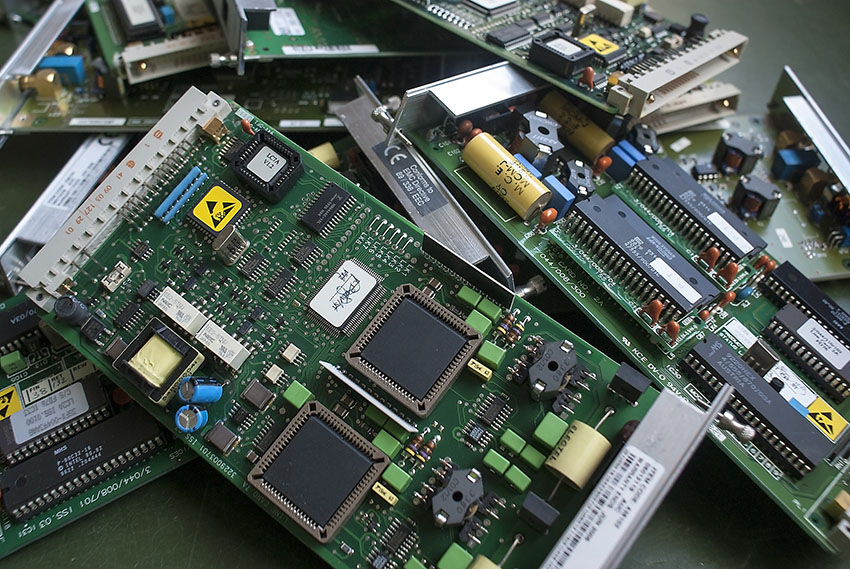
The amendment, approved by Basel parties in 2022, moved a wide array of e-scrap from a category with little regulation to a category requiring exporting companies to notify and receive authorization from relevant authorities in the importing country about what would be shipped, a process called prior-informed consent. Previously, materials such as printed circuit boards and a variety of other electronic components were generally exempt from such regulation.
Under the amendment, virtually all e-scrap is now subject to the prior-informed consent process.
It’s up to each Basel party to enforce the convention’s rules within that country’s domestic regulatory framework. And the convention allows for side agreements between countries that supersede Basel as long as they maintain the minimum environmental standards set out by the convention. The OECD maintains one such side agreement covering all members, theoretically providing simplified trade between OECD nations while upholding environmental standards.
The OECD agreement has historically translated the Basel rules into a list of e-scrap on a “green” list – typically non-hazardous materials presenting low risk and requiring no prior-informed consent – and materials on an “amber” list, requiring more steps including prior-informed consent.
The new Basel amendment was set to automatically incorporate into the OECD agreement, simply moving almost all e-scrap to the “amber” list, which likely would have meant OECD countries could continue trading normally provided they used prior-informed consent for the wider array of e-scrap. However, OECD member Japan objected to the new amendment’s automatic incorporation, preferring an approach that allowed some materials – like circuit boards – to continue being traded between OECD members without the consent process.
The move kicked off a number of meetings in 2023 and 2024 seeking agreement on a single set of rules to cover trade between all OECD countries. No agreement was reached, and OECD last summer announced each country would be on its own to enact the new Basel legislation as it sees fit. Some OECD members might continue to allow circuit boards and other newly covered materials to be traded without prior-informed consent, and others might fully adopt the new Basel rules, OECD wrote.
OECD members had to submit their decisions on what they’ll enforce by Jan. 15.
Five countries said they are not fully implementing the Basel changes, although some said they plan to in the near future:
- Canada wrote it was supportive of the Basel changes but “unable to accept the amendments prior to their entry into force,” echoing a notification the country submitted to the United Nations last fall. The country’s OECD notice added that some e-scrap including circuit boards and display devices “are currently controlled when subject to a transboundary movement under certain conditions,” in accordance with the country’s domestic law. Canada’s position was driven by concern for the effect on domestic industry, a spokesperson told E-Scrap News last month.
- Israel wrote it was unable to accept the amendments before their entry into force, like Canada, but the country’s notice added Israel “is supportive of the Amendments and has begun its domestic procedures to adopt the amendments in domestic legislation. Currently, upon request of the prospective States of import and transit, Israeli Authorities issue prior informed consent notifications to exporters of e-waste according to the Amendments.”
- Japan, which submitted the original OECD objection, wrote that it is maintaining the previous “green” list rules under the former OECD agreement, allowing materials like circuit boards to continue to be shipped from OECD countries to Japan without prior-informed consent.
- New Zealand wrote it is unable to accept the e-scrap amendments before their entry into force this month, but that it is supportive and has begun domestic rulemaking to incorporate the new rules.
- The U.S. – which is not a party to the Basel Convention – is requiring prior-informed consent for certain e-scrap that is considered hazardous waste under both Basel guidelines and the Resource Conservation and Recovery Act, RCRA. But e-scrap that was previously on the “green” list, as well as any other e-scrap that is not considered inherently hazardous, will not require prior-informed consent by U.S. law.
All other countries said they are fully adopting the rules in line with their Basel commitments, although some are allowing a longer phase-in period:
- Costa Rica wrote it will require the prior-informed consent procedure for all e-scrap in accordance with the new Basel amendment.
- Mexico wrote that it is fully implementing the new Basel rules for all countries, requiring prior-informed consent for the wider array of e-scrap, but that it is implementing the rules gradually throughout the first quarter of 2025.
- Switzerland wrote that it is fully implementing the new Basel rules for all countries, requiring prior-informed consent for the wider array of e-scrap.
- In the U.K., England, Scotland and Wales are fully implementing the new Basel rules for all countries, requiring prior-informed consent for the wider array of e-scrap. Northern Ireland is requiring prior-informed consent for e-scrap traded with non-European Union OECD members. The country is allowing e-scrap on the previous “green” list to continue being traded with EU member states without prior-informed consent until Dec. 31, 2026, but then it will require prior-informed consent in line with the new Basel rules. The country is prohibiting shipments of e-scrap to countries that are both non-EU and non-OECD.
- The European Union wrote that exports of all e-scrap from EU members to non-EU OECD members will require prior-informed consent. Exports to non-EU, non-OECD countries are prohibited. Imports of e-scrap into any EU member state from any other non-EU country requires prior-informed consent. However, the EU will allow e-scrap on the previous “green” list to be traded between EU member states without prior-informed consent until the end of 2026, allowing a phase-out period.