Resource Recycling
  • The Latest
  • Analysis
    • All
    • Certification Scorecard
    • Industry Announcements
    • Opinion
    NJ’s PCR delay risks making its own excuse permanently true

    NJ’s PCR delay risks making its own excuse permanently true

    E-scrap magnet recycling company scales up

    Why only some rare-earth sources are economically viable

    e-Stewards to develop an ITAD-specific standard

    Certification scorecard — week of Sept. 21

    Who should pay for lithium-ion battery fire damage?

    America’s critical-materials buildout has a feedstock problem

    Certification scorecard – week of Sept. 14

  • Conferences
    • Resource Recycling Conference
    • Plastics Recycling Conference
    • E-Scrap: The Longevity Conference
    • Textiles Recovery Summit
  • Publications
    • E-Scrap News
    • Plastics Recycling Update
    • Policy Now
    • Resource Recycling
    • Other Topics
      • All Topics
      • Brand Owners
      • Critical Minerals
      • Glass
      • Grant Watch / RFPs
      • Markets
      • Organics
      • Packaging
      • Research
      • Technology
      • Textiles
Subscribe
No Result
View All Result
Resource Recycling
No Result
View All Result
Home Plastics

Group issues roadmap to health care plastics recycling

byJared Paben
February 20, 2019
in Plastics
Group issues roadmap to health care plastics recycling

This is just what the doctor (and the plastics reclaimer) ordered: a guide that lays out the value of resins recovered from hospitals.

The Healthcare Plastics Recycling Council (HPRC) in January released its manual for plastics reclaimers, covering common types of noninfectious plastic scrap generated in clinical settings. It also details processing strategies, potential end markets and more.

U.S. hospitals and clinics generate about 1 million tons of clean, noninfectious plastic scrap each year, according to HPRC. “While the potential of this largely untapped waste stream is obvious, how to access this waste stream can be less clear,” the group noted.

The following are some of the most common types of scrap plastics from health care settings:

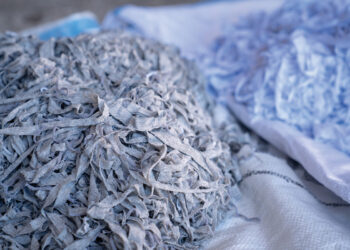
  • Sterilization wrap (often called blue wrap): This is a nonwoven PP wrap that protects surgical instruments from contamination during and after sterilization. Roughly 255 million pounds are sold to the healthcare industry annually. “It is a non-woven material and processes exceptionally well on densification lines with continuous melt filtration,” according to the report. With a MFI of 40, PP compounders use it to raise melt on their lower-MFI feed streams.
  • Irrigation bottles: These are PP or HDPE bottles, with PP caps, that hold saline solution. Label adhesives are commonly water-based. They’re natural in color. They’re best processed via grinding, washing and melt filtering to remove paper labels. The HDPE is commonly used in irrigation pipes, trays, slip sheets and railroad ties.
  • Pitchers, basins and cups: These are typically made from homopolymer PP and are most often white, gray, tan, pink or blue. They are injection grade with an MFI of 12 to 30. “This material can be used as a feedstock for compounders and injection molders for products ranging from parts to bins,” the guide states.
  • Trays: Used to hold instruments for sterilization and distributions, trays are made from PETG or HIPS and are commonly sealed with DuPont’s Tyvek-brand HDPE packaging. Extrusion-grade HIPS is commonly white, and once ground it has robust markets, including in horticultural trays and pots, points of purchase displays and sheets, the guide notes. PETG is known for its chemical and heat resistance, impact strength and clarity. “In regrind form, PETG is used in fiber, non-FDA packaging, and chemical recovery of PTA (purified terephthalic acid) and MEG (mono ethylene glycol),” the guide states.
  • Other flexibles (nonwoven and film): Flexible packaging is found in several areas and runs the gamut from single-layer LDPE films to multi-layered materials made of polyester, nylon and other plastics. To process them, densification and pelletization are required. “When flexible plastics of different densities or materials are combined, compatibilizers may be used to improve product performance, which will increase utilization and value,” according to the guide. Paper labels are often present. End markets include lawn edging, pipe, roofing and plastic lumber, according to HPRC.

HPRC last year coordinated a project testing the ability of compatibilizers to boost the quality of recycled multi-material flexible health care packaging.

The guide also touched on contamination and the fear the recyclables will be contaminated with infectious materials, hazardous chemical or medications, or sharps. The largest source of plastic recyclables is operating rooms, and a common approach to minimizing the potential for contamination is to collect them “pre-case,” meaning before the patient is brought in, the document noted.

HPRC also stressed the importance of working with hospital representatives – often environmental services staff, or EVS for short – to set up processes to ensure hazardous materials are kept out of the recyclables stream.

HPRC’s members are Baxter, BD, Cardinal Health, DuPont, Eastman, Johnson & Johnson, Medtronic, Nelipak, Ravago and Thermo Fisher Scientific.

Photo credit: By Senkumar Alfred/Shutterstock

To receive the latest news and analysis about plastics recycling technologies, sign up now for our free monthly Plastics Recycling Update: Technology Edition e-newsletter.
 

Plastics Recycling Conference

Tags: Hard-to-Recycle MaterialsIndustry GroupsProcessorsResearchTechnology
TweetShare
Jared Paben

Jared Paben

Related Posts

Analysis: Undersupply of PCR is ‘stifling’ brand goals

US lawmakers urge protection of domestic RPET

byAntoinette Smith
September 25, 2026

In a letter to the US Trade Representative, five representatives asked the USTR to consider trade remedies and support verification...

Oregon state capitol building with state flag and blue sky.

NAW appeals Oregon EPR ruling

byStefanie Valentic
September 25, 2026

NAW is challenging an Oregon judge's ruling in favor of the state's extended producer responsibility law.

Cutting healthcare plastics could save $18B

Report provides path to reduce medical e-scrap

byPaul Lane
September 25, 2026

The European report found that circularity in medical devices is possible through several potential initiatives.

APR reports success for 2026 recycling tours 

APR reports success for 2026 recycling tours 

byAntoinette Smith
September 23, 2026

In May, more than 2,500 visitors toured 41 facilities in the US and Mexico, during APR's second annual Recycling in...

Recyclers reeling from NJ PCR extension

Recyclers reeling from NJ PCR extension

byAntoinette Smith
September 23, 2026

The recent three-year extension for exemptions to the state's PCR mandates elicited frustration and confusion among recyclers.

Textile EPR and the definition of recycling

Textile Exchange reports progress in production

byPaul Lane
September 22, 2026

The organization said the industry has made some sustainability progress, but there’s much room for improvement.

Load More
Next Post

SEC: Company lied about recycled product quality

2026 Buyers’ Guide

Equipment, services and technology suppliers serving the recycling industry.

Browse the Guide

More Posts

Intel sign outside of company building.

Intel’s CapEx tops $20B on server demand while PC volume shrinks

July 29, 2026
Textile EPR and the definition of recycling

Textile Exchange reports progress in production

September 22, 2026

In other news: May 2, 2016

May 2, 2016

America’s critical-materials buildout has a feedstock problem

September 18, 2026
E-scrap magnet recycling company scales up

Why only some rare-earth sources are economically viable

September 24, 2026

AI and the changing economics of retired hardware

June 12, 2026
NJ’s PCR delay risks making its own excuse permanently true

NJ’s PCR delay risks making its own excuse permanently true

September 28, 2026
Ten e-scrap projects receive federal prize funds

Recycling rates for rare earths could double by 2040

July 17, 2026
Closeup of a printed circuitboard

Hardware demand puts new focus on parts harvesting

June 5, 2026
Feds to develop repairable computer donation program

The whitebox blind spot in PC recycling

April 24, 2026
Load More

About & Publications

About Us

Staff

Archive

Magazines

Work With Us

Advertise
Jobs
Contact
Terms and Privacy

Newsletters

Get the latest recycling news and analysis delivered to your inbox every week. Stay ahead on industry trends, policy updates, and insights from programs, processors, and innovators.

Subscribe

Welcome Back!

Login to your account below

Forgotten Password?

Retrieve your password

Please enter your username or email address to reset your password.

Log In

Add New Playlist

No Result
View All Result
  • The Latest
  • Analysis
  • Recycling
  • E-Scrap
  • Plastics
  • Policy Now
  • Conferences
    • E-Scrap Conference
    • Plastics Recycling Conference
    • Resource Recycling Conference
    • Textiles Recovery Summit
  • Magazines
  • About Us
  • Advertise
  • Archive
  • Jobs
  • Staff
Subscribe
This website uses cookies. By continuing to use this website you are giving consent to cookies being used. Visit our Privacy and Cookie Policy.
-
00:00
00:00

Queue

Update Required Flash plugin
-
00:00
00:00